
Green-Wood Cemetery
500 25th St, Brooklyn, NY
Brooklyn, NY
A rolling, tree-shaded landscape of hills, ponds, and grand monuments that was one of America's first great public parks, drawing crowds long before Central Park existed.
Green-Wood Cemetery in Brooklyn is one of the great landscapes of 19th-century America, a sweeping garden cemetery of rolling hills, ponds, winding lanes, and towering trees laid out beginning in 1838. In an era before public parks, places like Green-Wood served as the city's green retreats, and by the mid-1800s it was one of the most visited attractions in the country, drawing crowds who came simply to stroll and admire the scenery.
It is still a working cemetery and a National Historic Landmark, the resting place of hundreds of thousands of New Yorkers, from the famous to the forgotten. Its high ground, Battle Hill, was the site of fighting in the Revolution and is among the highest points in Brooklyn, offering a striking view across the harbor toward the towers of Lower Manhattan.
What Travelers Love
- A hilly, tree-filled landscape that feels like a great park, laced with winding paths
- The view from Battle Hill toward Lower Manhattan and the harbor
- The soaring Gothic entrance gate, home to a colony of wild monk parakeets
- Grand Victorian monuments and the graves of famous New Yorkers across the centuries
Worth Knowing
- This is an active cemetery and a place of mourning, so visit quietly and respectfully
- The grounds are hilly and large, so wear good walking shoes and allow plenty of time
- Guided walking and trolley tours run on a schedule; check ahead if you want one
- The site welcomes visitors during posted hours; stay on paths and roads and keep noise down
Learn about Green-Wood Cemetery
The rural cemetery and the birth of the public park
Green-Wood was founded in 1838 as one of America's first rural, or garden, cemeteries, part of a movement that rejected the crowded, grim churchyards of the past in favor of spacious, beautifully landscaped grounds set on the edge of the growing city. Its designers used the natural glacial hills and hollows of the site to create a picturesque landscape of curving drives, plantings, and vistas.
The idea proved wildly popular. By the 1850s Green-Wood had become one of the most-visited places in the nation, with families arriving to picnic, promenade, and take in the scenery. Its success helped inspire the movement for public parks, and the men who later designed Central Park and Prospect Park drew directly on the example of landscapes like this one. In a real sense, the American public park grew out of the garden cemetery.
Battle Hill and the Revolution
The cemetery's highest point, Battle Hill, saw hard fighting in August 1776 during the Battle of Brooklyn, the first major battle after the Declaration of Independence and the largest of the entire war. American troops fought a delaying action across these heights as the far larger British army advanced, and though the Americans were driven back, the stand helped Washington's army escape to fight another day.
Today a statue of Minerva stands atop Battle Hill, raised to mark the battle and positioned to gaze out toward the Statue of Liberty in the harbor. From this high ground the view stretches across Brooklyn and the water to the skyline of Lower Manhattan, a reminder that this quiet ridge was once a battlefield at the birth of the nation.
Monuments and the people who rest here
Green-Wood is an open-air museum of 19th and early 20th-century monument art, from soaring Gothic spires and marble angels to elaborate family mausoleums built like miniature temples. The grand entrance gate itself is a masterpiece of Gothic Revival design, its brownstone pinnacles rising over the main gate.
Beneath the monuments lie generations of New Yorkers, among them inventors, artists, politicians, tycoons, musicians, and countless ordinary citizens whose lives made the city. The composer and bandleader whose music defined an era, painters, a famous inventor of the telegraph, baseball pioneers, and Civil War soldiers all rest here. Walking the grounds is a way to read the whole social history of New York carved in stone.
A green refuge and its wildlife
Beyond its history, Green-Wood is one of the largest green spaces in Brooklyn, and it has become an accidental sanctuary for wildlife in the heart of the city. Its old trees, ponds, and quiet hills draw an astonishing variety of birds, and it is a well-known spot for birdwatchers, especially during spring and fall migration when warblers, hawks, and waterfowl pass through.
The most famous residents are the wild monk parakeets, bright green birds descended from escaped pets, who have built their bulky stick nests in the towers of the Gothic entrance gate for decades. Turtles bask in the ponds, and the flowering trees put on a show each spring. For a city cemetery, it is remarkably full of life, a hushed, living landscape wrapped around its monuments and memory.
Closest Boutels
The closest Boutel™ stays, so you can turn this stop into an overnight. Each is a place we chose through independent editorial review, never a paid placement.
Details
Brooklyn, NY
Frequently asked questions
What is Green-Wood Cemetery?
Green-Wood is a historic garden cemetery in Brooklyn founded in the 1830s, a National Historic Landmark spread across hundreds of acres of rolling, glacially sculpted hills, ponds, and grand old trees. Famous for its elaborate Victorian monuments, mausoleums, and its soaring Gothic entrance gate, it is also an accredited arboretum and a beloved green space, drawing history lovers, art fans, birders, and walkers alike.
What can you see at Green-Wood Cemetery?
Highlights include Battle Hill, the highest point in Brooklyn and a site of the Revolutionary War Battle of Brooklyn, with skyline and harbor views, the striking Gothic gate where wild monk parakeets famously nest, and the resting places of many notable figures, from composer Leonard Bernstein to artist Jean-Michel Basquiat and glassmaker Louis Comfort Tiffany. The winding paths, statuary, and seasonal blooms make it a place to wander slowly.
Can you visit and tour Green-Wood Cemetery?
Yes, it welcomes respectful visitors for walking, and it offers guided walking and trolley tours that explore its history, art, and famous residents, along with birding walks and cultural events. General entry for a self-guided stroll is free. Checking the current hours and tour schedule in advance is worthwhile, especially if you want to join a tour and learn the stories behind the monuments.
What etiquette should I follow at Green-Wood?
Remember it is an active cemetery, so visit with respect: keep your voice down, stay on the roads and paths, do not touch, lean on, or climb monuments, and give space to any funerals or mourners you encounter. Avoid picnicking on graves and follow posted rules, which may limit certain activities or commercial photography. Treated with care, it is a moving and beautiful place to spend a quiet few hours.
When is the best time to visit Green-Wood Cemetery?
Spring and fall are especially beautiful, with blossoms or brilliant foliage across the rolling grounds, and daytime visits let you take in the monuments and views at their best. The parakeets around the gate are a year-round delight. Weekdays are quietest. It pairs well with exploring the surrounding Brooklyn neighborhoods, so you can easily fold a visit into a fuller day in the borough.
Nearby

Federal Hall
3.5 miles away
The Wall Street site where the United States first governed itself: George Washington took the oath as the first President here in 1789, and the first Congress met and the Bill of Rights took shape he...

Ellis Island
3.7 miles away
People make for the Statue of Liberty and sometimes skip the island next to it, which for many families is the more personal stop.

Liberty State Park
4.6 miles away
It is a city park, but Liberty State Park also protects a genuine slice of Hudson estuary nature reclaimed from an old rail yard.

Liberty Science Center
4.7 miles away
This is a full-day kid magnet at the edge of Liberty State Park.

Little Island
5.9 miles away
A small, whimsical public park that floats above the Hudson River off the West Side of Manhattan, built on a cluster of tulip-shaped concrete columns that rise from the water to hold up an undulating...
The High Line
6.3 miles away
The High Line took an abandoned elevated freight rail line, left to weeds for twenty years, and kept the idea of that wild meadow when it became a park.
American Museum of Natural History
8.6 miles away
This is a full day for kids of almost any age. The dinosaur halls on the top floor are the draw, with real fossil mounts including a Titanosaur so long its head reaches into the hallway, and kids can...

Central Park
8.8 miles away
It is easy to forget that Central Park is entirely artificial, a landscape sculpted from swamp and bare schist in the 1850s so completely that it now reads as natural.

The Panorama of the City of New York
9.9 miles away
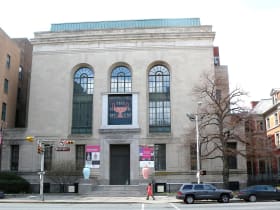
This is one of the great overlooked wonders of the city, tucked in a museum most tourists skip.
Newark Museum of Art
11 miles away
Many people are surprised the largest and one of the finest art museums in New Jersey sits in downtown Newark.

Branch Brook Park Cherry Blossoms
12 miles away
In cherry-blossom season this is one of the prettiest outdoor stops in the region, and the scale amazes kids: more than 5,000 flowering trees, the largest such collection in the country, larger than W...
Sandy Hook Lighthouse
14 miles away
History that kids can climb. Sandy Hook Lighthouse, lit in 1764, is the oldest working lighthouse in the country, and rangers lead tours up the tower on a seasonal schedule, best for ages 5 and up who...

The Bronx Zoo
15 miles away
At 265 acres this is a big day, so plan a route. Kids gravitate to the Congo Gorilla Forest, a walk-through rainforest where you come face to face with a gorilla troop through the glass, and the Wild...
The Cloisters
15 miles away
Most first-time visitors never make it this far uptown, which is exactly why the Cloisters feels like a secret.

Montclair Art Museum
16 miles away
Tucked in the leafy suburb of Montclair, this is a quietly excellent art museum most out-of-towners never hear about.
City Island
17 miles away
People are always surprised this is legally part of New York City.