
Grand Coulee Dam Visitor Center
WA-155
Coulee Dam, WA
The free visitor center at the foot of the biggest concrete structure in America, where a summer laser show turns the mile-long dam into a glowing screen after dark.
Some sights impress you with beauty and some with sheer scale. Grand Coulee Dam is the second kind. Nearly a mile long and taller than a fifty-story building, it holds three times as much concrete as Hoover Dam and stands as the largest concrete structure and the largest hydroelectric plant in the United States. Its free federal visitor center, at the foot of the dam in the little town of Coulee Dam, is the place to take the whole thing in.
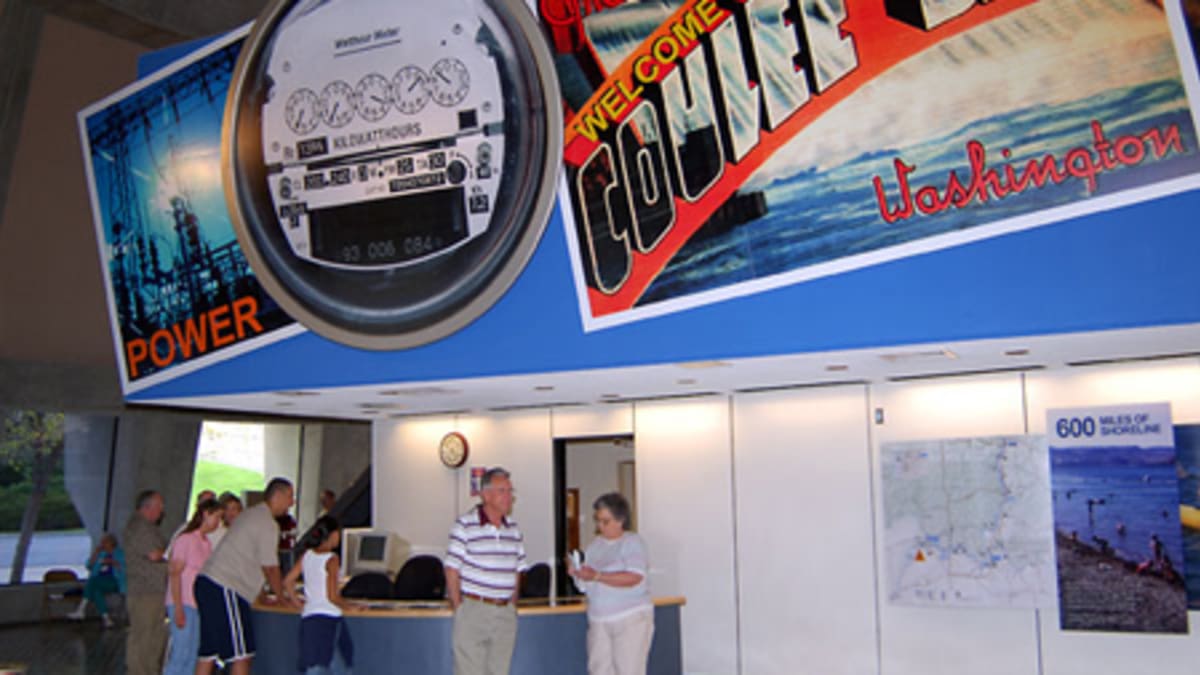
The visitor center itself is worth a look: a striking 1970s building designed to echo the shape of a generator rotor, filled with exhibits that explain how the dam was built during the Great Depression, how it waters over a million acres of the Columbia Basin, and how its power helped win a world war. Then, on summer nights, the dam becomes a spectacle of a different kind, when one of the largest laser light shows in the world plays across its enormous face.
What Travelers Love
- Standing at the foot of the largest concrete structure in the United States, nearly a mile long
- A free, well-done visitor center with exhibits on the dam, the river, and the Columbia Basin
- The nightly summer laser light show projected across the vast face of the spillway after dark
- The sheer scale of it all, three times the concrete of Hoover Dam, right in front of you
Worth Knowing
- Both the visitor center and the laser light show are free, run by the federal Bureau of Reclamation
- The laser show runs nightly only in the warm months, roughly Memorial Day weekend into fall, and starts after full dark
- The building is easy to reach on Highway 155 with parking on site, so no rough roads are involved
- Bring a jacket for the evening show; nights in the high, dry basin can cool off quickly even in summer
Learn about Grand Coulee Dam Visitor Center
A Depression-era wonder on the Columbia
Grand Coulee Dam was born of the Great Depression, a New Deal public-works project of almost unimaginable ambition. The first stake was driven in 1933, and over nine years thousands of workers poured concrete around the clock to raise a barrier across the Columbia River. The main structure and power plant were finished in 1941, just as the country was about to need every kilowatt it could make.
The numbers are hard to grasp standing at the base. The dam runs about 5,223 feet from end to end, just shy of a mile, rises some 550 feet, and contains nearly twelve million cubic yards of concrete, roughly three times what went into Hoover Dam. It backs the Columbia up into Lake Roosevelt, a reservoir stretching more than a hundred miles toward the Canadian border.
Its purpose was twofold: power and water. During World War II the dam's abundant, cheap electricity fueled the aluminum plants and shipyards of the Pacific Northwest and the secret work at Hanford, and its irrigation network eventually turned a vast stretch of arid basin into productive farmland. It remains one of the most important pieces of infrastructure ever built in the American West.
The visitor center and the laser show
The visitor center that helps you make sense of all this is a landmark in its own right. Built in the late 1970s to a design by the noted architect Marcel Breuer, its curving concrete form was meant to suggest a generator rotor, and inside you will find films, models, and exhibits on the dam's construction, its role in the Columbia Basin Project, and the river and its history. Admission is free, and it is the natural first stop before you take in the dam itself.
After dark in the summer months comes the show that draws many people here. Since 1989 the Bureau of Reclamation has projected a free nightly laser light show across the downstream face of the dam, using the mile-long spillway as an enormous screen. The current program, running colorful lasers and imagery in time with a narrated story of the river and the region, replaced an earlier show and remains a genuine crowd-pleaser.
There is something surreal about watching beams of light dance across a wall of concrete nearly a mile wide, out in the quiet, dark country of eastern Washington. It is the kind of only-here experience that turns a highway stop into a memory, and because both the center and the show cost nothing, it is one of the best free evenings on the road in the state.
Visiting Grand Coulee Dam
The visitor center sits right on Highway 155 at the base of the dam in the town of Coulee Dam, with parking on site and easy access, no gravel or backroads required. Plan to spend an hour or so in the exhibits and out on the overlook areas taking in the scale of the structure, and check whether guided tours or overlooks up top are open when you visit, as access can change.
If you can, time your stop to stay for the laser light show, which runs nightly through the warm season and begins after full dark. Bring a jacket, since summer nights in the high desert basin cool off fast, and settle in to watch the giant dam light up. Between the daytime spectacle of the structure itself and the nighttime spectacle of the lasers, Grand Coulee earns its place as one of the great engineering sights of the West.
Closest Boutels
The closest Boutel™ stays, so you can turn this stop into an overnight. Each is a place we chose through independent editorial review, never a paid placement.
Details
Coulee Dam, WA
Frequently asked questions
What is the Grand Coulee Dam Visitor Center?
The Grand Coulee Dam Visitor Center, in eastern Washington, is the main visitor facility for the massive Grand Coulee Dam, one of the largest concrete structures in the world and a major hydroelectric power producer on the Columbia River. The center offers exhibits on the dam's construction, engineering, and history, the Columbia River, and the region, along with information, films, and views of the enormous dam. It is also the place to learn about the famous summer laser light show projected onto the dam. Providing fascinating context on this engineering marvel, the Grand Coulee Dam Visitor Center enhances a visit to the awe-inspiring dam in eastern Washington.
What can you do at the Grand Coulee Dam Visitor Center?
You can explore exhibits on the construction, engineering, and history of the Grand Coulee Dam, learn about the Columbia River and the dam's role in power and irrigation, watch informative films, take in views of the enormous dam, get information about the area, and find out about the famous summer laser light show projected onto the dam at night. The center provides fascinating context on the massive structure. It is a great starting point for appreciating the dam. With its exhibits, films, and information on the Grand Coulee Dam, the visitor center offers an educational and enriching stop in eastern Washington.
Can you tour the Grand Coulee Dam?
The visitor center is the place to learn about any dam tours, which have historically been offered to let visitors see parts of the dam and its power-generating facilities up close, though tour availability, routes, and security requirements can change over time. Checking the current tour offerings and any requirements at the visitor center or ahead of your visit is the best way to find out what is available. Even without a tour, the visitor center's exhibits, films, and viewpoints let you appreciate the dam's staggering scale and history, making it a rewarding stop whether or not tours are running.
When is the best time to visit the Grand Coulee Dam Visitor Center?
The visitor center is enjoyable year-round as an indoor facility, though summer is especially popular, coinciding with the famous evening laser light show and pleasant weather, while the center provides a cool refuge on hot summer days. Checking current hours before you go is wise, as they can vary seasonally, with extended hours often in summer for the light show. For the full experience including the laser show, aim for a summer visit, while the visitor center's exhibits make it a worthwhile and educational stop any time of year at the Grand Coulee Dam.
What is near the Grand Coulee Dam Visitor Center?
The Grand Coulee Dam Visitor Center is in eastern Washington by the massive Grand Coulee Dam, near the Grand Coulee Dam Overlook, the town of Grand Coulee, the vast Lake Roosevelt National Recreation Area behind the dam, Banks Lake, and the dramatic Dry Falls and Channeled Scablands to the south. That makes the Grand Coulee Dam Visitor Center an educational stop to combine with the dam overlook, Lake Roosevelt, Dry Falls, and the other attractions of eastern Washington on a visit to the state.
Nearby
Grand Coulee Dam Overlook
1.9 miles away
The overlook and visitor center sit just off SR-155 on the west side of the dam near the town of Coulee Dam.
Banks Lake
9.2 miles away
A 27-mile reservoir filling the Ice-Age-carved Grand Coulee just south of Coulee Dam, guarded by the huge basalt butte of Steamboat Rock.
Lake Roosevelt National Recreation Area
27 miles away
A 130-mile lake held behind Grand Coulee Dam, the largest concrete structure in North America, winding through eastern Washington's open Columbia country.