
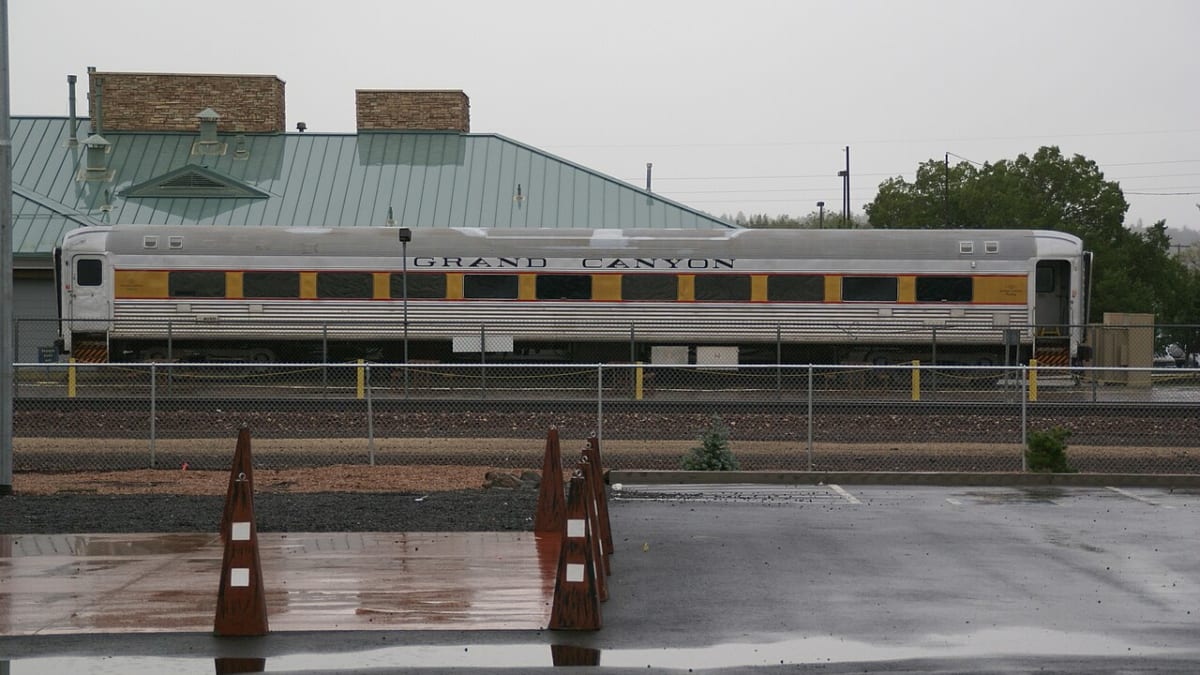
Grand Canyon Railway Depot
233 N Grand Canyon Blvd
Williams, AZ
A dignified 1908 Santa Fe depot and Harvey House on Route 66, Arizona's oldest poured-concrete building, still sending trains north to the Grand Canyon rim.
At the foot of Williams' Route 66 main street, where the neon and the diners give way to a curve of steel rail, stands a low, solid depot that has watched travelers head for the Grand Canyon for more than a century. Built by the Santa Fe Railway in 1908, it is the southern anchor of the line that carries visitors up to the South Rim, and it holds a quiet distinction: it is the oldest poured-concrete building in the state of Arizona.
The depot is more than a place to catch a train. It was built together with a Fray Marcos Harvey House, part of the famous chain of trackside hotels and restaurants that civilized rail travel across the Southwest. Listed on the National Register of Historic Places, it has survived the rise and fall and revival of the Grand Canyon Railway, and today it still hums with the same purpose it was built for: sending people north to one of the wonders of the world.
What Travelers Love
- A handsome, low-slung 1908 depot and Harvey House with real Santa Fe railroad character
- Its place in history as the oldest poured-concrete building in Arizona
- Walking the platform and grounds where trains still depart north toward the Grand Canyon
- The setting at the head of Williams' Route 66 main street, easy to pair with the town
Worth Knowing
- The depot is a working station, so parts of it serve the railway and hotel; the grounds and platform are the main free things to see
- It sits right in downtown Williams, so parking and food are close and no long detour is needed
- Trains north to the canyon run on a schedule that changes by season, so check ahead if you hope to see a departure
- The building is historic, so admire the architecture and read the markers, and be mindful of active tracks
Learn about Grand Canyon Railway Depot
A depot built for the canyon trade
Williams owes its life to the railroad. When the Atlantic and Pacific, later folded into the Santa Fe, pushed its transcontinental main line across northern Arizona in the 1880s, Williams became a division town and a jumping-off point for the Grand Canyon. In 1901 the Santa Fe completed a branch line north from Williams to the South Rim, and suddenly reaching the canyon meant a comfortable train ride rather than a long, jolting stagecoach haul.
To serve the growing tide of canyon-bound travelers, the Santa Fe built a new depot in Williams in 1908. Rather than the usual wood-frame station, the railroad chose poured concrete, a modern and fireproof choice for the era, and the result is now recognized as the oldest surviving poured-concrete building in Arizona. Its long, low lines and deep eaves are classic Santa Fe, built to shelter passengers stepping down onto the platform in high-country sun and snow.
The Fray Marcos and the Harvey House era
Attached to the depot was the Fray Marcos Hotel, one of the Fred Harvey Company's Harvey Houses, named for the Spanish friar Marcos de Niza. The Harvey Houses were legendary along the Santa Fe: clean, elegant trackside hotels and restaurants staffed by the famous Harvey Girls, they brought good food and good manners to a rough frontier and made rail travel across the Southwest a genuine pleasure.
For decades the depot and its Harvey House were the front door to the Grand Canyon for travelers from Chicago, Los Angeles, and everywhere between. But the automobile age slowly drained the railroads, and passenger service on the canyon branch ended in 1968, leaving the historic depot quiet and the line's future in doubt.
The story did not end there. In 1989 the Grand Canyon Railway was revived, and the old depot came back to life as the departure point for excursion trains once more climbing the sixty-plus miles to the South Rim. A newer Fray Marcos hotel now stands nearby, and the 1908 building serves travelers again, a rare case of a historic station saved and put back to its original work.
Visiting the depot and Williams
The depot sits right at the base of Grand Canyon Boulevard in downtown Williams, so it is an easy stop rather than a detour. You can walk the grounds and platform for free, take in the architecture, read the markers on the building's history, and, if the timing is right, watch a train pull out for the rim, sometimes preceded by a bit of Old West showmanship on the platform.
Pair the depot with the town it anchors. Williams calls itself the gateway to the Grand Canyon and wears its Route 66 heritage proudly, with a compact main street of vintage motels, neon signs, diners, and shops just steps from the tracks. It makes a natural base for the canyon: you can drive the hour north to the South Rim, or leave the car and let the historic railway carry you there from the very depot the Santa Fe built in 1908.
Closest Boutels
The closest Boutel™ stays, so you can turn this stop into an overnight. Each is a place we chose through independent editorial review, never a paid placement.
Lantern Light Inn & Wedding Gardens
Boutel+3085 W State Rte 89A, Sedona, AZ
34 miles away|Learn More ›
The Iron Horse Inn
Boutel1034 N Main St, Cottonwood, AZ 86326, Cottonwood, AZ
36 miles away|Learn More ›
Details
Williams, AZ
Frequently asked questions
What is the Grand Canyon Railway Depot?
The Grand Canyon Railway Depot, in Williams, Arizona, is the historic station from which the Grand Canyon Railway carries passengers on a scenic journey to the South Rim of the Grand Canyon. Housed in a handsome early-twentieth-century depot, it is the starting point for a beloved train excursion that recreates the classic way travelers once reached the canyon. With its vintage charm, historic significance, and role in offering a relaxing, car-free trip to one of the world's great natural wonders, the depot is a delightful piece of Route 66 and railroad history.
Where does the Grand Canyon Railway go?
The Grand Canyon Railway travels from the historic depot in Williams north to the South Rim of Grand Canyon National Park, a scenic ride of a couple of hours each way through high desert, prairie, and pine forest, arriving at the historic depot in Grand Canyon Village near the rim. Passengers can spend time at the canyon before the return trip. The excursion offers a relaxing, nostalgic, and traffic-free alternative to driving, complete with entertainment, making the journey itself part of the Grand Canyon experience.
What is the Grand Canyon Railway experience like?
The experience blends scenic travel with entertainment, as passengers ride in restored vintage-style cars, from coach to premium classes, enjoy narration and often musicians or costumed characters, and take in the changing landscape on the way to the canyon. Playful touches like a mock Old West train robbery add fun, especially for families. At the South Rim, there is time to see the canyon before returning. The relaxing, festive ride makes reaching the Grand Canyon a memorable adventure in itself rather than just transportation.
When is the best time to ride the Grand Canyon Railway?
The railway runs year-round, with late spring through fall offering pleasant weather for enjoying both the ride and time at the South Rim, and winter bringing snowy scenery and the hugely popular Polar Express holiday trains, a festive family favorite. Because trips, especially the holiday trains and premium classes, are popular and can sell out, booking tickets in advance is recommended. Checking the current schedule before you go helps you plan, whether for a scenic canyon trip or a seasonal holiday excursion.
What is near the Grand Canyon Railway Depot?
The depot is in downtown Williams, steps from the town's nostalgic Route 66 shops, diners, and saloons and the Bearizona wildlife park, with the Grand Canyon's South Rim reachable by the railway or car, Flagstaff a short drive east, and the Route 66 town of Seligman to the west. That makes the Grand Canyon Railway Depot a historic and convenient centerpiece to combine with Williams' Route 66 charm, the Grand Canyon, and the attractions of northern Arizona along the Mother Road.
Nearby
Red Garter Bed and Bakery
0.1 miles away
The Red Garter is an 1897 building on Williams' Saloon Row that was a saloon and "sporting house" (brothel) through the 1940s.

Sycamore Canyon Wilderness
22 miles away
Sycamore Canyon is a 21-mile wilderness canyon with a perennial creek, sycamore-cottonwood gallery forest, and red rock walls.
Palatki Heritage Site, Sedona area
26 miles away
Palatki has two adjacent sites: a Sinagua cliff dwelling occupied 1150-1350 CE, and a shelter with 6,000 years of painted pictographs in overlapping layers.
Red Rock Scenic Byway
38 miles away
Red Rock Scenic Byway follows AZ-179 for about seven miles between the Village of Oak Creek and Sedona, threading past some of the most photographed red rock in the Southwest.

Grand Canyon National Park
56 miles away
A mile deep and up to 18 miles wide, revealing nearly two billion years of Earth's history in its walls.