
Fort Vancouver National Historic Site
1501 E Evergreen Blvd
Vancouver, WA
A rebuilt frontier fort on its original ground, where a fur-trade empire, a dozen cultures, and the future of the Northwest all met.
Fort Vancouver was, for a couple of crucial decades, the most important place in the Pacific Northwest. Built by the Hudson's Bay Company in the mid-1820s as the headquarters of its vast fur-trading operation, it was part trading post, part farm, part factory, and part capital, controlling commerce across a territory that stretched for hundreds of miles.
Today the National Park Service has reconstructed the stockade and many of its buildings on the original ground, so you can walk through the fort as it was. Around it lie the traces of everything that came after: a diverse workers' Village, a United States Army post, and a graceful row of officers' houses.
What Travelers Love
- Walking inside the reconstructed stockade and buildings on the fort's original site
- Living-history demonstrations of blacksmithing, baking, and the fur trade
- The story of the Village, one of the most diverse communities in the early Northwest
- Strolling Officers Row and the historic army barracks that grew up next to the old fort
Worth Knowing
- The reconstructed fort buildings and some sites keep regular hours and may charge admission, while the grounds are open more broadly
- It is a working history site, so the best experience comes on days with costumed interpreters and demonstrations; check the schedule
- The site spreads out across fort, Village, army post, and airfield, so give it real time to see well
- The fort's story is one of empire and trade, and it also carries the harder history of disease and displacement for the region's Native peoples
Learn about Fort Vancouver National Historic Site
The headquarters of a fur empire
In the 1820s the Hudson's Bay Company moved its regional operations to this spot on the Columbia and built Fort Vancouver, making it the nerve center of the fur trade across a huge swath of the West. From behind its stockade, the company ran trapping brigades, shipped furs to Britain, and supplied its network of far-flung posts.
The commanding figure was the Chief Factor, Dr. John McLoughlin, a towering, white-haired man who ran the fort for years and became so influential in the region's early days that he is sometimes remembered as the Father of Oregon. Under his direction the fort was not just a trading counter but a farm, a shipyard, a sawmill, and a school of frontier commerce.
The Village
Just outside the stockade stood the Village, home to the fort's workers, and it was one of the most diverse communities in North America at the time. Hawaiians, French Canadians, Iroquois and other Native people from the east, Scots, and members of local tribes lived and worked side by side, speaking many languages and blending their foodways and traditions.
The park works hard to tell that fuller story, because the fort's history is not only the story of the company officers but of the many peoples whose labor made it run. Archaeology of the Village continues to turn up the everyday objects of that mixed community.
From fur trade to army post
As the fur trade faded and the border between British and American territory was settled, the era of the company fort ended, and the United States Army established a post on the same ground. That post, long known as Vancouver Barracks, served for well over a century.
Alongside it rose Officers Row, a handsome line of Victorian homes that housed the post's officers, including figures who would go on to national fame. Walking from the reconstructed fur fort to the army parade ground and the officers' houses, you cross several distinct chapters of Northwest history in a few hundred yards.
A landscape older than the fort
Long before any fort, this reach of the Columbia was home and thoroughfare to Chinookan-speaking peoples and their neighbors, who fished the river and traded along it. The arrival of the fur companies brought new goods and new opportunities but also devastating waves of disease that fell especially hard on the river communities.
The historic site sits within that longer story, and its interpretation increasingly reflects it, so a visit is a chance to see not just a rebuilt fort but the meeting point of many peoples on a river that was central to all of them.
Closest Boutels
The closest Boutel™ stays, so you can turn this stop into an overnight. Each is a place we chose through independent editorial review, never a paid placement.
Details
Vancouver, WA
Frequently asked questions
What is Fort Vancouver National Historic Site?
Fort Vancouver National Historic Site, in Vancouver, Washington, on the Columbia River across from Portland, Oregon, preserves and reconstructs a historic Hudson's Bay Company fur-trading fort that was the center of British commercial and political power in the Pacific Northwest in the early to mid-nineteenth century. The reconstructed wooden stockade and buildings, along with living-history programs, bring to life the bustling fur-trade era, the diverse people who lived and worked there, and the region's pivotal history. With its reconstructed fort, gardens, exhibits, and costumed interpreters, Fort Vancouver National Historic Site offers a fascinating and immersive look at the fur-trade era and the early history of the Pacific Northwest.
What can you do at Fort Vancouver National Historic Site?
You can tour the reconstructed fur-trading fort with its wooden stockade and period buildings like the trade shop, blacksmith, and bakery, watch living-history demonstrations and meet costumed interpreters portraying the fur-trade era, explore the gardens, visit the visitor center and museum with exhibits and artifacts, and learn about the diverse peoples and history of the site. The immersive, hands-on history is engaging for all ages. Special events bring the past to life. With its reconstructed fort, living history, gardens, and exhibits, Fort Vancouver National Historic Site offers an engaging and educational experience of Pacific Northwest history in Vancouver, Washington.
Why is Fort Vancouver historically significant?
Fort Vancouver was historically significant as the headquarters of the Hudson's Bay Company's fur-trading operations across a vast region of the Pacific Northwest in the early to mid-1800s, making it the center of British commercial, political, and cultural influence in the area before American settlement dominated. A bustling, diverse community of traders, workers, and families from many backgrounds lived and worked there, and the fort played a key role in the region's economy and history during a pivotal era. This importance in the fur trade and the shaping of the Pacific Northwest makes Fort Vancouver a nationally significant historic site.
When is the best time to visit Fort Vancouver National Historic Site?
Spring through fall offers the most pleasant weather for exploring the outdoor fort, gardens, and grounds, with summer bringing full living-history programs and special events, and the gardens lovely in the growing season, while the visitor center is enjoyable year-round. Checking the schedule for living-history demonstrations and events before you go can enhance a visit. Winter is cooler and quieter with some indoor focus. For the fullest experience with living history and pleasant weather, aim for spring through fall at Fort Vancouver National Historic Site.
What is near Fort Vancouver National Historic Site?
Fort Vancouver National Historic Site is in Vancouver, Washington, on the Columbia River just across from Portland, Oregon, near the Vancouver waterfront, the Pearson Air Museum, and within reach of the Columbia River Gorge to the east and the attractions of Portland to the south. That makes Fort Vancouver National Historic Site a fascinating stop to combine with the Vancouver waterfront, the Columbia River Gorge, and the attractions of the Portland-Vancouver area on a visit to Washington.
Nearby

Cathedral Park
5.2 miles away
The St. Johns Bridge was completed in 1931, designed by David Steinman, and is one of only a handful of Gothic-styled suspension bridges ever built in the United States.

Witch's Castle, Forest Park
5.7 miles away
The Lower Macleay Trail follows Balch Creek into the canyon below Thurman Street and reaches the Witch's Castle at about one mile.

Pittock Mansion
7.2 miles away
A grand French Renaissance-style chateau on a hilltop in Portland's forested West Hills, built in the early twentieth century by Henry Pittock, the pioneering publisher of The Oregonian, and his wife...
Rocky Butte Natural Area
7.3 miles away
Five Cascade volcanoes visible from one overlook inside a major city is not common.
Oaks Bottom Wildlife Refuge
10 miles away
The refuge occupies a floodplain terrace between the Willamette River and the Springwater Corridor. The shallow wetland pools were restored after years of industrial fill.

Tryon Creek State Natural Area
12 miles away
Good for ages three and up. The trail network has multiple loops from half a mile to three miles, and all of them cross Tryon Creek at least once. Mud is expected in winter and spring.
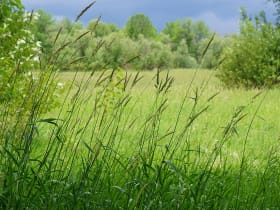
Ridgefield National Wildlife Refuge
14 miles away
Ridgefield NWR north of Vancouver is one of the best places in the Pacific Northwest to see sandhill cranes during fall migration, with birds sometimes foraging in fields visible from the auto tour ro...
Willamette Falls Overlook, West Linn
19 miles away
People rushing between Portland and Salem blow past one of the largest waterfalls in North America without knowing it is there.