
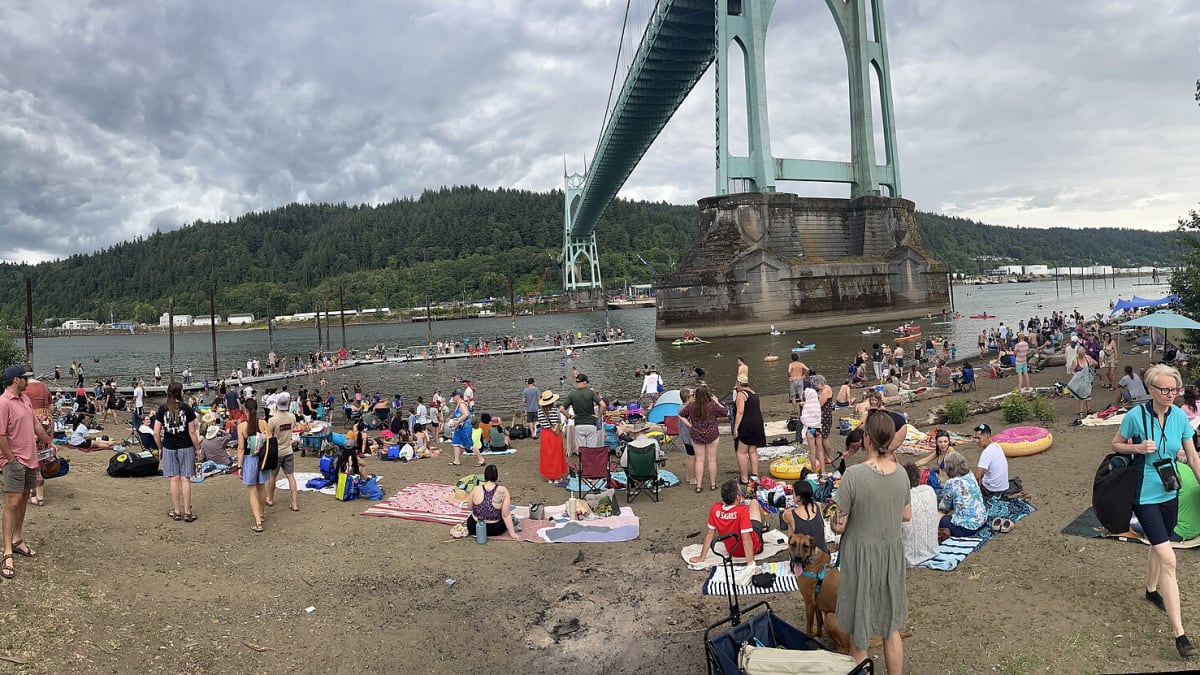
Cathedral Park
N Edison St & Pittsburg Ave
Portland, OR
A riverside park where the stone piers of the St. Johns Bridge rise into pointed arches, like the nave of a cathedral open to the sky.
Cathedral Park earns its name the moment you look up. The stone piers that carry the St. Johns Bridge march down toward the Willamette River in a double row of tall, pointed arches, and standing among them feels less like being under a bridge than inside the nave of a great stone church, open to the sky and the water.
It is one of Portland's most beloved corners, equal parts engineering and accident of beauty. The arches were built to hold up a road, but the way they frame the light, the river, and the green towers above has made this quiet riverfront park a place people come to be married, to take photographs, and simply to stand and look.
What Travelers Love
- Standing beneath the soaring Gothic arches that give the park its name
- The green towers of the St. Johns Bridge framing the sky overhead
- An easy grassy lawn down to the Willamette River, with a boat ramp and beach
- A favorite of photographers, especially in soft morning light and fog
Worth Knowing
- The park sits directly under a working bridge and rail line, so there is traffic noise overhead
- The riverbank and boat ramp draw a crowd on warm weekends; mornings are quietest
- It is a city park, so the usual river cautions apply near the water and the ramp
- Street parking fills up on summer evenings and during the annual jazz festival
Learn about Cathedral Park
The bridge that made the arches
The St. Johns Bridge opened in June 1931, a steel suspension bridge designed by the engineers David Steinman and Holton Robinson to carry traffic high over the Willamette between the St. Johns and Linnton sides of the river. Its two towers rise about four hundred feet, and Steinman gave them a deliberately Gothic shape, with pointed arches meant to echo a cathedral.
That design is exactly what the park below is named for. The tall concrete piers that anchor the bridge's east approach form the cathedral-like arches you walk among, and the neighborhood and park both took their name from them. The bridge was painted green, a color the county announced on St. Patrick's Day in 1931, and it has worn a shade of green ever since.
St. Johns, before and after the bridge
Before the bridge, this crossing was served by a ferry that shuttled as many as a thousand vehicles a day between St. Johns and Linnton, communities that sat miles from the heart of Portland. St. Johns began as its own city, named for the early settler James John, and kept its independence until Portland annexed it in 1915.
That history is why St. Johns still feels like a small town folded into a big city, with its own compact main street just up the hill from the park. Long before any of it, Chinookan-speaking peoples lived and traveled along this stretch of the Willamette for thousands of years, fishing and gathering where the park lawn now runs down to the water.
The park by the river
For all its drama, Cathedral Park is an easygoing place. A broad lawn slopes from the arches down to a beach and a boat ramp on the Willamette, where paddlers put in and kids wade at the edge on hot days. Benches and paths let you linger with a view straight up the arches or out across the river.
Each summer the park hosts a long-running free jazz festival beneath the arches, when the strange acoustics of all that stone fill with music. Most days, though, it is simply a quiet place to watch the river slide by under one of the most beautiful bridges in the country.
Light, fog, and photographs
The park has become a magnet for photographers, and it is easy to see why. Early morning light slants down the double row of arches and lays long shadows across the grass, and on a foggy Portland morning the tops of the bridge towers vanish entirely, leaving the arches floating in gray.
Come at sunrise for the emptiest park and the softest light, or at dusk when the bridge lights come on above the darkening river. It is a small place, easy to see in an hour, but one that rewards a slow look and a bit of patience with the weather.
Closest Boutels
The closest Boutel™ stays, so you can turn this stop into an overnight. Each is a place we chose through independent editorial review, never a paid placement.
Details
Portland, OR
Frequently asked questions
What is special about Cathedral Park?
The park sits directly beneath the St. Johns Bridge, a 1929 steel suspension bridge whose tall, pointed arches rise like the vaulted ceiling of a Gothic cathedral, which is exactly how the park got its name. Standing under the soaring arches, with the Willamette River beyond, is a genuinely striking sight and one of the most photographed spots in Portland.
Is Cathedral Park good for photography?
Yes, it is one of Portland's favorite photo spots. The lines of the bridge's cathedral-like arches make for dramatic images, especially in the soft light of early morning or at sunset, and the park is a popular backdrop for wedding and portrait photos. It can get busy with photographers on golden-light evenings, so early is often quieter.
What is there to do at Cathedral Park?
Beyond admiring the bridge, the park has grassy lawns for picnics, walking paths, and a floating dock and boat launch on the Willamette River, where you can fish, watch the river traffic, or simply take in the water. Stone steps lead down through the park, and in summer it hosts a beloved jazz festival. It is an easy, peaceful place to spend a relaxed hour or two.
When is the best time to visit Cathedral Park?
It is pleasant year-round, but summer and early fall bring the warmest, driest weather for a picnic on the grass, and the low light of morning and evening is best for photographs of the bridge. Weekends can be lively; a weekday or an early hour is the quietest. The historic St. Johns neighborhood nearby has cafes and shops to round out a visit.
Is Cathedral Park easy to visit with kids?
Yes. It is a flat, open city park with plenty of grass to run on, benches, and the river to watch, so it suits families and casual strollers well. Keep an eye on children near the dock and the riverbank, where the water is deep and can move quickly, but otherwise it is a relaxed, low-key spot.
Nearby

Witch's Castle, Forest Park
3.3 miles away
The Lower Macleay Trail follows Balch Creek into the canyon below Thurman Street and reaches the Witch's Castle at about one mile.

Pittock Mansion
5.0 miles away
A grand French Renaissance-style chateau on a hilltop in Portland's forested West Hills, built in the early twentieth century by Henry Pittock, the pioneering publisher of The Oregonian, and his wife...
Fort Vancouver National Historic Site
5.2 miles away
Fort Vancouver National Historic Site is in Vancouver, Washington, directly across the Columbia River from Portland, Oregon.
Oaks Bottom Wildlife Refuge
9.2 miles away
The refuge occupies a floodplain terrace between the Willamette River and the Springwater Corridor. The shallow wetland pools were restored after years of industrial fill.
Rocky Butte Natural Area
10 miles away
Five Cascade volcanoes visible from one overlook inside a major city is not common.

Tryon Creek State Natural Area
10 miles away
Good for ages three and up. The trail network has multiple loops from half a mile to three miles, and all of them cross Tryon Creek at least once. Mud is expected in winter and spring.
Ridgefield National Wildlife Refuge
16 miles away
Ridgefield NWR north of Vancouver is one of the best places in the Pacific Northwest to see sandhill cranes during fall migration, with birds sometimes foraging in fields visible from the auto tour ro...
Willamette Falls Overlook, West Linn
18 miles away
People rushing between Portland and Salem blow past one of the largest waterfalls in North America without knowing it is there.