
Angel Oak
3688 Angel Oak Rd, Johns Island, SC
Johns Island, SC
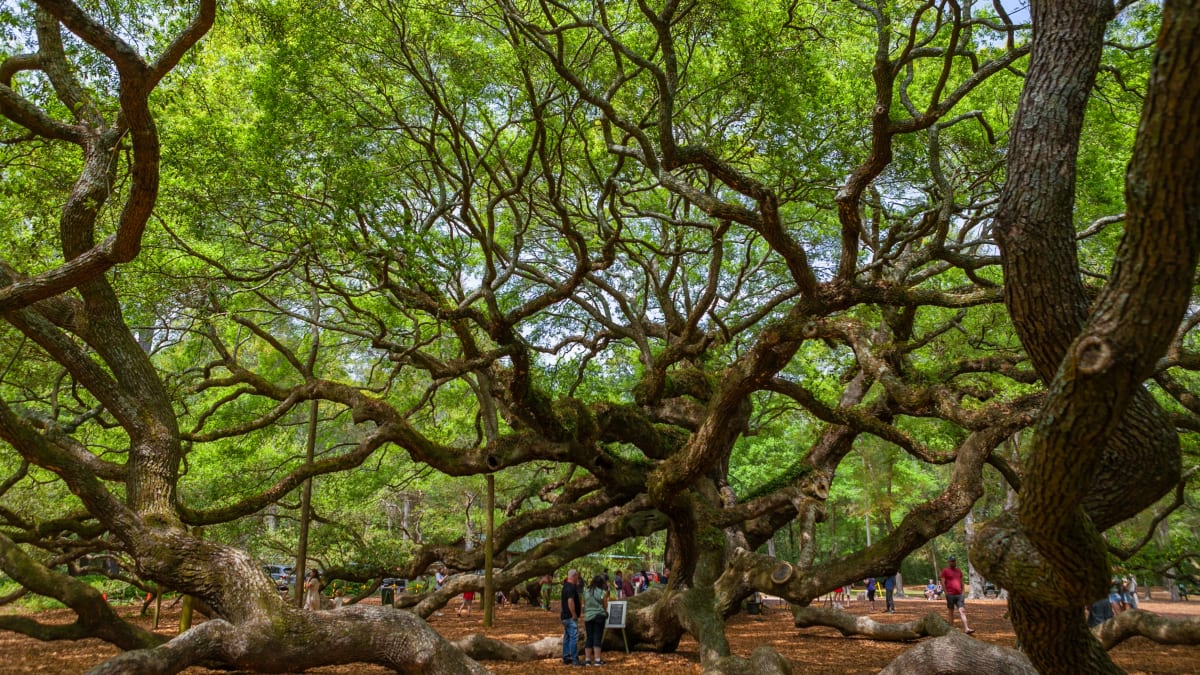
A single live oak so vast its lowest limbs rest on the ground and rise again, a living giant that has stood over the Lowcountry for centuries.
The Angel Oak is a single Southern live oak of astonishing size, its trunk thick as a small room and its limbs so long and heavy that some rest on the ground before rising again into the canopy. It stands in a modest park on Johns Island, near Charleston, and it is widely thought to be several centuries old, one of the oldest living things east of the Mississippi.
Numbers only go so far in describing it. The tree spreads its shade across the entire clearing, and beneath the canopy the light turns green and cool even on a hot Lowcountry afternoon. Live oaks do not grow tall so much as vast, and the Angel Oak is the grandest example many people will ever stand under.
What Travelers Love
- Standing beneath limbs so heavy and long they drape to the ground and curl back up
- The sheer scale and age of a single living tree centuries in the making
- A shaded, peaceful park that invites quiet lingering rather than a quick photo
- The soft green light filtering through a canopy that spreads across the whole clearing
Worth Knowing
- The park welcomes visitors at no cost and keeps regular open days, so check the schedule
- Climbing on or touching the tree is not allowed, to protect its old limbs
- The site is small, so a visit is short but worth an unhurried pause
- It pairs well with a wider day on Johns Island or in Charleston nearby
Learn about Angel Oak
The tree and its age
Southern live oaks grow slowly and live long, and the Angel Oak has had a very long time to reach its size. Estimates of its age vary widely, from a few hundred years to much older, because a live oak's spreading, ground-hugging habit makes precise dating difficult. What is certain is that it was already a landmark generations ago, and that it dwarfs almost every other live oak in the region.
Rather than shooting straight up, the tree throws out enormous horizontal limbs that curve down to touch the earth and then rise again, some of them longer than the tree is tall. This is how live oaks endure hurricanes, keeping their center of gravity low and their weight braced across the ground. The Angel Oak has weathered countless Lowcountry storms this way and still stands.
How it got its name
Despite the ethereal quality of the tree, its name is simply a family name. The land was part of a colonial-era plantation, and the oak took the name of the Angel family who once held the property. Over time, the coincidence of that name and the tree's cathedral-like presence gave rise to local legends of ghosts and spirits among its branches, though the plain history is more prosaic.
That plantation past also carries the weight of the Lowcountry's history of slavery. Johns Island and the surrounding sea islands were worked by enslaved people, many of them ancestors of the Gullah Geechee communities who still live in the region and preserve a distinct culture and language. The tree stood through all of it, a silent witness to centuries of the island's life.
A living monument, carefully kept
The Angel Oak is now a protected city park, and the tree is cared for with real attention. Some of its longest limbs are supported to keep them from cracking under their own weight, and visitors are asked not to climb on or touch the tree so that its old wood is not stressed or worn. These small rules are why it remains healthy enough to enjoy.
The park welcomes visitors at no cost during its open hours, and there is a small stand and shaded benches. It is a place to slow down rather than snap a picture and leave. People come, stand quietly under the canopy, walk a slow circle around the trunk, and often stay longer than they planned.
Johns Island and Charleston nearby
Johns Island is one of the rural sea islands ringing Charleston, a landscape of farm fields, tidal creeks, and roads canopied by moss-draped oaks. Despite growth pushing outward from the city, much of the island keeps a quiet, agricultural character, and the Angel Oak fits that mood.
Downtown Charleston, with its historic streets and waterfront, is a short drive away, so the tree makes an easy addition to a Lowcountry itinerary. Many visitors pair it with the island's produce stands, the coastal beaches, or a day in the city, coming to the oak for a dose of quiet green amid a busy region.
Closest Boutels
The closest Boutel™ stays, so you can turn this stop into an overnight. Each is a place we chose through independent editorial review, never a paid placement.
Details
Johns Island, SC
Frequently asked questions
What is the Angel Oak?
The Angel Oak, on Johns Island near Charleston, South Carolina, is a magnificent and ancient Southern live oak tree, one of the oldest living things east of the Mississippi, estimated to be many hundreds of years old. The enormous tree spreads its massive, gnarled limbs low and wide across a huge area, some branches so long and heavy they rest on the ground, creating a breathtaking natural canopy. A beloved and awe-inspiring landmark set in a small public park, the Angel Oak draws visitors to marvel at its size, age, and beauty. With its ancient, sprawling grandeur, the Angel Oak offers a spectacular destination in South Carolina.
How old is the Angel Oak?
The Angel Oak is estimated to be many hundreds of years old, with some estimates suggesting it could be several centuries or more, making it one of the oldest living oak trees and living things in the region east of the Mississippi River. Its great age is reflected in its enormous size, with a massive trunk and sprawling limbs that have grown over the centuries into a breathtaking canopy. While the exact age is uncertain, the tree's ancient grandeur is undeniable. This remarkable age and beauty are what make the Angel Oak such an awe-inspiring landmark on Johns Island in South Carolina.
What can you do at the Angel Oak?
You can visit the small public park to marvel at the ancient live oak, walk around and beneath its breathtaking canopy of massive, sprawling limbs, photograph the extraordinary tree, and enjoy the peaceful, shaded setting. Admiring and photographing the enormous, centuries-old tree is the whole experience, a serene and awe-inspiring stop. Please treat the tree with care, staying on paths and not climbing on the branches to protect this living treasure. With its ancient, spreading grandeur and peaceful setting, the Angel Oak offers a memorable visit near Charleston, South Carolina.
When is the best time to visit the Angel Oak?
The Angel Oak can be visited year-round, with spring and fall offering the most pleasant weather to enjoy the park and tree comfortably, while summer is popular but hot and humid, so mornings are best then. The tree is evergreen and majestic in every season. The park keeps regular hours, so checking current times before you go is wise, and mornings often offer softer light and fewer crowds for photos. For the most comfortable weather and beautiful light, aim for spring or fall, especially mornings, at the Angel Oak on Johns Island in South Carolina.
What is near the Angel Oak?
The Angel Oak is on Johns Island near Charleston, South Carolina, within reach of historic Charleston with its City Market, Fort Sumter, and Patriots Point, the Lowcountry plantations like Magnolia Plantation and Middleton Place, and the coastal islands. That makes the Angel Oak a spectacular stop to combine with historic Charleston, the Lowcountry plantations, and the other attractions of the Charleston area on a visit to South Carolina.
Nearby

Charleston City Market
9.8 miles away
The market itself is touristy, but slow down for the sweetgrass basket makers and it becomes something else.

Magnolia Plantation and Gardens
11 miles away
Everyone books Middleton or Boone Hall; fewer realize the oldest public garden in America is right next door.

Patriots Point and the USS Yorktown
11 miles away
For kids who like big machines, this is the standout day in Charleston.

Fort Sumter
12 miles away
Half the fun for kids is getting there, because Fort Sumter can only be reached by boat.

Middleton Place
13 miles away
The gardens most people picture when they imagine a Southern estate are here, and they are older than the country.

Boone Hall Plantation
17 miles away
The oak allee is the shot everyone knows, but the reason to stop is what stands at the end of it.

Botany Bay Beach
19 miles away
This is the wild, ghostly beach that Edisto keeps out of the brochures.