
Yiddish Book Center
1021 West Street
Amherst, MA
The world's largest Yiddish cultural center, born from a young man's rescue of more than a million discarded books, housed in a building built to look like a lost Old World village.
The Yiddish Book Center in Amherst is the largest Jewish cultural organization of its kind in the world, and it exists because of a rescue. In 1980 a young graduate student named Aaron Lansky realized that Yiddish books, the printed heart of a thousand-year civilization, were being thrown away by the truckload as the immigrant generation that read them passed on. He set out to save them, and he and a network of volunteers went on to recover well over a million volumes.
Today those books, and the culture they carry, live in a building on the campus of Hampshire College that was deliberately designed to look like a cluster of Old World wooden buildings, the kind of village synagogue and shtetl architecture that the Yiddish-speaking world of Eastern Europe left behind. It is part museum, part library, part living cultural center, and the whole place is animated by the improbable story of how it came to be.
What Travelers Love
- The story of a rescue mission that saved a literature from the dumpster
- A building designed to evoke a vanished Eastern European village
- Exhibitions that make Yiddish culture vivid whether or not you read the language
- A serious cultural institution set in an apple orchard on a college campus
Worth Knowing
- The center is on the Hampshire College campus, and there is visitor parking on site
- You do not need to read Yiddish to appreciate the exhibitions, which are in English
- Check current days and hours before visiting, since it keeps a cultural-center schedule rather than a store's
- Public programs, concerts, and book talks run through the year and are worth timing a visit around
Learn about Yiddish Book Center
The rescue
When Aaron Lansky began his work, scholars estimated that perhaps seventy thousand Yiddish books might still be recoverable. That number turned out to be wildly low. Over the following decades Lansky and his volunteers collected more than a million and a half volumes, often literally pulling them from dumpsters, basements, and demolition sites as older Yiddish speakers died and their children, unable to read the language, cleared out their shelves.
The urgency was real. Yiddish had been the everyday language of millions of Jews in Eastern Europe and the immigrant neighborhoods of America, the vehicle of a vast literature of novels, poetry, journalism, and theater. The Holocaust destroyed the communities that spoke it, and assimilation thinned the ranks of readers in America, so the books were in danger of vanishing simply for lack of anyone to keep them.
Lansky told the story in his memoir Outwitting History, which became the way many people first learned about the center. The rescued books have since been shared with libraries and readers worldwide and digitized, so that a literature once headed for the trash is now more accessible than it has ever been.
A building shaped like a memory
The center's home, which opened in 1997, was designed to feel like stepping into the world the books came from. Its exterior evokes the wooden buildings of a Central and Eastern European Jewish village, with forms drawn from the old wooden synagogues and shtetl houses that were nearly all destroyed in the twentieth century.
Inside, the building holds the book repository, exhibition galleries, a theater, and reading spaces. The design is not a museum period-room so much as an act of remembrance in architecture, giving a physical form to a culture that lost most of its physical places.
The setting adds to the effect. The center sits amid an apple orchard on the Hampshire College campus, so a visit combines a serious cultural institution with the open, rural feel of the Pioneer Valley.
More than a library
The center is a working cultural organization, not just a warehouse of old books. Its exhibitions, presented in English, introduce visitors to Yiddish literature, theater, music, and daily life, so that people who cannot read a word of the language still come away understanding what was nearly lost.
Major projects have extended its reach far beyond the building. It digitized its collection into a free online library, and its oral history project has recorded hundreds of interviews capturing the memories of Yiddish speakers in their own voices before they are gone.
Throughout the year the center hosts concerts, lectures, translation fellowships, and educational programs, keeping Yiddish a living rather than a purely historical subject. It has become a gathering point for a new generation rediscovering the language.
Why it belongs on a road trip
The Yiddish Book Center is the kind of place that surprises people who did not know it existed. You can arrive with no connection to Yiddish and leave moved by a story about what it takes to save a culture, and about one person's stubborn refusal to let a literature disappear.
Set among the Five Colleges of the Pioneer Valley, it pairs naturally with a slow day of college towns, farm stands, and river scenery in western Massachusetts. It is a reminder that some of the most powerful destinations are not scenery at all, but ideas kept alive.
Closest Boutels
The closest Boutel™ stays, so you can turn this stop into an overnight. Each is a place we chose through independent editorial review, never a paid placement.
Details
Amherst, MA
Frequently asked questions
What is the Yiddish Book Center?
The Yiddish Book Center in Amherst is the largest Jewish cultural organization of its kind, dedicated to rescuing, preserving, and celebrating Yiddish language, literature, and culture. It has saved more than a million Yiddish books that might otherwise have been lost, and it shares that heritage through exhibits, programs, and its collections. Housed in a striking building designed to evoke an Eastern European shtetl streetscape, it is a moving, thoughtful, and welcoming cultural destination.
What can you see and do at the Yiddish Book Center?
You can explore exhibits on Yiddish literature, history, and the world of Eastern European Jewish life, see the rescued-book collections, browse the bookstore, and take in rotating cultural programming, from talks to music and film. The architecture itself, evoking a lost world of Jewish villages, is part of the experience. It offers a rich, reflective look at a language and culture that shaped generations, presented with warmth and depth.
When is the best time to visit the Yiddish Book Center?
As an indoor destination it is rewarding year-round and a fine choice in any weather. Checking current hours before you go is wise, and it is worth looking at the calendar of events and programs, since a talk, concert, or special exhibition can enrich a visit. Allow roughly one to two hours to explore the exhibits, collections, and building at a relaxed pace.
Who will enjoy the Yiddish Book Center?
Anyone interested in Jewish history and culture, literature, language, or immigrant and Eastern European heritage will find it especially meaningful, but it also welcomes curious visitors of all backgrounds who want to learn about a vibrant and resilient culture. Students, readers, and travelers alike come away moved and informed. It is a distinctive, enriching stop that adds real depth to a visit to the Pioneer Valley.
What is near the Yiddish Book Center?
The center sits on a college campus in Amherst, in the heart of the cultural Pioneer Valley, near the Emily Dickinson Museum and within easy reach of Northampton, the Five Colleges, and their many bookshops, cafes, and cultural offerings. Historic Deerfield and the scenic Connecticut River valley are nearby as well, so the Yiddish Book Center fits naturally into a rich day of culture and history in western Massachusetts.
Nearby
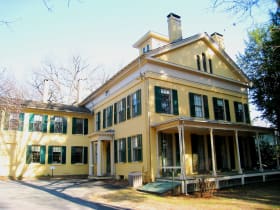
Emily Dickinson Museum
3.6 miles away
One of the great American poets lived almost her entire life inside this one house, and you can stand in the room where she wrote.

Quabbin Reservoir
9.5 miles away
The Quabbin is a strange and beautiful place: a huge reservoir made in the 1930s by flooding an entire river valley, drowning four towns whose foundations still lie beneath the water.

Historic Deerfield
16 miles away
It looks like a film set, but every house is real and original.
Springfield Museums and the Dr. Seuss Sculpture Garden
16 miles away
Five museums on one green, one ticket, and a bronze zoo of Dr. Seuss characters outside, all in downtown Springfield where Theodor Geisel grew up.

Naismith Memorial Basketball Hall of Fame
16 miles away
Basketball was invented right here in Springfield in 1891, and this is the place to feel it.