

Historic Deerfield
13 Albany Rd, Deerfield, MA
Deerfield, MA
A mile-long village street lined with early American houses, a rare stretch of colonial New England kept almost exactly as it stood.
Historic Deerfield is an entire colonial village kept largely intact, centered on a broad, tree-lined street where dozens of early houses still stand. Several are open to the public as museum houses filled with early American furniture, silver, ceramics, needlework, and everyday objects, the kind of deep collections usually broken up and scattered among big-city museums. Here they sit inside the very rooms they were made for.
What makes the place unusual is that it is not a reconstruction. This is a real village that simply never tore down its past. The street you walk today looks much as it did more than two centuries ago, and behind that calm lies one of the most dramatic frontier histories in New England, a story of a settlement caught for decades on the edge of colonial wars.
What Travelers Love
- Strolling a mile of preserved 18th- and 19th-century houses along a single quiet street
- The deep collections of early American furniture, silver, ceramics, and textiles inside the houses
- The setting among working farms and tobacco barns in the Connecticut River valley
- Guided tours that bring out the daily life and craft of the colonial frontier
Worth Knowing
- The houses are entered on guided tours; check the schedule before you plan a full day
- Old Deerfield is also a living residential village and home to Deerfield Academy, so respect private homes and the school
- Fall foliage brings the busiest crowds to the valley, and the village street is especially lovely then
- Winters are quiet and cold in the valley, with a reduced schedule at some sites
Learn about Historic Deerfield
The frontier village and the raid of 1704
The valley around Deerfield is the homeland of the Pocumtuc people, who farmed the rich river bottoms and fished the Connecticut and Deerfield rivers long before English settlers arrived. English families began building here in the 1670s, on the far northern edge of the New England frontier, in country that Native nations still held and used. That frontier position shaped everything that followed.
In the winter of 1704, during one of the wars between England and France, a force of French soldiers and their Native allies attacked the palisaded village before dawn. Many townspeople were killed and more than a hundred were taken captive and marched hundreds of miles north into what is now Canada. Among the captives was the minister John Williams, whose account of the ordeal became one of the most widely read books of the colonial era. His young daughter Eunice never returned, choosing to stay with the Mohawk community that adopted her, marrying there and living out her life as a member of that nation. Her story is still remembered on both sides of the border.
The houses and the collections
After the frontier era passed, Deerfield settled into a prosperous farming town, and its 18th-century families built the handsome doorways and paneled rooms that survive along the street today. In the early 20th century, collectors and preservationists began saving these houses rather than letting them be modernized or lost, and Historic Deerfield grew out of that effort.
Inside, the houses hold one of the country's best gatherings of early American craft: cherry and maple furniture, engraved silver, redware and stoneware pottery, printed and embroidered textiles, and the tools of colonial trades. A separate collections building lets you see thousands more objects up close. Rather than a single grand mansion, the appeal is the accumulation of ordinary and extraordinary things across many rooms, each tied to the people who lived with them.
Walking the village street
The heart of a visit is simply the walk. The main street runs about a mile, wide and shaded, lined with clapboard houses set back behind old trees, with the spire of the meetinghouse and the buildings of Deerfield Academy giving the village its center. It is a rare thing to walk a colonial streetscape that has not been swallowed by later development.
Because Old Deerfield is a real neighborhood, private homes stand among the museum houses, and the boarding school is very much alive. That mix is part of the charm. You are not touring a stage set but a living town that happens to have kept its history standing, with the surrounding farmland and river valley opening out at either end of the street.
The valley around it
Deerfield sits in the fertile bottomlands of the Connecticut River valley, long famous for its farms and, historically, its tobacco, which was grown here under gauzy tents and cured in the long weathered barns you still see across the fields. The soil is some of the richest in New England, and the farm stands and orchards nearby make good stops in season.
The village makes an easy base for the wider Pioneer Valley, with the college towns of Amherst and Northampton close by and the hill country of the Berkshires rising to the west. Spring and summer bring green fields and river light, and fall turns the ridges gold and red, which is the busiest and most beautiful time to walk the street.
Closest Boutels
The closest Boutel™ stays, so you can turn this stop into an overnight. Each is a place we chose through independent editorial review, never a paid placement.
Details
Deerfield, MA
Frequently asked questions
What is Historic Deerfield?
Historic Deerfield is a beautifully preserved colonial-era village in the Pioneer Valley of western Massachusetts, centered on a mile-long street lined with original eighteenth-century houses. Several of these historic homes are open as museums, and a dedicated museum showcases early American furniture, textiles, silver, and decorative arts. A National Historic Landmark district, it offers an authentic, atmospheric look at early New England life, in a village that remains lived-in rather than a recreated theme park.
What can you see at Historic Deerfield?
You can tour meticulously furnished period houses, see world-class collections of early American craftsmanship, and learn the village's dramatic history, including the famous colonial-era raid that shaped its story. Costumed interpreters and guided tours bring the homes and their inhabitants to life, while the tree-lined main street itself, with its stately old houses, is a pleasure to stroll. It is a rich destination for anyone interested in early American history and antiques.
When is the best time to visit Historic Deerfield?
The museum houses are generally open from spring through fall, so plan a warm-season visit and check current dates and hours, especially early or late in the season. The historic street itself is lovely to walk year-round, and autumn brings beautiful foliage to the Pioneer Valley setting. Allow a half day to tour the houses and explore the collections and village at a comfortable, unhurried pace.
Who will enjoy Historic Deerfield?
History enthusiasts, lovers of antiques and early American decorative arts, and anyone who appreciates authentic colonial architecture will find it especially rewarding, since the quality and authenticity of the houses and collections are exceptional. Families and students gain a vivid sense of early New England life. Its quieter, more scholarly character appeals to those who want genuine historic depth rather than costumed spectacle, though guided tours keep it engaging.
What is near Historic Deerfield?
Historic Deerfield lies in the scenic Pioneer Valley along the Connecticut River, within easy reach of the college towns of Amherst and Northampton, home to the Emily Dickinson Museum and the Yiddish Book Center, as well as regional favorites and the valley's farms and countryside. That makes it easy to combine a morning of colonial history with more culture, dining, and river-valley scenery for a full day in western Massachusetts.
Nearby
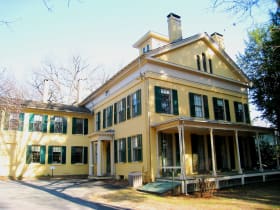
Emily Dickinson Museum
12 miles away
One of the great American poets lived almost her entire life inside this one house, and you can stand in the room where she wrote.
Yiddish Book Center
16 miles away
Few people expect a world center of Jewish culture tucked into a college campus in the Pioneer Valley.

Quabbin Reservoir
20 miles away
The Quabbin is a strange and beautiful place: a huge reservoir made in the 1930s by flooding an entire river valley, drowning four towns whose foundations still lie beneath the water.