

UW-Madison Arboretum
2880 Longenecker Dr, Madison, WI
Madison, WI
The place where the whole idea of restoring a wild landscape was born, where the oldest replanted prairie in the world grows on ground that was once worn-out farm fields.
The University of Wisconsin-Madison Arboretum is not a garden of specimen trees, as the name might suggest, but the place where the science of ecological restoration was invented. In the 1930s, on tired old farm fields beside Lake Wingra, researchers set out to do something no one had really tried: to rebuild whole native communities, a tallgrass prairie, an oak savanna, a northern forest, from scratch. The prairie they planted here is now the oldest restored prairie in the world.
Behind the effort stood some of the great figures of American conservation, including Aldo Leopold, whose thinking about how people should live with land took shape in these years. The Arboretum became a working laboratory for the radical idea that a damaged landscape need not stay damaged, that with patient care it can be brought back. Today its trails let anyone walk through the results, mature prairies and woods that people put back piece by piece.
What Travelers Love
- Walking Curtis Prairie, the oldest restored tallgrass prairie in the world
- Miles of trails through prairie, oak savanna, woods, and lakeshore marsh in the heart of the city
- Spring wildflowers in the woods and towering grasses in the late-summer prairie
- The living link to Aldo Leopold and the birth of restoration ecology
Worth Knowing
- This is a research and teaching site, so stay on trails, keep dogs leashed where allowed, and take nothing
- Bikes are limited to certain paved paths; most trails are for walking
- A visitor center orients newcomers and offers guided walks on a seasonal basis
- Prescribed burns are part of managing the prairies, so a section may be closed or blackened at times
Learn about UW-Madison Arboretum
The birthplace of restoration
This land, like all of the Madison area, is part of the ancestral home of the Ho-Chunk, whose villages, effigy mounds, and long presence around the four lakes reach back thousands of years. Several ancient mounds survive within the Arboretum, quiet reminders of that deep history on the ground.
When the University set the Arboretum aside during the Great Depression, the land was worn-out farm fields and pasture. Rather than simply let it grow wild, the founders chose a bolder path: to restore the native ecosystems that had once covered this country before the plow. In 1934 workers began planting Curtis Prairie, seeding and transplanting native grasses and flowers onto bare ground, and in doing so they launched the entire discipline of restoration ecology. It was here that people first proved a lost prairie could be brought back.
Aldo Leopold and a land ethic
Aldo Leopold, one of the Arboretum's guiding figures and a professor at the University, helped shape its early work and its philosophy. His idea of a land ethic, that people are members of a community that includes the soil, water, plants, and animals, and owe that community care rather than mere use, runs through everything the Arboretum stands for.
The restored prairies and woods here are that ethic made real. They embody the belief that humans can be healers of land as well as its users, and generations of students and scientists have carried the lessons learned on these fields out into the wider world of conservation. To walk the Arboretum is to walk through the practical proof of an idea that reshaped how America thinks about nature.
Prairie, woods, and lakeshore
The Arboretum packs a surprising range of habitats into its green belt. Curtis and Greene prairies wave with tallgrass in late summer, oak savannas open into scattered old trees and sun-loving flowers, and mature woods carpet the ground with spring ephemerals before the leaves close overhead. Along Lake Wingra, marshes and wet meadows draw a different set of birds and plants.
That variety makes for rich wildlife watching in the middle of a city. Deer, turkeys, foxes, and countless birds move through the preserve, sandhill cranes stalk the wetlands, and the prairies hum with insects and grassland songbirds in summer. Miles of trails thread all of it, so a short walk can carry you from open prairie into deep woods to the edge of a marsh.
Season by season
Spring is beloved for the wave of woodland wildflowers that blooms before the trees leaf out, and for the return of migrating birds to the marshes. Summer brings the prairies into their full height and flower, a slow crescendo that peaks in late summer when the tallgrass towers overhead and the blooms are at their richest.
Autumn turns the woods gold and the prairies bronze, and the seed-heavy grasses draw sparrows and finches. Winter opens the landscape to snowshoe and quiet walking, and prescribed burns in the dormant season, part of keeping the prairies healthy, are a striking reminder of the constant work behind this restored land.
Closest Boutels
The closest Boutel™ stays, so you can turn this stop into an overnight. Each is a place we chose through independent editorial review, never a paid placement.
Black Hawk Motel & Suites
Honorable Mention720 Race St, Wisconsin Dells, WI
44 miles away|Learn More ›
Details
Madison, WI
Frequently asked questions
What is the University of Wisconsin Arboretum?
The University of Wisconsin Arboretum, in Madison, is a beautiful and historic arboretum renowned as the birthplace of ecological restoration, where some of the oldest restored prairies and natural communities in the world were established. Spanning a large expanse along Lake Wingra, the arboretum protects restored tallgrass prairies, forests, wetlands, and gardens laced with miles of trails, offering a peaceful natural retreat within the city and a living laboratory of native landscapes. A place of both beauty and scientific importance, it welcomes walkers, birders, and nature lovers. With its restored prairies, forests, and trails, the University of Wisconsin Arboretum offers a special destination in Wisconsin.
What can you do at the University of Wisconsin Arboretum?
You can hike or walk the miles of trails through restored prairies, forests, and wetlands, watch for birds and wildlife, admire seasonal wildflowers and prairie grasses, visit the horticultural gardens, and learn about the pioneering ecological restoration for which the arboretum is famous at the visitor center. The restored prairies, the peaceful trails, the birding, and the seasonal beauty are the draws, offering a tranquil natural escape and a living history of restoration. It is free to enjoy. With its prairies, forests, and trails, the University of Wisconsin Arboretum offers a rewarding experience in Madison, Wisconsin.
Why is the University of Wisconsin Arboretum historically important?
The University of Wisconsin Arboretum is historically important as the birthplace of ecological restoration, where in the early twentieth century scientists, inspired in part by the famed conservationist Aldo Leopold, began restoring native prairies and natural communities on former farmland, pioneering the practice of rebuilding damaged ecosystems. The arboretum's Curtis Prairie is among the oldest restored prairies in the world, and the work done here shaped the science of restoration ecology worldwide. This groundbreaking legacy makes the University of Wisconsin Arboretum a place of lasting significance in Madison, Wisconsin.
When is the best time to visit the University of Wisconsin Arboretum?
The arboretum is beautiful year-round, with spring bringing wildflowers and blooming lilacs and crabapples, summer showcasing the tallgrass prairies in full growth and bloom, fall offering prairie grasses and autumn color, and winter providing quiet trails for walking and skiing. Birding is rewarding in spring and fall migration. Mornings are peaceful in any season. For prairie wildflowers aim for summer, for blossoms visit in spring, or come any season, at the University of Wisconsin Arboretum in Madison, Wisconsin.
What is near the University of Wisconsin Arboretum?
The University of Wisconsin Arboretum is in Madison along Lake Wingra, near the Henry Vilas Zoo, within reach of the Olbrich Botanical Gardens, the State Street area and the Wisconsin State Capitol, and Madison's lakes and museums. That makes the University of Wisconsin Arboretum a special natural stop to combine with the Henry Vilas Zoo, the Wisconsin State Capitol, and the other attractions of Madison on a visit to Wisconsin.
Nearby
Henry Vilas Zoo
1.6 miles away
A full zoo day that costs nothing to enter is a rare thing, and Henry Vilas Zoo has been that since 1911.
Olin Park
2.8 miles away
For the postcard view of Madison, pull into Olin Park on the south shore of Lake Monona, right off the John Nolen causeway.

Memorial Union Terrace
2.9 miles away
You do not have to be a student to sit here, and that is the secret.
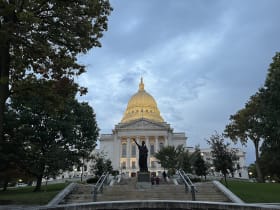
Forward Statue
3.2 miles away
Most visitors stride right past her on their way up State Street.
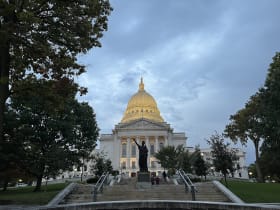
Wisconsin State Capitol
3.3 miles away
People photograph the dome without realizing what they are looking at: the only granite dome in the country and the largest dome by volume in the United States.
Madison Children's Museum
3.4 miles away
This is a downtown rainy-day rescue and much more. The Madison Children's Museum, a block off Capitol Square, fills several floors and a green rooftop with hands-on exhibits built for climbing, buildi...
National Mustard Museum
5.5 miles away
This is the kind of gloriously specific museum most people cannot believe exists.
Olbrich Botanical Gardens
6.0 miles away
Olbrich packs a lot of beauty into 16 acres, and the outdoor gardens are free.

Cave of the Mounds
19 miles away
Cave of the Mounds is an easy, wonder-filled cave visit for families, and the discovery story hooks kids right away: in 1939 a quarry blast accidentally blew open the entrance and revealed the chamber...