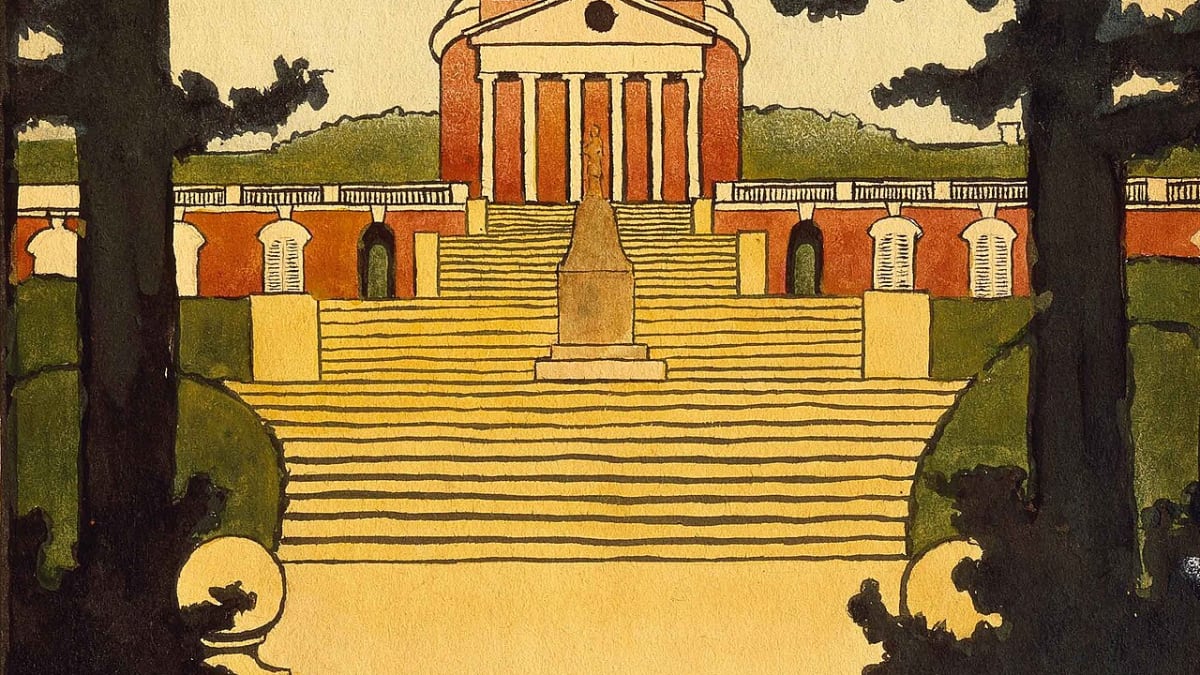
The Rotunda at the University of Virginia
1826 University Ave, Charlottesville, VA
Charlottesville, VA
Thomas Jefferson's domed library, modeled on the Roman Pantheon, presiding over the tree-lined Lawn he designed as the model for American higher education.
The Rotunda at the University of Virginia is Thomas Jefferson's architectural masterpiece and the symbolic heart of the university he founded. Modeled on the Pantheon in Rome and built at roughly half its scale, the domed brick-and-white-columned building crowns the head of the Lawn, a long terraced green flanked by student pavilions that Jefferson designed together as a single composition he called his academical village.
Jefferson considered the founding of the university one of the great achievements of his life, ranking it on his tombstone alongside the Declaration of Independence, and pointedly not his presidency. The Rotunda and the Lawn were completed in the 1820s, near the end of his life, and today they are jointly recognized by UNESCO as a World Heritage site, honored as a landmark of American architecture and Enlightenment ideals.
What Travelers Love
- Standing under the great dome of Jefferson's original university library
- The view down the Lawn, the grassy terraced expanse he designed as an academical village
- The site's status as a UNESCO World Heritage landmark of American architecture
- The walkable, tree-shaded university grounds threaded with student pavilions and gardens
Worth Knowing
- The Rotunda welcomes visitors and the grounds are open to walk; check for guided-tour times
- The Lawn and pavilions are working parts of a living university, so be considerate of residents and classes
- It pairs naturally with a visit to Monticello, Jefferson's home just outside town
- The building was rebuilt after an 1895 fire, then carefully restored to Jefferson's design
Learn about The Rotunda at the University of Virginia
Jefferson's academical village
In his final years, retired from the presidency and settled at his mountaintop home of Monticello nearby, Thomas Jefferson turned his energy to founding a new kind of university. He designed the buildings himself, laid out the grounds, chose the curriculum, and even watched the construction through a telescope from his hilltop. He called his creation an academical village: a community where students and professors lived and learned together in a shared architectural setting.
At the head of this village he placed the Rotunda, and rather than a chapel, which crowned most universities of the age, he made it a library, a deliberate statement that reason and knowledge, not religious doctrine, would sit at the center of the institution. From the Rotunda the Lawn stretches downhill in terraces, lined by ten pavilions, each a different classical design, connected by student rooms and colonnaded walkways. The whole ensemble was meant to teach by example, surrounding students with architecture as a form of education.
Fire, rebuilding, and restoration
In 1895 a devastating fire gutted the Rotunda, destroying its interior and much of its collection. The architect Stanford White led a rebuilding that changed Jefferson's design, opening up the interior into a single grand space rather than the two floors Jefferson had intended. For decades this altered Rotunda served the university, but it was no longer quite Jefferson's building.
In the 1970s, around the nation's bicentennial, the university undertook a major restoration that returned the interior to Jefferson's original two-story plan, recreating the domed library room at the top. A further comprehensive restoration in the 2010s repaired the structure and refined the historical accuracy still further. The Rotunda you visit today is thus both very old and carefully renewed, a building that has been loved, lost, and restored more than once.
A fuller telling of the history
The University of Virginia's founding story has grown more honest in recent years. The Rotunda, the Lawn, and the early university were built and maintained by enslaved laborers, and enslaved people lived and worked throughout the grounds during Jefferson's era and after. The university has worked to acknowledge this history, and the Memorial to Enslaved Laborers, dedicated in 2020 near the Rotunda, honors the thousands of enslaved men, women, and children whose work made the place possible.
Telling both stories, the soaring ideals of the Enlightenment village and the enslaved labor that built it, gives a visit real depth. Jefferson's architecture remains extraordinary and his vision of public education genuinely radical for its time, and the university now presents that alongside the human cost that its founding carried.
Charlottesville and the Jefferson country
The Rotunda anchors a lively college town set in the rolling Piedmont, with the Blue Ridge rising to the west. Charlottesville's walkable downtown, its pedestrian mall, and its restaurants and music make an easy complement to the university grounds, and the surrounding countryside has become one of Virginia's leading wine regions.
The area is thick with Jefferson's legacy. His mountaintop home of Monticello, a masterpiece of his own design, sits just outside town, as does the home of his friend James Monroe. Between the Rotunda, Monticello, and the vineyards and mountains around them, the Charlottesville area rewards a leisurely stay.
Closest Boutels
The closest Boutel™ stays, so you can turn this stop into an overnight. Each is a place we chose through independent editorial review, never a paid placement.
Grey Pine Lodge
Honorable Mention494 Three Notched Mountain Hwy, Waynesboro, VA
19 miles away|Learn More ›
Details
Charlottesville, VA
Frequently asked questions
What is the Rotunda at the University of Virginia?
The Rotunda at the University of Virginia, in Charlottesville, is the iconic centerpiece of the university that Thomas Jefferson founded and designed, one of the most celebrated works of American architecture. Modeled on the Pantheon in Rome and originally built as the university's library, the domed, columned Rotunda anchors Jefferson's beautiful Academical Village, a masterpiece of design and a UNESCO World Heritage Site. Visitors can tour the historic building and grounds and appreciate Jefferson's architectural and educational vision. With its stunning Jeffersonian architecture and history, the Rotunda at the University of Virginia offers an inspiring destination in Charlottesville, Virginia.
Who designed the Rotunda at the University of Virginia?
The Rotunda was designed by Thomas Jefferson, the third president of the United States, who founded the University of Virginia and served as the architect of its original buildings, drawing inspiration from the Pantheon in Rome. Jefferson considered the university one of his proudest achievements, and the Rotunda, as the heart of his Academical Village, expressed his ideals about education and architecture. His design is celebrated as a masterpiece of American neoclassical architecture. Learning of Jefferson's vision deepens appreciation of the Rotunda at the University of Virginia in Charlottesville.
Can you visit the Rotunda at the University of Virginia?
Yes, the Rotunda and the surrounding grounds of the University of Virginia are generally open to visitors, who can tour the historic building, admire its beautiful architecture and dome, and stroll the Academical Village and Lawn, with guided tours often available to share the history and Jefferson's vision. Because it is an active university, being respectful of students and any events is appreciated. Checking current visiting hours and tour options before you go is wise. Touring this architectural masterpiece and its grounds makes the Rotunda at the University of Virginia a rewarding stop in Charlottesville, Virginia.
When is the best time to visit the Rotunda at the University of Virginia?
Spring through fall offers the most pleasant weather for touring the Rotunda and strolling the beautiful grounds and Lawn, with spring and fall especially lovely on the historic campus, though the Rotunda can be visited year-round. The university is quieter during academic breaks and livelier when classes are in session. Checking current visiting hours and tour availability before you go is wise. For the best weather to enjoy the architecture and grounds, aim for spring or fall at the Rotunda at the University of Virginia in Charlottesville, Virginia.
What is near the Rotunda at the University of Virginia?
The Rotunda at the University of Virginia is in Charlottesville, within reach of Thomas Jefferson's home Monticello, the historic downtown, the Blue Ridge Mountains with Shenandoah National Park and Skyline Drive to the west, and the Blue Ridge Tunnel at Rockfish Gap. That makes the Rotunda an inspiring stop to combine with Charlottesville's attractions, Shenandoah National Park, and the other sights of central Virginia on a visit to the state.
Nearby

Skyline Drive
16 miles away
The 105-mile scenic drive along the Blue Ridge crest through Shenandoah National Park, a National Historic Landmark with seventy-five overlooks and famous fall color.

Blue Ridge Tunnel
19 miles away
Walk almost a mile straight through the Blue Ridge inside Claudius Crozet's hand-dug 1850s railroad tunnel, cool and dark with daylight at the far end.

Blue Ridge Parkway
19 miles away
America's Favorite Drive, a 469-mile mountain parkway with no trucks or billboards, running the crest of the southern Appalachians from Shenandoah to the Great Smokies.
Appalachian Trail at Rockfish Gap
19 miles away
The Blue Ridge gap where the Appalachian Trail, Skyline Drive, and the Blue Ridge Parkway all meet, three miles uphill from Waynesboro, a designated Appalachian Trail Community.
Frontier Culture Museum
31 miles away
People expect a small local history stop and find something far more ambitious.

Shenandoah National Park
34 miles away
Cascading waterfalls, blue-hazed ridges, and the 105-mile Skyline Drive along the Blue Ridge Mountains.