
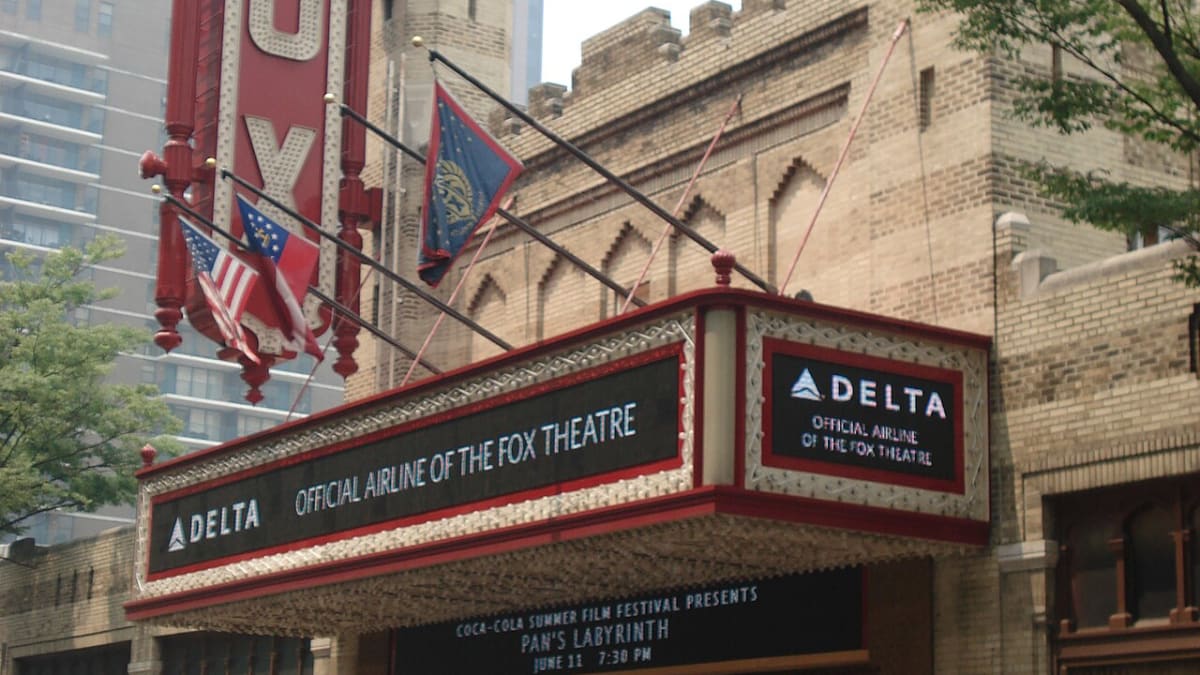
The Fox Theatre
660 Peachtree St NE
Atlanta, GA
A 1929 movie palace built to look like a Moorish courtyard at night, with a domed blue ceiling scattered with twinkling stars and drifting clouds above the seats.
The Fox Theatre is one of the great surviving movie palaces of the 1920s, opened in 1929 on Peachtree Street in Atlanta. It was designed as a fantasy, an exotic dreamscape blending Moorish, Egyptian, and Middle Eastern motifs, so that stepping inside feels like walking into an open-air courtyard under a night sky. Its auditorium ceiling is a domed blue vault scattered with hundreds of twinkling stars and lit with a machine that drifts clouds across it.
The Fox nearly did not survive. Like many grand old movie houses, it fell on hard times as audiences drifted away, and by the 1970s it faced demolition. A grassroots campaign led by Atlantans who loved the building fought to save it, and their success made the Fox a national symbol of historic preservation. Today it thrives again as a venue for touring shows, concerts, and film, its fantasy interior lovingly kept up.
What Travelers Love
- The star-filled sky ceiling with drifting clouds above the auditorium
- The fantasy Moorish and Egyptian decoration that fills every corner
- The mighty theater organ that still rises and plays before shows
- The story of how the community saved it from the wrecking ball
Worth Knowing
- The best way to see the interior in daylight is on a guided tour when one is offered
- Show nights are busy, so arrive early to take in the lobby and auditorium before the lights dim
- The building is historic, so seating and sightlines vary; check details when choosing a show
- It sits in a walkable part of Midtown, so plan for parking or transit on busy nights
Learn about The Fox Theatre
A palace built as a fantasy
The Fox began not as a theater but as the planned headquarters and auditorium for a Shriners organization, whose fascination with Middle Eastern imagery shaped the wild, exotic design. When the project grew too costly, the movie mogul William Fox stepped in, and the building opened in 1929 as a lavish movie palace bearing his name, just as the Great Depression was about to arrive.
The interior is a theatrical illusion from top to bottom. The auditorium is dressed as a Moorish courtyard open to the night, with striped canopies, arched arcades, and a domed ceiling of deep blue set with twinkling stars and a device that sends clouds drifting overhead. Every lobby, staircase, and lounge continues the fantasy in tile, plaster, and gilding, a full immersion meant to sweep audiences out of ordinary life the moment they walked in.
Hard times and the fight to save it
The Fox's early years were rocky. It opened into the Depression and struggled, and over the following decades, as television and suburban multiplexes drew audiences away, the great downtown movie palaces of America went dark and fell to the wrecking ball one after another. By the mid-1970s the Fox was losing money and slated for demolition, with a plan to replace it.
What saved it was the community. A coalition of Atlantans organized to buy and rescue the building, raising money and rallying public support in a campaign that became famous in preservation circles. Their victory kept one of the country's finest movie palaces standing and turned the Fox into a proof that ordinary citizens could save a landmark. That story is now part of the building's identity.
The mighty organ and the stage
One of the theater's treasures is its enormous pipe organ, a grand instrument that rises into view and fills the auditorium with sound before performances, a living piece of the movie-palace era when an organ accompanied silent films and set the mood for the crowd. Hearing it is one of the classic Fox experiences.
Today the Fox is a working stage as much as a monument. Touring Broadway productions, concerts, comedians, ballet, and film screenings fill its calendar through the year, so the building is not a museum but a place that is still very much alive. Seeing a show there means experiencing the fantasy interior lit up and full of people, the way it was meant to be used.
Seeing the Fox
The most immersive way to experience the Fox is to attend a performance, when the lights come up on the star ceiling and the whole exotic interior surrounds a full house. But even on a quiet day the building rewards a look, and guided tours, offered on a schedule, walk visitors through the lobbies, lounges, and auditorium and tell the story of its design and rescue.
The Fox anchors a walkable stretch of Midtown Atlanta, so a visit pairs easily with the restaurants, theaters, and museums nearby. However you come to it, the experience is the same at its core: stepping out of a modern city street into a 1929 fantasy of a night under the stars, kept alive by the people who refused to let it go.
Closest Boutels
The closest Boutel™ stays, so you can turn this stop into an overnight. Each is a place we chose through independent editorial review, never a paid placement.
Details
Atlanta, GA
Frequently asked questions
What is the Fox Theatre?
The Fox Theatre, in Atlanta, Georgia, is a magnificent and beloved historic theater, a lavishly ornate movie palace from the golden age of cinema now serving as a premier performing arts venue. Built in the late 1920s, the opulent Fox dazzles with its exotic, Moorish and Egyptian-inspired architecture, including a soaring auditorium designed to resemble a starlit outdoor courtyard with twinkling stars and drifting clouds on the ceiling. Saved from demolition and beautifully preserved, the Fox hosts Broadway shows, concerts, films, and events, and offers tours of its stunning interior. A dazzling landmark of architecture and entertainment, it delights visitors. With its ornate architecture and shows, the Fox Theatre offers a fascinating destination in Georgia.
What can you do at the Fox Theatre?
You can attend Broadway shows, concerts, films, and events in the spectacular historic theater, admire its opulent Moorish and Egyptian-inspired architecture and the famous starlit-sky auditorium ceiling, and, at times, take a guided tour of the stunning interior to learn its history and see its details. The breathtaking architecture, the starlit auditorium, the live performances, and the tours are the draws, making it a dazzling destination for entertainment and architecture lovers. Seeing a show under its twinkling ceiling is magical. With its architecture and shows, the Fox Theatre offers a rewarding experience in Atlanta, Georgia.
Why is the Fox Theatre famous?
The Fox Theatre is famous as one of the most beautiful and beloved historic theaters in the country, a lavish 1920s movie palace renowned for its exotic Moorish and Egyptian architecture and its magical auditorium designed to look like a starlit outdoor courtyard, with twinkling stars and clouds. Once threatened with demolition, it was saved by a beloved community preservation effort and restored, becoming a symbol of Atlanta and a premier performing arts venue. Its beauty and history make it iconic. This heritage makes the Fox Theatre a treasured landmark in Georgia.
When is the best time to visit the Fox Theatre?
The Fox Theatre is best experienced by attending a performance or event, which run on a schedule throughout the year, so checking the current calendar and reserving tickets ahead before you go is important, while guided tours of the interior are offered at certain times for those who wish to see its architecture without a show. As an indoor venue, it is enjoyable in any season. For the fullest experience, time a visit to a show, or take a tour, checking the current schedule, at the Fox Theatre in Atlanta, Georgia.
What is near the Fox Theatre?
The Fox Theatre is in midtown Atlanta, Georgia, within reach of downtown Atlanta with the Georgia Aquarium and the World of Coca-Cola, the Atlanta History Center, the Martin Luther King Jr. National Historical Park, and the Atlanta area. That makes the Fox Theatre a fascinating stop to combine with the Atlanta attractions and the other sights of the area on a visit to Georgia.
Nearby

World of Coca-Cola
0.8 miles away
Right next to the aquarium, this one is pure fun for kids. The World of Coca-Cola walks through the story of the drink an Atlanta pharmacist mixed up in 1886, with a vault said to guard the secret for...

Georgia Aquarium
0.8 miles away
This is the anchor of a great kid day downtown. The Georgia Aquarium is among the biggest in the world, and its huge Ocean Voyager tank holds whale sharks, the largest fish on the planet, gliding over...
Martin Luther King Jr. National Historical Park
1.4 miles away
This is sacred ground for American history, and it is free. The Martin Luther King Jr. National Historical Park in Sweet Auburn gathers the places of Dr.

Atlanta History Center
4.8 miles away
Many visitors never make it up to Buckhead and miss one of the best history museums in the South.

Stone Mountain Park
14 miles away
Stone Mountain is a geological giant: the largest exposed granite dome on earth, an 825-foot bald rock that swells out of the Georgia piedmont and runs miles underground.