
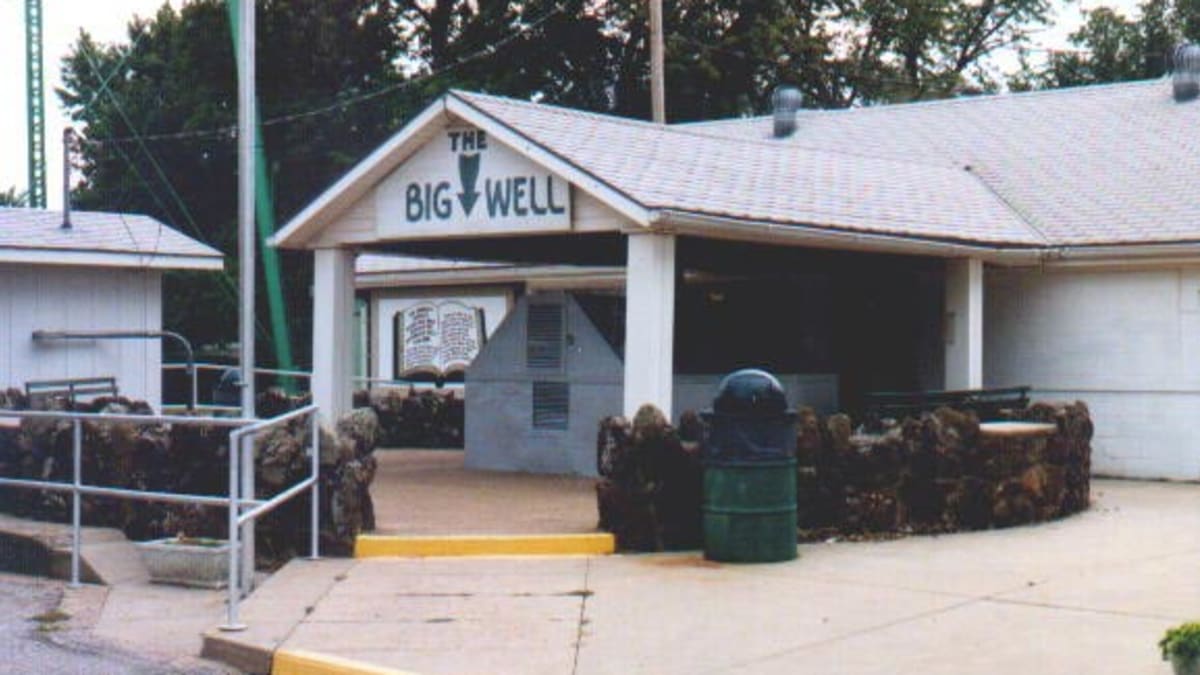
The Big Well
315 S Sycamore St, Greensburg, KS
Greensburg, KS
The largest hand-dug well in the world anchors a museum in a town that rebuilt itself green after a tornado nearly wiped it off the map.
The Big Well in Greensburg is exactly what its name says: the largest hand-dug well in the world, a vast shaft sunk by pick and shovel in the 1880s to supply water for the railroad and the growing town. More than a hundred feet deep and over thirty feet across, it was an engineering feat of the frontier era, and today visitors can walk down a stairway into its cool, stone-lined depths.
But the Big Well now carries a second meaning. In 2007 a powerful tornado nearly destroyed Greensburg, and the town chose to rebuild not just its buildings but its future, committing to become a model green community. The well survived, and its rebuilt museum stands as both a monument to frontier grit and a symbol of a town that came back stronger.
What Travelers Love
- Descending a stairway into the world's largest hand-dug well
- The story of a whole town rebuilt as an energy-efficient green community after disaster
- A rebuilt, modern museum telling the well's and the town's history
- A meteorite display, a famous space rock long tied to Greensburg's history
Worth Knowing
- Reaching the bottom of the well is by stairway, so consider mobility needs
- The museum and well are the town's anchor attraction and an easy, focused stop
- Greensburg's green rebuild is part of the story; look for the sustainable architecture around town
- There is little shade outside, so bring water on hot days
Learn about The Big Well
A well dug by hand
In the 1880s, the young town of Greensburg needed a reliable water supply for its households and for the steam locomotives passing through. Workers dug the Big Well entirely by hand, hauling out earth bucket by bucket to create a shaft more than a hundred feet deep and wide enough to feel like a room, lined with native stone. For its time and place it was a remarkable undertaking.
The well served the town for decades before modern water systems made it obsolete. Rather than fill it in, Greensburg turned it into an attraction, and generations of travelers have climbed down its stairway to stand at the bottom and look up at the ring of daylight far overhead. It became the town's proud claim to fame, drawing visitors off the highway to a place otherwise easy to pass by.
The town that came back green
On a May night in 2007, a massive tornado struck Greensburg head-on, leveling most of the town in minutes. The devastation was near total, and the community faced a wrenching choice about whether and how to rebuild. Greensburg decided to rebuild, and to do so with an eye toward the future, adopting green building standards and renewable energy in an effort to become one of the most sustainable small towns in the country.
The Big Well survived the storm, and its museum was rebuilt as part of the town's renewal, an energy-efficient structure that now interprets both the well and the tornado story. Visiting Greensburg today means seeing a place that turned catastrophe into a chance to lead, with wind power, efficient buildings, and a renewed sense of purpose visible around town.
The Greensburg meteorite
The museum's other treasure is a famous meteorite long associated with Greensburg. A large stony-iron space rock found in the region became one of the best-known meteorites in the world, prized by collectors and scientists for its beauty and composition, and a specimen has long been a highlight of the town's collection.
Together the well, the meteorite, and the town's rebuilding story give the museum an unusually rich range, spanning frontier engineering, the cosmos, and the resilience of a small community. It is a lot of story packed into one modest Kansas town.
Greensburg and the Red Hills country
Greensburg lies at the eastern edge of the Red Hills, or Gypsum Hills, a region of red-rock buttes and mesas in south central Kansas that surprises visitors expecting only flat plains. It is ranch and farm country, quiet and open, with big skies and the distinctive rusty landforms nearby.
The wider region was long the range of Plains nations, including the Kiowa, Comanche, and Cheyenne and Arapaho peoples, who followed the bison across these grasslands. That deep history, along with the frontier, disaster, and renewal stories layered into Greensburg, makes the town a compact and moving stop for travelers crossing south central Kansas.
Closest Boutels
The closest Boutel™ stays, so you can turn this stop into an overnight. Each is a place we chose through independent editorial review, never a paid placement.
Evergreen Inn Motel & RV Park
Honorable Mention20001 W. US Highway 54, Pratt, KS
29 miles away|Learn More ›
Prairie Lodge Motel
Honorable Mention1219 Old US Highway 56, Council Grove, KS
169 miles away|Learn More ›
Details
Greensburg, KS
Frequently asked questions
What is the Big Well?
The Big Well, in Greensburg in southwestern Kansas, is billed as the largest hand-dug well in the world, a remarkable feat of nineteenth-century engineering and a beloved Kansas landmark. Dug by hand in the 1880s to supply water for the town and the railroad, the enormous well is many feet across and deep, and today a museum built around it lets visitors descend a stairway to view the well and learn its history, along with exhibits on the town, including its rebuilding as a model green community after a devastating tornado. The museum also displays a huge pallasite meteorite. A unique blend of engineering marvel, history, and resilience, it fascinates visitors. With its giant hand-dug well, the Big Well offers a fascinating destination in Kansas.
What can you do at the Big Well?
You can descend the stairway into the enormous hand-dug well to view it up close, explore the museum's exhibits on the well's construction, the history of Greensburg, and the town's remarkable rebuilding as a green community after a devastating tornado, and see the large pallasite meteorite on display. The giant well, the descent, the town history, and the famous meteorite are the draws, offering a memorable and educational stop. The story of the town's resilience adds depth. With its hand-dug well and exhibits, the Big Well offers a rewarding experience in Greensburg, Kansas.
Why is Greensburg known for rebuilding green?
Greensburg became known for rebuilding green after a catastrophic tornado nearly destroyed the town in the mid-2000s, prompting the community to rebuild in a remarkably sustainable, environmentally friendly way, becoming a model green town with energy-efficient buildings and renewable energy. This inspiring story of resilience and renewal, alongside the historic Big Well that survived, is part of what the museum shares. The town's recovery is a moving example of a community rebuilding with vision. Learning this story adds meaning to a visit to the Big Well in Greensburg, Kansas.
When is the best time to visit the Big Well?
As a mostly indoor museum built around the well, the Big Well is enjoyable year-round in any weather, making it a great stop in any season, and it offers a cool retreat on a hot summer day. It can be busier in the summer travel season. Because hours can vary, checking the current schedule before you go is wise. Because it is indoors, the Big Well makes a rewarding stop any time of year in Greensburg, Kansas.
What is near the Big Well?
The Big Well is in Greensburg in southwestern Kansas, within reach of the Fromme-Birney Round Barn near Mullinville, Dodge City with the Boot Hill Museum, the Big Basin Prairie Preserve, and Meade County State Park with the Dalton Gang Hideout. That makes the Big Well a fascinating stop to combine with the Fromme-Birney Round Barn, the Boot Hill Museum, and the other attractions of southwestern Kansas on a visit to the state.
Nearby
Fromme-Birney Round Barn
9.0 miles away
Fromme-Birney Round Barn: on a county road southwest of Mullinville in Kiowa County. A restored 1912 true round barn, 70 feet across, with a domed self-supporting roof and no center posts.
M.T. Liggett Roadside Art
10 miles away
M.T. Liggett Roadside Art: along the highway on the edge of Mullinville, Kiowa County. Free, always visible from the road.
Big Basin Prairie Preserve
28 miles away
Big Basin Prairie Preserve: 12 miles south of US-160 on county roads near Ashland, KS (Clark County). Free, no facilities. The basin rim is accessible by unpaved county road.