
Fromme-Birney Round Barn
Kc N St, Mullinville, KS
Mullinville, KS
A great circular barn crowned with a domed cupola, rising alone from the wheat country of southern Kansas like a wooden temple to the age of the family farm.
The Fromme-Birney Round Barn rises from the wheat fields south of Mullinville like something out of a dream, a huge circular structure topped with a domed cupola, standing alone against the wide southern-Kansas sky. Built in 1912 by a prospering farm family, it is one of the finest round barns in the state, a monument to a brief era when farmers believed the circle was the future of agriculture.
Round barns had a moment in the early twentieth century, promoted as more efficient than the traditional rectangular kind. Cattle and horses could be tended from a central point, hay stored above in the great domed loft, and the round shape was said to stand up better to the prairie wind. Few of these barns were ever built, and fewer survive, which makes this beautifully restored example a genuine prairie treasure.
What Travelers Love
- The sheer scale and beauty of the great circular barn and its domed cupola
- How it rises alone from the surrounding fields, visible from a distance
- The craftsmanship of the self-supporting roof and interior framing
- A window into the ambitions of early-1900s prairie farming
Worth Knowing
- This is a rural site reached by country roads, so watch for gravel and farm traffic
- The barn has been restored and is a local landmark; treat the grounds with care
- It pairs well with nearby stops in Greensburg and Mullinville
- The setting is open and exposed, so plan for prairie sun and wind
Learn about Fromme-Birney Round Barn
The round-barn idea
In the late 1800s and early 1900s, agricultural reformers and university experts promoted round and polygonal barns as a modern improvement on the old rectangular design. The theory was efficiency. With stalls arranged in a ring around a central core, a single worker could feed and tend the animals with less walking, hay could be dropped from a central loft, and the strong, self-bracing roof needed fewer interior posts to hold it up.
The round shape was also said to resist the wind better, an appealing idea on the open plains where storms sweep unbroken across the land. For a couple of decades the idea caught on here and there, but building a round barn required real skill and expense, and the coming of tractors and different farming methods soon made the traditional barn practical again. Round barns became a curiosity almost as quickly as they appeared.
A farm family's ambition
The barn was raised in 1912 by the Fromme family, prosperous farmers who wanted a barn worthy of their operation. It stands tall and wide, its walls curving in an unbroken circle, capped by a broad conical roof and a windowed cupola at the very top that vented the hayloft. Inside, the framing rises in a graceful spiral of timber, a genuine feat of rural carpentry.
The barn passed later to the Birney family, whose name it shares, and for decades it served the working farm before age and weather began to take their toll. In time a community restoration effort saved the structure, repairing the roof and framing and returning the barn to its full grandeur. Today it stands as a preserved landmark rather than a working barn, cared for as a piece of the region's heritage.
Craft in wood
What strikes most visitors is the craftsmanship. Building a large circular structure by hand, with a self-supporting domed roof that needs no forest of interior posts, demanded careful engineering and skilled labor. The curved walls, the radiating floor plan, and the soaring loft all reflect a level of care that few utilitarian farm buildings ever received.
Standing inside, you can look up into the great open loft where hay was once stored, and see how the timbers spiral upward to meet at the cupola. It is easy to understand why the barn has become a point of local pride, a reminder that ordinary farm work could produce something genuinely beautiful.
The wheat country around it
The barn sits in the broad agricultural country of south-central Kansas, where fields of winter wheat and pastures of cattle roll toward the Gypsum Hills to the south. This was long the country of Plains nations including the Kiowa, Comanche, and Osage, who hunted the grasslands before settlement, and whose descendants continue today, most now centered in Oklahoma.
The land around the barn is quiet and open, best appreciated on a clear day when the structure stands sharp against the sky. Spring and early summer bring green wheat and, later, the gold of harvest, while fall offers mild air and long light. The barn pairs naturally with the other roadside wonders of the area, from the Big Well at Greensburg to the eccentric metal art of nearby Mullinville.
Closest Boutels
The closest Boutel™ stays, so you can turn this stop into an overnight. Each is a place we chose through independent editorial review, never a paid placement.
Evergreen Inn Motel & RV Park
Honorable Mention20001 W. US Highway 54, Pratt, KS
37 miles away|Learn More ›
Prairie Lodge Motel
Honorable Mention1219 Old US Highway 56, Council Grove, KS
178 miles away|Learn More ›
Details
Mullinville, KS
Frequently asked questions
What is the Fromme-Birney Round Barn?
The Fromme-Birney Round Barn, near Mullinville in southwestern Kansas, is a beautiful and historic round barn, one of the finest examples of this distinctive style of agricultural architecture in the state. Built in the early twentieth century, the large, graceful round barn was designed for efficiency in an era when round barns were briefly popular, and it has been lovingly restored as a historic landmark. Its striking circular form, fine craftsmanship, and prairie setting make it a beloved and photogenic destination for lovers of history and architecture. A rare survivor of a unique building style, it delights visitors. With its historic round barn, the Fromme-Birney Round Barn offers a fascinating destination in Kansas.
What can you do at the Fromme-Birney Round Barn?
You can admire and photograph the beautifully restored historic round barn, appreciate its distinctive circular design and fine craftsmanship, learn about the round-barn era and the barn's history, and enjoy the peaceful prairie setting. The striking round architecture, the fine restoration, and the rural setting are the draws, making it a rewarding stop for those interested in history, architecture, and the heritage of the plains. Its unusual form is a memorable sight. With its historic round barn, the Fromme-Birney Round Barn offers an engaging experience in Kansas.
Why were round barns built?
Round barns were built during a brief period in the late nineteenth and early twentieth centuries when they were promoted as more efficient than traditional rectangular barns, with their circular design intended to save on materials, allow easier feeding of livestock arranged around a central point, and provide structural strength. Though the style never became widespread and few were built, the surviving examples like the Fromme-Birney Round Barn are treasured for their distinctive form and craftsmanship. Understanding this history adds interest to a visit to the Fromme-Birney Round Barn in Kansas.
When is the best time to visit the Fromme-Birney Round Barn?
The mild months of spring through fall offer the most pleasant weather for visiting and photographing the historic round barn in its prairie setting, with the soft light of morning and evening especially beautiful for the striking circular form. Because access to the interior may be limited or seasonal, checking any current hours or arrangements before you go is wise. For the most pleasant weather and beautiful light, aim for spring through fall at the Fromme-Birney Round Barn near Mullinville, Kansas.
What is near the Fromme-Birney Round Barn?
The Fromme-Birney Round Barn is near Mullinville in southwestern Kansas, within reach of the M.T. Liggett roadside art near Mullinville, the Big Well in Greensburg, Dodge City with the Boot Hill Museum, and the Big Basin Prairie Preserve. That makes the Fromme-Birney Round Barn a fascinating stop to combine with the Big Well, the Boot Hill Museum, and the other attractions of southwestern Kansas on a visit to the state.
Nearby
M.T. Liggett Roadside Art
3.9 miles away
M.T. Liggett Roadside Art: along the highway on the edge of Mullinville, Kiowa County. Free, always visible from the road.
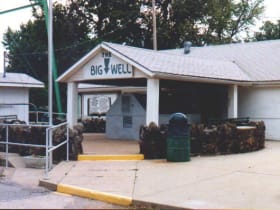
The Big Well
9.0 miles away
The Big Well Museum: 315 S Sycamore St, Greensburg. Walk down into a stone-lined well 109 feet deep and 32 feet wide, hand-dug in the 1880s to water steam trains.
Big Basin Prairie Preserve
20 miles away
Big Basin Prairie Preserve: 12 miles south of US-160 on county roads near Ashland, KS (Clark County). Free, no facilities. The basin rim is accessible by unpaved county road.