

Territorial Statehouse
315 S Main St, Fillmore, UT
Fillmore, UT
The oldest government building still standing in Utah, raised in a town meant to be the capital of a territory the size of a nation.
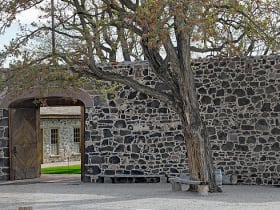
The Territorial Statehouse in Fillmore is the oldest existing government building in Utah, a handsome sandstone structure begun in the 1850s when Utah was still a sprawling territory and Fillmore was chosen to be its capital. Both the town and its county were named for President Millard Fillmore, who signed the act creating Utah Territory, in a bid to win federal favor for the young settlement.
The grand plan was for a great four-winged capitol at the center of the territory, but only a single wing was ever completed. The legislature met here briefly before the seat of government shifted back to Salt Lake City, leaving the statehouse as a monument to an ambitious idea that never fully came to pass. Today it is preserved as a state park and museum, filled with pioneer artifacts and the story of early Utah.
What Travelers Love
- The oldest surviving government building in Utah, built in the 1850s
- Pioneer-era furnishings, quilts, and artifacts inside the museum
- The story of a would-be capital in the middle of a vast territory
- A quiet, uncrowded stop rich in early Utah history
Worth Knowing
- Only one wing of the grand planned capitol was ever finished
- It is a state park museum, so the grounds and building are open to visitors
- Fillmore makes a handy stop on Interstate 15 between the big cities and the parks
- The building and its shade trees are a pleasant place to stretch your legs and learn some history
Learn about Territorial Statehouse
A capital in the center of a territory
When Utah Territory was organized in 1850 it was enormous, stretching far across the Great Basin, and the leaders of the young Latter-day Saint settlement wanted a capital near its geographic center rather than off in the north. They chose a spot in the Pahvant Valley, founded the town of Fillmore, and named both it and the surrounding county for President Millard Fillmore, hoping the gesture would earn goodwill from Washington.
This valley was long the country of the Pahvant band of the Ute people and neighboring Paiute groups, who lived off its springs, game, and plants, and whose descendants remain part of Utah's Native communities today. The pioneers settled among them in the early 1850s, and the choice of Fillmore as capital reflected both the vast scale of the territory and the settlers' hope of building an orderly society at its heart.
The statehouse that was never finished
The plan for the capitol was grand: a large building with four wings meeting at a central rotunda, designed to house a full territorial government. Work began in the mid-1850s, and the red sandstone for its walls was quarried nearby and shaped by pioneer masons. But funds ran short, and only the south wing was ever completed, a single arm of the intended cross.
The territorial legislature met in the finished wing for a session or two in the mid-1850s, but the remoteness of Fillmore and the pull of the larger settlement to the north soon told, and the seat of government returned to Salt Lake City. The partly built statehouse went on to serve the town over the years in many humbler roles, as a school, a church, a jail, and a theater, before it was recognized as a landmark and preserved.
Inside the museum today
The surviving wing is now a state park museum, and stepping inside is a journey into the pioneer era. Its rooms hold furnishings, tools, quilts, clothing, photographs, and artifacts from the early days of the territory, along with exhibits that tell the story of the building itself and the people who settled the Pahvant Valley. The thick sandstone walls and period rooms give a strong sense of the 1850s.
For all its ambitions, the statehouse is a modest and human-scaled place, and that is part of its charm. It is rarely crowded, and a visitor can wander the rooms, study the pioneer objects, and read the story of a capital that almost was, all at an unhurried pace. Shade trees and grounds around the building make it a pleasant spot to pause and reflect on the improbable early history of Utah.
Fillmore and the valley
Fillmore today is a small central Utah town of farms and ranches, a quiet community along Interstate 15 roughly halfway between the Salt Lake area and the red-rock parks of the south. For travelers making that long drive, the statehouse is a rewarding reason to leave the freeway for a while, stretch, and step into a chapter of Utah history that most people speed right past.
The surrounding Pahvant Valley is flanked by mountains and dotted with old pioneer settlements, and the wider region rewards a curious traveler with rock art, fossil sites, and volcanic country not far off. But the heart of a Fillmore visit is the statehouse on Main Street, a dignified sandstone survivor from the days when this small town was meant to govern a territory the size of a nation.
Closest Boutels
The closest Boutel™ stays, so you can turn this stop into an overnight. Each is a place we chose through independent editorial review, never a paid placement.
Details
Fillmore, UT
Frequently asked questions
What is the Territorial Statehouse?
The Territorial Statehouse, in the central Utah town of Fillmore, is the oldest existing government building in the state, built in the 1850s as the original capitol when Fillmore briefly served as Utah's territorial capital. Now a state park museum, the handsome sandstone building preserves a fascinating chapter of Utah's frontier history, displaying pioneer and territorial-era artifacts amid rose gardens. It is an easy, worthwhile stop for anyone curious about how the young Utah Territory took shape.
What can you see at the Territorial Statehouse?
Inside the historic building, exhibits and artifacts tell the story of Utah's territorial period and pioneer life, including period furnishings, historical documents, and Native American artifacts, with rooms restored to evoke the era. The grounds feature pleasant rose gardens and shade trees. It is a compact museum, so a visit is brief but rich, offering a tangible connection to the ambitions and everyday realities of Utah's early settlers and government.
When is the best time to visit the Territorial Statehouse?
As an indoor museum, it is enjoyable year-round and makes a good break in any weather, while the surrounding gardens are loveliest in spring and summer. It is worth checking current hours before you go, since a small state-park museum may have limited days or times. A visit takes only about an hour, making it easy to fold into a drive through central Utah as a quick, educational stop.
Who will enjoy the Territorial Statehouse?
History enthusiasts, families, and travelers curious about Utah's origins will find it engaging, since it brings the territorial era to life through authentic artifacts and its own status as the state's oldest government building. Its manageable size and clear exhibits make it approachable for children as well as adults. For anyone interested in pioneer and frontier history, it is a meaningful and easy stop in Fillmore.
What is near the Territorial Statehouse?
The Territorial Statehouse sits in Fillmore, right along the Interstate 15 corridor in central Utah, making it a convenient stop between Salt Lake City and the southern part of the state. It lies within reach of other central Utah attractions, including Cove Fort and the Fremont Indian State Park a bit farther along. That location makes it easy to combine with a broader road trip through the region's history and scenery.
Nearby

Fremont Indian State Park
26 miles away
Fremont Indian State Park preserves the site of Five Fingers village, the largest Fremont culture community ever excavated. When I-70 was being built in 1983, workers uncovered the site.
Cove Fort Historic Site
27 miles away
Cove Fort was built in 1867 under the direction of Brigham Young as a way station between settlements in the Sevier Valley and Beaver to the south.

Big Rock Candy Mountain
32 miles away
Big Rock Candy Mountain is a bright yellow-and-orange hillside that rises right beside US-89 in Marysvale Canyon, its colors the result of hot volcanic fluids bleaching and staining the old rock.