
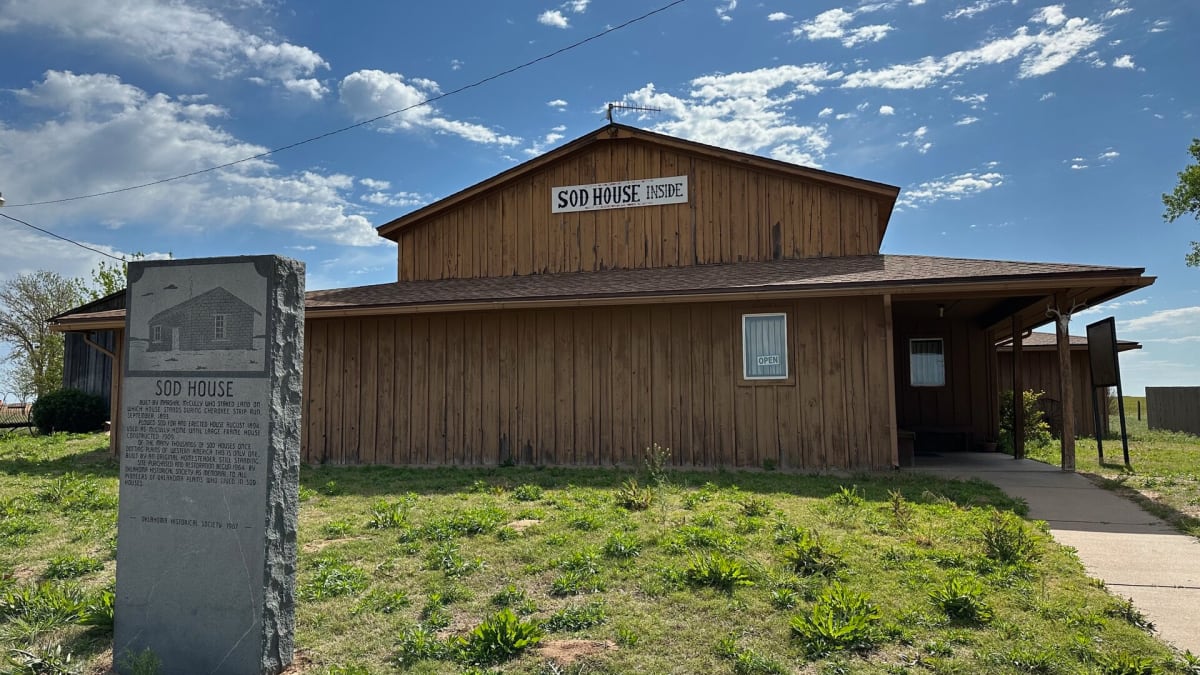
Sod House Museum
57095 Blaine Rd, Aline, OK
Aline, OK
The last original sod house left standing in Oklahoma, built of prairie earth by a homesteader who staked his claim in the great land run of 1893.
The Sod House Museum preserves the only original sod house still standing in Oklahoma, a home built of prairie earth by a homesteader named Marshal McCully after he claimed this land in the great land run into the Cherokee Outlet in 1893. On a treeless plain where lumber was scarce and costly, thousands of settlers cut the tough prairie sod into bricks and stacked them into walls, and this is the last of them left.
The house survives because it was cared for and, in time, protected inside a larger shelter that shields the fragile earthen walls from the weather. Inside, McCully's own furnishings and household goods remain, giving an unusually intimate look at the hard, resourceful life of the homesteaders who broke this prairie. It is a small museum with an outsized story of Oklahoma's settlement.
What Travelers Love
- Seeing the only original sod house left in the entire state
- The vivid picture it gives of hard homestead life on the treeless plains
- The homesteader's own furnishings and tools preserved inside
- A quiet, off-the-beaten-path stop that brings frontier history to life
Worth Knowing
- It is a small, remote museum, so check that it is open before making the drive
- The sod house is protected inside a larger shelter building to preserve it
- This is open plains country, so plan your fuel and provisions ahead
- Pair it with other northwest Oklahoma sites like the Salt Plains or Gloss Mountains
Learn about Sod House Museum
The land runs and the Cherokee Outlet
The land the sod house stands on had been the Cherokee Outlet, a strip granted to the Cherokee Nation but later opened by the federal government to non-Native settlement. On September 16, 1893, the largest of Oklahoma's land runs sent tens of thousands of settlers racing across the line at a signal to stake homestead claims, one of the wildest chapters in the settlement of the American West.
Marshal McCully was among those who claimed land that day. Like his neighbors, he faced a plain with almost no trees and little money for imported lumber. The solution, used across the treeless plains from Oklahoma to the Dakotas, was to build with the land itself, cutting the dense, root-bound prairie sod into bricks and stacking them into thick, insulating walls.
A house made of prairie
To build a soddy, a homesteader plowed strips of tough buffalo grass and cut the sod into heavy bricks, then laid them grass-side down in overlapping courses to form walls a foot or more thick. The earth walls kept the house cool in summer and warm in winter, but they were dark, damp when it rained, and home to insects and the occasional snake dropping from the roof, hard living by any measure.
McCully built his sod house in 1894 and lived in it while he improved his claim, as thousands of families did across the plains. Most soddies eventually crumbled back into the earth or were replaced by frame houses once settlers could afford lumber. That this one endured, and was recognized and protected, is what makes it a rare survivor and the only original example left in Oklahoma.
Preserved for the future
Because earthen walls cannot survive the elements indefinitely, the sod house has been enclosed within a larger protective museum building that shelters it from rain, wind, and sun. Visitors walk inside that shelter to see the soddy up close, its walls, its low doorways, and the original furnishings and tools McCully used, arranged much as they would have been in his day.
The museum is operated as a state historic site, interpreting not just the house but the whole story of homesteading and the land runs that populated this part of Oklahoma. It offers a rare, tangible connection to the ordinary settlers whose labor turned open prairie into farms, a chapter usually told only in words and photographs.
The northwest Oklahoma plains
The country around the museum is classic northwest Oklahoma, flat to gently rolling wheat and cattle land under a huge sky, thinly settled and quiet. The nearest town, Aline, is tiny, and the region has the spare, open character that has defined it since the homesteaders arrived, a landscape that still tells the story the museum preserves.
For travelers, the sod house pairs naturally with the other quiet wonders of this corner of the state. The glittering Great Salt Plains, the red mesas of the Gloss Mountains, and the gypsum caves at Alabaster Caverns all lie within a drive, together making northwest Oklahoma a rewarding, uncrowded region for the curious traveler.
Closest Boutels
The closest Boutel™ stays, so you can turn this stop into an overnight. Each is a place we chose through independent editorial review, never a paid placement.
Evergreen Inn Motel & RV Park
Honorable Mention20001 W. US Highway 54, Pratt, KS
83 miles away|Learn More ›
Prairie Lodge Motel
Honorable Mention1219 Old US Highway 56, Council Grove, KS
184 miles away|Learn More ›
Details
Aline, OK
Frequently asked questions
What is the Sod House Museum?
The Sod House Museum, near Aline in northwestern Oklahoma, preserves a rare original sod house, a home built from blocks of prairie sod, offering a vivid glimpse into the hard life of the pioneers who settled the treeless plains. Because timber was scarce on the prairie, early settlers built their homes from the tough grassland sod, and this museum protects a genuine surviving sod house, one of the few originals left, within a building that shelters it, along with exhibits on pioneer and homesteading life. It is a remarkable and authentic link to the frontier past. A fascinating and authentic pioneer site, it educates visitors. With its historic sod house, the museum offers a compelling destination in Oklahoma.
What is a sod house?
A sod house is a home built from blocks of prairie sod, cut from the tough, root-bound grassland soil, which pioneers on the treeless Great Plains used as building material because lumber was scarce and expensive. These sod homes, though humble, were sturdy and well-insulated against the extremes of prairie weather, a testament to the resourcefulness of the settlers. The Sod House Museum preserves a rare original example. Learning about sod houses enriches a visit to the Sod House Museum in Oklahoma.
What can you see at the Sod House Museum?
You can see a rare original sod house, sheltered and preserved within the museum, along with exhibits on pioneer and homesteading life, artifacts, and the story of the settlers who built and lived in such homes on the prairie. The authentic sod house, the pioneer artifacts, and the story of frontier life are the draws, offering a vivid and authentic glimpse of the past. Seeing a genuine surviving sod house is remarkable. With its history, the Sod House Museum offers a rewarding visit near Aline, Oklahoma.
When is the best time to visit the Sod House Museum?
As a mostly indoor museum sheltering the historic sod house, the Sod House Museum can be enjoyed year-round in various weather, though it keeps its own hours, so checking the current schedule before you go is wise, especially given its rural location. Its authentic exhibit rewards those who seek it out. For a visit, check current hours and plan around them at the Sod House Museum in Oklahoma.
What is near the Sod House Museum?
The Sod House Museum is near Aline in northwestern Oklahoma, within reach of the Cherokee Strip Regional Heritage Center in Enid to the southeast, the Great Salt Plains area to the north, and the routes across northwestern Oklahoma. That makes the Sod House Museum a compelling stop to combine with the Cherokee Strip Regional Heritage Center and the other attractions of northwestern Oklahoma on a visit to the state.
Nearby

Gloss Mountain State Park
12 miles away
Gloss Mountain State Park: on US-412 roughly 6 miles west of Orienta in Major County. Free, open year-round, no facilities beyond a small picnic area and restroom.
Great Salt Plains Crystal Digging Beach
19 miles away
Great Salt Plains crystal digging: free with state park entry (a per-vehicle fee applies). Bring trowels, buckets, and a change of clothes - the red sand stains. Best for ages 4+.

Great Salt Plains State Park
20 miles away
Crystal digging area: on the beach below the dam, northwest shore of Great Salt Plains Lake. Free with park entry. Bring a trowel and containers. Limit: 10 pounds per person per day.