

Snoqualmie Falls
6501 Railroad Ave SE
Snoqualmie, WA
A 268-foot waterfall a hundred feet taller than Niagara's drop, sacred to the Snoqualmie people as the place of creation, half an hour east of Seattle.
Snoqualmie Falls is the rare great waterfall that sits within easy reach of a major city. Less than an hour east of Seattle, the Snoqualmie River gathers itself and drops 268 feet over a rock lip in a single thundering plunge, a fall a full hundred feet taller than the drop at Niagara. Mist rises from the pool below and drifts up the gorge, and a free overlook puts the whole spectacle in front of you.
For all its accessibility, this is not just a scenic stop. To the Snoqualmie people, who have lived in this valley since time immemorial, the falls are among the most sacred places in their world, the very site of creation, and understanding that changes how you see the water and the mist.
What Travelers Love
- The full 268-foot plunge, taller than Niagara Falls, seen from a free overlook
- The short trail down to the base and the river below the falls
- The Salish Lodge perched right at the brink
- How easy it is to reach from Seattle for a quick dose of wild water
Worth Knowing
- This is a sacred site and a traditional burial place for the Snoqualmie people; visit respectfully
- The upper overlook and park are free; parking fills fast on sunny weekends, so come early
- Flow is strongest in the wet season and with snowmelt; a working power plant diverts some of the river
- The trail to the base is short but steep, and the viewpoints can be misty and slick
Learn about Snoqualmie Falls
The sacred heart of the Snoqualmie
The Snoqualmie people regard the falls as central to their culture and spirituality. In their tradition, this is where First Woman and First Man were created by Moon the Transformer, and the great mists rising from the plunge carry the prayers of the people up to the Creator. The area around the falls has been a traditional burial ground for centuries.
That sacredness sits in tension with the falls' modern life as a power site and tourist destination. The Snoqualmie Tribe has long spoken of the hydroelectric development and heavy visitation as a kind of desecration of a holy place. Visiting well means treating the falls not as a backdrop for photos but as a living sacred site, and giving the place and its people respect.
A landmark in the history of power
The falls also hold a landmark place in the history of electricity. In 1898 a hydroelectric plant was built here, and remarkably the powerhouse was tunneled into the rock behind and below the falls rather than built above ground. It is considered the first completely underground hydroelectric plant in the country.
More than a century later the falls still generate power, with the plant drawing water from the river above the drop. That is why the amount of water going over the falls can vary; in high water the full river roars over the lip, while at lower flows more of it is routed through the plant. The engineering is hidden, but it shapes what you see.
Seeing the falls
The main viewpoint sits in a small park at the top of the falls, free to visit, with a railed overlook that frames the plunge and the gorge. A paved path and a steeper trail lead down toward the river at the base, where you can feel the spray and sense the sheer force of the water up close.
Perched right at the brink is the Salish Lodge, a well-known inn and restaurant whose windows look straight over the falls, and which many television viewers recognize from its starring role in a certain surreal series set in a Northwest logging town. Whether or not you stay, the falls themselves are the show.
The Snoqualmie Valley
The falls are the gateway to the Snoqualmie Valley, a green pocket of farms, rivers, and historic railroad towns tucked against the Cascade front. The old towns of Snoqualmie and North Bend keep their small-town character, and the Snoqualmie Valley Trail follows the former rail line for miles through the countryside.
Because it is so close to Seattle and right on the way to the mountains, the falls make an easy first stop on a bigger day. Beyond the valley, the highway climbs to Snoqualmie Pass and the trails, lakes, and ski slopes of the high Cascades, so a waterfall visit can be the opening act of a full mountain outing.
Closest Boutels
The closest Boutel™ stays, so you can turn this stop into an overnight. Each is a place we chose through independent editorial review, never a paid placement.
Details
Snoqualmie, WA
Frequently asked questions
What is Snoqualmie Falls?
Snoqualmie Falls, near the town of Snoqualmie just east of Seattle in Washington, is one of the state's most famous and popular natural attractions, a powerful two-hundred-sixty-eight-foot waterfall thundering over a rocky cliff into the pool below. Set amid lush forest with the historic Salish Lodge perched at its edge, the falls are easily accessible, with viewing platforms, a park, and a trail down toward the base. Famous also for appearing in the television series Twin Peaks, Snoqualmie Falls draws millions of visitors to admire its impressive cascade and beautiful setting. With its dramatic waterfall and easy access, Snoqualmie Falls is a beloved and scenic destination near Seattle.
What can you do at Snoqualmie Falls?
You can view the powerful waterfall from the observation deck and viewpoints in the park at the top, walk the trail that descends toward the base of the falls for a different perspective, stroll the grounds and gardens, dine or stay at the historic Salish Lodge overlooking the falls, and take in the beautiful forest scenery. The upper viewpoints are easily accessible, while the trail to the lower area is a moderate walk. Photography is superb. With its impressive falls, viewpoints, trail, and scenic setting, Snoqualmie Falls offers a beautiful and accessible outdoor outing just east of Seattle in Washington.
What safety tips apply at Snoqualmie Falls?
Stay on the designated viewpoints, trails, and behind railings, as the areas near the top and edge of the falls are dangerous, and going off-trail or beyond barriers toward the water or cliff edges has led to serious accidents, so keep children close and do not attempt to reach the water above the falls. The trail to the lower area can be steep and slippery when wet, so wear good shoes and watch your footing. The river below is powerful. Respecting the barriers and staying on trails ensures a safe visit to enjoy the falls.
When is the best time to visit Snoqualmie Falls?
Snoqualmie Falls is impressive year-round, with the falls most powerful and dramatic in the rainy season and during spring snowmelt, roughly late fall through spring, when high water sends huge volumes over the cliff, while summer offers pleasant weather and easier trail conditions though somewhat lower flow. The falls are beautiful in any season, and mist and rainbows can appear. Weekends and midday are busiest, so early or weekday visits mean smaller crowds. For the most powerful falls, aim for the wetter months, and for pleasant weather and trail access, summer is lovely at Snoqualmie Falls.
What is near Snoqualmie Falls?
Snoqualmie Falls is near the towns of Snoqualmie and North Bend just east of Seattle in Washington, along the Interstate 90 corridor into the Cascade Mountains, near hiking trails, the historic Northwest Railway Museum, and within reach of Seattle to the west and the Cascade recreation to the east. That makes Snoqualmie Falls a scenic and accessible stop to combine with the Snoqualmie Valley, the Cascade foothills, and the attractions of the Seattle area on a visit to Washington.
Nearby
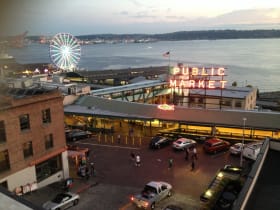
Pike Place Market
24 miles away
One of the oldest continuously running public markets in the country, opened in Seattle in 1907: a rambling warren of fishmongers, flower stalls, produce, and craft tables under the famous red Public...

Pacific Science Center
24 miles away
Pacific Science Center in Seattle Center has IMAX theaters, a laser dome, a butterfly house, a dinosaur exhibit, and hands-on science exhibits across six buildings.

Sunrise
44 miles away
Sunrise is the highest point you can reach by car in Mount Rainier National Park, at about 6,400 feet, with a face-on view of the mountain and the vast Emmons Glacier, the largest glacier in the lower...

Mount Rainier National Park
53 miles away
An active glaciated volcano ringed by wildflower meadows, the tallest peak in the Cascade Range.