

Pacific Science Center
200 2nd Ave N
Seattle, WA
A hands-on science museum housed in Minoru Yamasaki's ethereal white arches, the most beautiful thing to survive the 1962 Seattle World's Fair.
Pacific Science Center is Seattle's beloved hands-on science museum, but its first gift to you is the architecture. The complex is wrapped in five slender white arches rising over reflecting pools, a composition so graceful it looks less like a museum and more like a modern cathedral to curiosity.
Those arches are the last great survivor of the 1962 Seattle World's Fair. Built as the United States Science Pavilion, the buildings were reborn the day after the fair closed as a permanent science center, and they have been filling children and adults with wonder ever since, from the butterfly house to the planetarium dome.
What Travelers Love
- Standing under Yamasaki's five soaring white arches and their reflecting pools
- The warm, free-flying tropical butterfly house
- The planetarium and the domed laser shows
- Hands-on exhibits and live science demonstrations that land for all ages
Worth Knowing
- It sits inside Seattle Center, so parking fills on event days; transit and the monorail are easy alternatives
- The IMAX theater and some special exhibits are separate from general admission
- It is a favorite rainy-day stop, so weekend and school-break afternoons get busy
- The butterfly house is kept warm and humid on purpose, so peel a layer before you go in
Learn about Pacific Science Center
Born from a World's Fair
The 1962 World's Fair, officially Century 21, gave Seattle its Space Needle, its monorail, and this building. The United States Science Pavilion was the fair's showcase of American science, and at the time it held the largest science exhibit in the country, drawing crowds through the summer of 1962.
When the fair closed that October, the pavilion did not go dark. The very next day it reopened as Pacific Science Center, a private nonprofit museum, making it one of the first institutions in the nation founded specifically as a science and technology center for the public. It has anchored Seattle Center, the old fairgrounds, ever since.
Yamasaki's space gothic
The pavilion was designed by the Seattle-raised architect Minoru Yamasaki, who would later design the World Trade Center towers in New York. For the fair he wanted something that felt uplifting and serene, and he gave the complex a set of delicate, pointed white arches over courtyards and pools of moving water.
Yamasaki called the look space gothic, a deliberate blend of the soaring lines of a Gothic cathedral with the optimistic, forward-looking spirit of the space age. Six white exhibit halls, patterned with fine parallel tracery, gather around the elevated central courtyard, and the arches remain one of the most photographed pieces of architecture in the city.
What is inside
Inside, the museum is unapologetically hands-on, built for touching, testing, and asking why. Live science demonstrations run on a stage, exhibits invite you to experiment, and traveling shows bring in everything from dinosaurs to the human body.
The signature spaces have their own devoted fans. A large tropical butterfly house lets hundreds of butterflies flutter freely around you in warm, planted air. A planetarium projects the night sky, a domed theater hosts laser light shows set to music, and an IMAX screen shows science and nature films at giant scale.
Seattle Center around it
The science center is one piece of Seattle Center, the seventy-plus-acre campus that the World's Fair left behind and the city turned into a permanent gathering place. Step out of the arches and the Space Needle is right there across the plaza, along with museums, theaters, fountains, and festival lawns.
That makes the museum an easy anchor for a day in this corner of Seattle. The monorail glides in from downtown, the Museum of Pop Culture and the Chihuly glass garden are steps away, and Pike Place Market and the waterfront are a short ride south.
Closest Boutels
The closest Boutel™ stays, so you can turn this stop into an overnight. Each is a place we chose through independent editorial review, never a paid placement.
Details
Seattle, WA
Frequently asked questions
What is the Pacific Science Center?
The Pacific Science Center, at the Seattle Center in Seattle, Washington, is a beloved hands-on science museum housed in a distinctive complex of buildings with graceful white arches. Offering a wide array of interactive exhibits, the center engages visitors of all ages with displays on physics, biology, the human body, dinosaurs, space, and more, along with a tropical butterfly house, a planetarium, IMAX theaters, and live science demonstrations. A top family destination, the Pacific Science Center makes learning fun and interactive. With its engaging exhibits, butterfly house, planetarium, and IMAX films, the Pacific Science Center offers an educational and entertaining experience for families and curious minds in Seattle.
What can you do at the Pacific Science Center?
You can explore hundreds of hands-on, interactive exhibits on science and nature, walk through the warm tropical butterfly house filled with live butterflies, see dinosaur exhibits, watch a show in the planetarium, catch a film in the IMAX theaters, enjoy live science demonstrations, and let children experiment and play at engaging stations. The variety keeps visitors of all ages entertained and learning. The butterfly house is a special highlight. With its interactive exhibits, butterfly house, planetarium, IMAX, and demonstrations, the Pacific Science Center offers a fun and educational outing for families and science lovers in Seattle, Washington.
Is the Pacific Science Center good for families?
Yes, the Pacific Science Center is an outstanding family destination, with hands-on, interactive exhibits designed to engage children while teaching them about science and nature, along with the beloved tropical butterfly house, dinosaurs, planetarium and IMAX shows, and live demonstrations that captivate kids and adults alike. There are areas geared to younger children as well. The mix of education and fun makes it a top choice for families. With its engaging, kid-friendly exhibits and attractions, the Pacific Science Center offers an enriching and enjoyable outing that sparks curiosity and delights children and families in Seattle.
When is the best time to visit the Pacific Science Center?
As an indoor attraction, the Pacific Science Center is enjoyable year-round and a great option in any weather, including a perfect choice on a rainy Seattle day. Weekdays and mornings tend to be less crowded than busy weekends, school holidays, and popular exhibitions. Checking the schedule for planetarium and IMAX shows and any special exhibits before you go helps you plan. Allowing several hours lets you enjoy the extensive exhibits and shows. The indoor setting means almost any time works, making the Pacific Science Center a reliable and enriching family destination year-round in Seattle.
What is near the Pacific Science Center?
The Pacific Science Center is at the Seattle Center in Seattle, Washington, right near the iconic Space Needle, the Museum of Pop Culture, the Chihuly Garden and Glass, and the other attractions of the Seattle Center, with Pike Place Market and the downtown waterfront a short distance away. That makes the Pacific Science Center a top family stop to combine with the Space Needle, the Seattle Center attractions, Pike Place Market, and the many other sights of Seattle on a visit to Washington.
Nearby
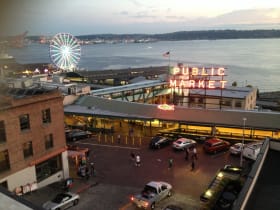
Pike Place Market
0.8 miles away
One of the oldest continuously running public markets in the country, opened in Seattle in 1907: a rambling warren of fishmongers, flower stalls, produce, and craft tables under the famous red Public...

Snoqualmie Falls
24 miles away
Snoqualmie Falls is off SR-202 near the town of Snoqualmie, about 30 miles east of Seattle and minutes from I-90.
Deception Pass State Park
56 miles away
Deception Pass State Park is Washington's most visited state park, where Whidbey and Fidalgo Islands nearly meet at a narrow, churning tidal channel.

Olympic National Park
60 miles away
Three worlds in one park: rugged Pacific coast, temperate rainforest, and glacier-capped mountains.

Mount Rainier National Park
64 miles away
An active glaciated volcano ringed by wildflower meadows, the tallest peak in the Cascade Range.