
Smelt Sands State Recreation Site
Off US-101 near milepost 163
Yachats, OR
An intimate cove where surf explodes against black basalt, and the trailhead of the 804, a stretch of old public right-of-way that citizens fought to keep open.
Smelt Sands is a small state site with an outsized personality. Tucked at the north end of Yachats, it is a stretch of rugged rocky shoreline where the surf comes in hard against a shelf of black volcanic basalt, throwing spray through spouting horns and filling the air with the boom of the sea. There is no broad sandy beach here, just tide pools, churning water, and a low bluff that feels close to the raw power of the Pacific.
It is also the trailhead of the 804, one of the more quietly remarkable public paths on the Oregon coast. The trail runs north from the parking lot along the top of the bluff, paved and largely accessible, with benches where you can sit and watch for gray whales. Behind that gentle path lies a real story about a community that fought to keep a piece of coastline open to everyone.
What Travelers Love
- Surf and spouting horns exploding against a rugged shelf of volcanic basalt
- The paved, largely accessible 804 Trail running north atop the bluff with benches and views
- Tide pools at low tide and gray whales passing offshore on migration
- Storm-watching and dramatic sunsets in the wet season
Worth Knowing
- This is a day-use site with restrooms and picnic tables, and typically no day-use fee is charged
- This is a sneaker-wave and slippery-rock coast where people have been swept from the rocks, so stay well back from the surf and off the wet basalt
- The 804 Trail is paved and accessible for much of its length, though footing near the beach access can be slick in storms
- The parking lot is small and can fill on nice days, and coast weather is often wet and windy, so dress in layers and time tide pools for low tide
Learn about Smelt Sands State Recreation Site
The fish that gave it its name
Smelt Sands is named for the smelt, the small silvery fish, relatives of salmon, that once ran along this shore in great numbers. For generations coastal Native people and later local residents gathered here and along the nearby Yachats River to catch the spawning fish with dip nets right from the shore. As recently as the 1980s people came with nets and buckets and filled them in minutes.
Those runs faded. They grew irregular through the 1990s, and the Pacific smelt, the eulachon, was listed under the Endangered Species Act in 2010, so there are few smelt at Smelt Sands today. The name endures as a small piece of coastal memory, a reminder that this quiet cove was once a working shoreline where families came to fill their buckets from the sea.
The 804 Trail
The trail that begins at Smelt Sands is called the Yachats 804 Trail, and it follows an old county road right-of-way, a historic public access route preserved as a walking path. It runs north along the top of the low bluff, paved and wheelchair-accessible for much of its length, with benches set out for whale watching and rest, and it now forms a segment of the long Oregon Coast Trail.
It exists because people made it so. After roughly fifteen years of effort by local citizens who did not want to lose this stretch of shoreline access, the route was dedicated for public recreation as a hiking trail in 1990, and it was later improved with help from Oregon Parks Forever. The reported length varies by source, from a short stretch of the bluff to a longer walk toward Yachats State Park, but the point is the same: a rare piece of accessible, hard-won coast open to anyone.
Surf, tide pools, and whales
The draw at Smelt Sands is the meeting of water and rock. The shore here is rugged volcanic basalt rather than sand, so the incoming surf breaks and churns and shoots up through natural spouting horns, and at low tide the same rocks hold tide pools full of small coastal life. In the wet season the site becomes a fine spot for storm-watching, and its designated viewpoint makes it a good place to catch gray whales passing on migration.
That same beauty carries real danger. This is a sneaker-wave coast, where an ordinary-looking sea can suddenly send a much larger wave far up the rocks, and people have been swept off and drowned here. The rule is simple and firm: stay well back from the surf, never turn your back on the ocean, and keep off the wet, slick basalt. Enjoy the power of the place from a safe distance.
Visiting Smelt Sands
Smelt Sands is easy to reach, at the north edge of Yachats off US-101 near milepost 163. Turn west at the sign onto the short lane that leads to the parking lot, which is small, holding only about a dozen cars, so it can fill on a fine day. There are restrooms and picnic tables on site, and typically no day-use fee.
Come dressed for the coast, which is often wet and windy, and bring layers and rain gear whatever the forecast. Time a visit for low tide if you want the tide pools, and give yourself time to walk at least part of the 804 Trail. It is the kind of small, honest place that rewards a slow hour, watching the surf work the rocks and the horizon for the spout of a passing whale.
Closest Boutels
The closest Boutel™ stays, so you can turn this stop into an overnight. Each is a place we chose through independent editorial review, never a paid placement.
Details
Yachats, OR
Frequently asked questions
What is Smelt Sands State Recreation Site?
It is a small, scenic park at the north edge of Yachats on the central Oregon coast, set on a rugged basalt shoreline. It offers parking, restrooms, and picnic spots, plus access to tide pools, dramatic spouting horns where waves shoot up through the rocks, and the lovely 804 Trail. Named for the small silvery smelt that once ran here, it is a peaceful, beautiful stop with ever-changing views.
What is the 804 Trail?
The historic 804 Trail runs through Smelt Sands along the rocky shore, an easy path of about three-quarters of a mile one way with benches along the route, and much of it is wheelchair accessible. Part of the larger Oregon Coast Trail, it stays above the tide line, so it can be safely walked at any time, offering gorgeous ocean views, rock formations, and whale-watching chances as you go.
How dangerous are sneaker waves at Smelt Sands?
This is the most important thing to know. Sneaker waves here are powerful and unpredictable, surging far higher up the rocks than expected with no warning, and a marker at the park remembers two boys who were swept off the rocks and drowned. Never turn your back on the ocean, stay well back from the wet rocks and the surf, keep children close, do not climb over barriers, and check a tide table before exploring the shore.
What can you see at Smelt Sands?
At low tide, the basalt shelves reveal tide pools full of sea stars, anemones, and other creatures, while incoming waves send spray blasting up through the spouting horns. It is also a fine spot to watch for migrating gray whales offshore and to catch a spectacular sunset. Explore the tide pools gently and leave all wildlife undisturbed, taking only photos so the shore stays rich for everyone.
When is the best time to visit Smelt Sands?
Low tide is best for tide pools, while a good swell makes the spouting horns most dramatic, so each visit differs with the weather and tide, which is part of the charm. Whale-watching peaks during the winter and spring migrations. The 804 Trail is enjoyable year-round and safe above the tide line, but always keep an eye on the surf, and bring layers for the cool, breezy coast.
Outside the Park
Cape Perpetua Tidepools
2.9 miles away
Cape Perpetua tidepools are among the best kid-friendly tide pool spots on the coast: giant green anemones, purple sea urchins, hermit crabs, and sea stars in pools that are waist-deep for an adult an...
Thor's Well and the Devil's Churn
3.0 miles away
Two of the Oregon coast's most theatrical natural features, carved by the surf into the basalt of Cape Perpetua.
Sea Lion Caves
14 miles away
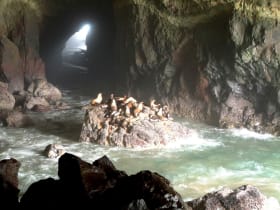
Sea Lion Caves delivers on its promise: an elevator drops you into a cathedral-sized sea cave packed with Steller sea lions hauled out on the rocks.