
Roosevelt Arch
1 Roosevelt Arch, Gardiner
Gardiner, MT
The towering basalt gateway to Yellowstone's North Entrance, dedicated by Theodore Roosevelt in 1903 and carved with the promise that the park is for everyone.
The Roosevelt Arch is the grand basalt gateway that has framed the North Entrance to Yellowstone National Park since 1903. Two fifty-foot towers of dark local stone are joined by a broad arch, and across the top runs a line from the 1872 law that created the park: For the Benefit and Enjoyment of the People. For more than a century it has been the ceremonial front door to the world's first national park.
The arch rose in a practical moment. In 1903 most Yellowstone visitors arrived by train at Gardiner and boarded stagecoaches for the ride into the park, and the dusty staging area needed something worthy of the destination. President Theodore Roosevelt, on a tour of the park, laid the cornerstone that spring before thousands of onlookers, and his name has been attached to the arch ever since.
What Travelers Love
- Driving or walking through the massive stone arch on the way into Yellowstone
- The inscription across the top, 'For the Benefit and Enjoyment of the People'
- The tie to Theodore Roosevelt and the early days of the national park idea
- Watching elk and the Yellowstone River right at the park's historic front door
Worth Knowing
- This is the North Entrance, one of the few Yellowstone gates open to cars year round
- Gardiner and the entrance area get busy in summer; early or late in the day is calmer
- Elk often graze right in town and near the arch; keep a safe distance
- There is a small pull-off and park to view and photograph the arch on foot
Learn about Roosevelt Arch
A gateway for the railroad age
In the early 1900s, a trip to Yellowstone usually meant a train to Gardiner and then a stagecoach into the park. Gardiner had just built a handsome rustic depot, and park administrators along with local boosters felt the arrival point deserved a proper monument. The idea came from Captain Hiram Chittenden, the U.S. Army engineer overseeing Yellowstone's roads, who designed a rusticated gate to mark the threshold.
Stonemasons quarried basalt nearby and built the arch over several months in 1903, raising two fifty-foot towers spanned by a twenty-foot arch and flanked by low wing walls. The result was monumental and rough-hewn at once, a gate that looked like it had grown from the mountains it guarded.
Roosevelt's cornerstone
On April 24, 1903, President Theodore Roosevelt, touring Yellowstone, laid the cornerstone of the still-unfinished arch at a ceremony that drew thousands and a great deal of fanfare. A champion of the young conservation movement, Roosevelt was a fitting figure to bless a gateway to the nation's first national park, and the structure has carried his name ever since.
There is a small irony in the story. After that dedication, Roosevelt never returned to Yellowstone, so he never saw the completed arch that bears his name. Carved across its top is the phrase from the park's founding law, For the Benefit and Enjoyment of the People, a line that still sums up the national park idea.
The North Entrance today
The arch still marks the North Entrance at Gardiner, one of the few Yellowstone gates that stays open to vehicles all year. Drivers and walkers pass beneath it on their way toward Mammoth Hot Springs and the park's northern range, one of the best places in Yellowstone to see wildlife.
Gardiner itself is a lively little gateway town on the Yellowstone River, and elk are frequent visitors, grazing on lawns and near the arch as if they own the place. The northern range beyond holds bison, wolves, pronghorn, and bighorn sheep, so the drive through the arch often opens onto animals within minutes.
Closest Boutels
The closest Boutel™ stays, so you can turn this stop into an overnight. Each is a place we chose through independent editorial review, never a paid placement.
Details
Gardiner, MT
Frequently asked questions
What is the Roosevelt Arch?
The Roosevelt Arch, at the North Entrance to Yellowstone National Park in Gardiner, Montana, is a grand and iconic stone archway marking the historic original entrance to America's first national park. Built in the early twentieth century and dedicated by President Theodore Roosevelt, the massive basalt arch bears the inscription For the Benefit and Enjoyment of the People, capturing the ideals of the national park movement. Standing as a majestic gateway through which visitors have passed into Yellowstone for well over a century, the arch is a beloved and photographed landmark and a symbol of the parks. With its historic arch and symbolism, the Roosevelt Arch offers a fascinating destination in Montana.
What can you do at the Roosevelt Arch?
You can drive or walk through the grand stone arch marking the historic entrance to Yellowstone, photograph the iconic landmark and its inscription, learn its history and connection to Theodore Roosevelt, and use it as your gateway into the park's northern wonders. The majestic historic arch, its inspiring inscription, and its role as the symbolic front door to Yellowstone are the draws, making it a memorable and meaningful stop. Passing through the arch into the park is a special experience. With its historic arch, the Roosevelt Arch offers an engaging experience in Montana.
What does the inscription on the Roosevelt Arch mean?
The inscription on the Roosevelt Arch reads For the Benefit and Enjoyment of the People, a phrase capturing the founding ideal of Yellowstone and the national park movement: that these extraordinary natural places should be protected and made available for everyone to enjoy, not just the privileged few. The words express the democratic vision behind the creation of America's first national park. Reading the inscription as you pass through the arch connects you to this ideal. Understanding it adds meaning to a visit to the Roosevelt Arch in Montana.
When is the best time to visit the Roosevelt Arch?
The Roosevelt Arch can be visited year-round at the year-round North Entrance, with summer the busiest and warmest, late spring and fall offering fewer crowds and lovely weather, and winter providing a striking snowy backdrop, especially since this entrance stays open to cars in winter. The arch is photogenic in any season. For fewer crowds aim for spring or fall, or visit in summer for full park access or winter for snowy scenery, at the Roosevelt Arch in Gardiner, Montana.
What is near the Roosevelt Arch?
The Roosevelt Arch is at the North Entrance to Yellowstone in Gardiner, Montana, within reach of the town of Gardiner, Mammoth Hot Springs just inside the park, Chico Hot Springs in the Paradise Valley, and the Yellowstone gateway region. That makes the Roosevelt Arch a fascinating stop to combine with Gardiner, Mammoth Hot Springs, and the other attractions of the Yellowstone gateway on a visit to Montana.
Nearby

Gardiner and the Yellowstone North Entrance
0.4 miles away
Gardiner puts kids right at the edge of Yellowstone, and the wildlife often comes to them: elk regularly graze the lawns and roadsides in and around town, a safe distance away.
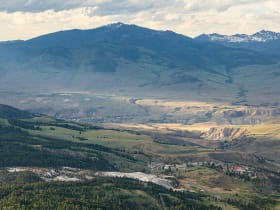
Mammoth Hot Springs
3.3 miles away
Yellowstone's living travertine terraces, pale stone laid down layer by layer by hot mineral water so the springs grow and shift from year to year.

Absaroka-Beartooth Wilderness
19 miles away
Nearly a million acres of alpine plateau, granite peaks, and glacier-carved lakes rise east and north of Gardiner, just outside Yellowstone's north entrance.

Beartooth Highway
34 miles away
This is one of the great mountain drives on the continent. The Beartooth Highway leaves Red Lodge and climbs in tight switchbacks onto the Beartooth Plateau, cresting close to 11,000 feet at Beartooth...

Yellowstone National Park
40 miles away
The world's first national park, sitting atop a supervolcano of geysers, hot springs, and vast wildlife herds.

Chief Joseph Scenic Highway
49 miles away
Chief Joseph Scenic Highway (WY-296) runs 47 miles from Cody to Cooke City, Montana through the Absaroka Range country that Nez Perce Chief Joseph led his people through in 1877 during the epic 1,170-...