
Pu'uhonua o Honaunau National Historical Park
Honaunau, HI 96726
Honaunau, HI
An ancient Hawaiian place of refuge on the Kona coast, where a lawbreaker who reached the sacred ground was forgiven and set free.
In old Hawaii, breaking a sacred law could cost you your life. The laws, called kapu, governed almost everything, and Hawaiians believed that breaking one angered the gods and could bring earthquakes, eruptions, or tidal waves down on everyone. There was one way out. If a lawbreaker could reach a pu'uhonua, a place of refuge, before their pursuers caught them, they were safe. This point of black lava on the Kona coast was the greatest of them.
A person fleeing here, often swimming across the bay to get past the people chasing them, was protected the moment they set foot on the sacred ground. A priest performed a ceremony of absolution, and after a time the offense was wiped clean and the person was free to go home. The same sanctuary sheltered defeated warriors and the old, the women, and the children during war. Today the National Park Service keeps the place, its Great Wall and its temple and its carved guardian images still standing at the water's edge.
What Travelers Love
- Standing at the Great Wall, a massive lava-rock wall built around the 1500s and fitted together without any mortar
- The reconstructed temple ringed by tall carved wooden images looking out over the bay
- Watching honu, Hawaiian green sea turtles, bask on the shore of the old royal canoe cove
- The world-class snorkeling at Two Step, the shore-entry spot just outside the park boundary
Worth Knowing
- This is a living sacred site, so stay on marked paths and do not touch, lean on, or climb the wall, the temple, or the carved images, and never move rocks or take anything
- The honu are federally protected; keep well back, and never touch, feed, or approach a turtle on the sand
- You cannot swim from inside the park, since the royal cove is closed to water entry; snorkelers use the adjacent Two Step access just outside the boundary
- The Kona coast is hot, dry, and sunny with little shade, and the loop crosses uneven, sharp lava rock, so bring water, sun protection, and closed-toe shoes
Learn about Pu'uhonua o Honaunau National Historical Park
What a place of refuge meant
To understand this park you have to understand kapu, the sacred laws of old Hawaii. Kapu, the root of the English word taboo, governed nearly every part of daily life, from what a person could touch to where they could walk to who could eat with whom. A commoner could not let his shadow fall on a chief. Men and women could not eat together. Breaking a kapu was not just a crime, it was believed to threaten the whole community by angering the gods, so the punishment was often death.
The pu'uhonua was the mercy built into that hard system. A person who broke a kapu, or a warrior on the losing side of a war, could flee to the sacred ground and be safe. A kahuna pule, a priest, would perform a ceremony of absolution, and once it was done the person was forgiven and free to return to ordinary life. The refuge belonged to the gods, and no one, not even a chief, could take a life on that ground.
The Great Wall and the temple
The most striking thing you see here is the Great Wall, called the Pa Pu'uhonua, which separates the sacred refuge from the royal grounds beside it. It was built around the middle of the 1500s, and it is roughly a thousand feet long, about ten feet high, and some seventeen feet thick. What makes it remarkable is that it is dry-stacked, meaning the heavy lava stones are fitted together by hand with no mortar at all, and much of it has stood for nearly five centuries.
At the shore stands Hale o Keawe, a reconstructed temple, or heiau, that once served as a royal mausoleum. It held the bones of about twenty-three chiefs, and that mattered deeply, because Hawaiians believed a person's bones carried their mana, their sacred spiritual power. Keeping the chiefs' bones here concentrated great mana on the site, which was believed to sanctify and protect the whole refuge. Tall carved wooden images called ki'i, representing gods and guardian spirits, stand watch around the temple. The temple and images you see today are careful reconstructions; the bones are no longer there.
The royal grounds and the shore
Beside the refuge lie the royal grounds, where the ali'i, the Hawaiian chiefs, lived and held ceremonies. They chose this spot for its sheltered bay, its fresh springs, and its fishponds, and you can still see the old aquaculture ponds where they raised fish. A pitted stone board marks where people played konane, a traditional Hawaiian game a little like checkers, using black and white pebbles. A small cove nearby was the royal canoe landing, once reserved for chiefs alone.
That royal cove is now a favorite resting place for honu, the Hawaiian green sea turtles, which often haul out onto the sand and rocks along the shore. They are federally protected, and the rule is simple: keep your distance, never touch or feed them, and give them room. Between the turtles, the tide pools, the coconut grove, and the black lava meeting turquoise water, the shoreline is as memorable as the historic sites themselves.
Visiting the park
A visit is an easy, flat walking loop of about half a mile, with numbered stops keyed to a park brochure and a free phone audio tour, and most people spend an hour or a little more. Park staff and cultural practitioners often demonstrate traditional Hawaiian crafts and skills, and the park holds an annual cultural festival with hula and Hawaiian arts. This is an active NPS site with an entrance fee, covered by the national parks pass; check the park website for current details.
Above all, treat it as the sacred place it is. Stay on the marked paths, and do not touch, lean on, or climb the wall, the temple, or the carved images. Just outside the park boundary is Two Step, one of the island's best shore-entry snorkeling spots, named for the natural lava ledges that let you step down into the clear water. Remember that you cannot enter the water from inside the park itself, since the royal cove is closed to swimming, so snorkelers use that adjacent public access. Bring water, sun protection, and sturdy shoes for the lava, and give yourself time to let the place sink in.
Closest Boutels
The closest Boutel™ stays, so you can turn this stop into an overnight. Each is a place we chose through independent editorial review, never a paid placement.
Details
Honaunau, HI
Frequently asked questions
What is Puuhonua o Honaunau National Historical Park?
Puuhonua o Honaunau National Historical Park, on the Kona coast of the Big Island of Hawaii, preserves a sacred and historic place of refuge, one of the most significant and beautiful cultural sites in the islands. In ancient Hawaii, a puuhonua was a sacred place of refuge, where those who had broken a sacred law, or defeated warriors and others, could find sanctuary and absolution, and this remarkably preserved site includes the puuhonua, temple platforms, sacred images, royal grounds, fishponds, and the reconstructed structures of this important place, set on a stunning lava coastline. It is a place of deep cultural and spiritual significance. A sacred and beautiful cultural site, it moves and educates visitors. With its place of refuge, the park offers a meaningful destination in Hawaii.
What is a puuhonua, or place of refuge?
A puuhonua, or place of refuge, was a sacred site in ancient Hawaii where a person who had broken a sacred law, which could carry a death sentence, or defeated warriors and noncombatants in war, could flee to find sanctuary and absolution, sparing their life if they reached the sacred grounds. These places held deep spiritual power and significance in Hawaiian culture. Puuhonua o Honaunau preserves one of the most important such sites. Understanding this concept deepens a visit to Puuhonua o Honaunau National Historical Park in Hawaii.
What can you see at Puuhonua o Honaunau National Historical Park?
You can see the sacred place of refuge, temple platforms, reconstructed sacred images, or kii, the royal grounds, fishponds, and other preserved and reconstructed features of this important site, all on a stunning lava coastline, while learning about ancient Hawaiian culture and the concept of the puuhonua. The sacred grounds, the carved images, the royal grounds, and the beautiful coastal setting are the draws, offering a meaningful and moving experience. The place of refuge and its significance are highlights. Approaching it with respect enriches a visit to Puuhonua o Honaunau in Hawaii.
How should visitors treat Puuhonua o Honaunau National Historical Park?
Because Puuhonua o Honaunau is a sacred cultural site of profound significance to Native Hawaiians, visitors should treat it with great respect and reverence, staying on designated paths, not touching, climbing on, or disturbing the sacred structures, images, or any offerings, and being quiet and respectful. Honoring the sacredness of the place respects Hawaiian culture and heritage. Approaching the park with deep respect ensures a meaningful visit to Puuhonua o Honaunau National Historical Park in Hawaii.
What is near Puuhonua o Honaunau National Historical Park?
Puuhonua o Honaunau National Historical Park is on the Kona coast of the Big Island of Hawaii, within reach of the Captain Cook and Kealakekua Bay area, Kona town, Magic Sands Beach, and the other attractions of the Kona coast. That makes Puuhonua o Honaunau a meaningful stop to combine with the Captain Cook Monument and the other attractions of the Kona coast on a visit to Hawaii.
Nearby
Magic Sands Beach Park
16 miles away
A rare pocket of soft white sand on the black-lava Kona coast, right on Ali'i Drive a few miles south of downtown Kailua-Kona.

Mauna Kea
40 miles away
Mauna Kea is a giant volcano on Hawaii's Big Island, so tall that its summit rises high above the clouds.
Hawaii Volcanoes National Park
40 miles away
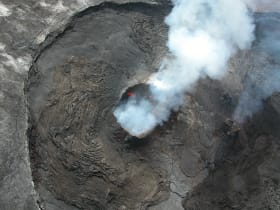
Two of the world's most active volcanoes, Kilauea and Mauna Loa, still building the island of Hawaii.

Kilauea Caldera
41 miles away
Kilauea is one of the most active volcanoes on Earth, and its summit caldera, with the Halemaumau crater at its heart, is the centerpiece of Hawaii Volcanoes National Park.