
Peter French Round Barn
Round Barn Rd
Diamond, OR
A cattle baron built this round barn to break horses through the high-desert winter, and more than a century later it still stands alone on the sagebrush plain, the last of its kind.
The Peter French Round Barn is one of the strangest and most striking structures in the Oregon high desert, a great circular horse barn standing by itself on the sagebrush plain of Harney County. Built in the 1880s by the cattle baron Peter French and his ranch hands, it was designed so that young saddle horses could be broken and exercised under cover through the long, brutal high-desert winter. Inside, a wall of local lava rock forms a round corral, ringed by a covered track where the horses were worked.
French built more than one round barn in this country, but this is the sole survivor and the best preserved, and it has become a quiet monument to a vanished world. It speaks to the sheer scale of the cattle empire that once spread across these valleys, and to the hard, ingenious craft of the people who worked it. Today it stands on public land, free and unstaffed, a piece of the Old West left out in the open air.
What Travelers Love
- A striking, well-preserved round barn standing entirely alone on the open range
- The lava-rock corral wall inside, hauled and laid stone by stone in the 1880s
- The deep, uncrowded silence of Harney County's high desert
- The tie to Peter French, one of the Old West's great and controversial cattle barons
Worth Knowing
- It is remote, reached by back roads that include gravel, so check conditions and carry water and a full tank
- The site is open, unstaffed, and self-guided, with few or no services nearby
- Winters are cold and snowy and summers are hot and dry, so spring and fall are the easiest times to visit
- You are in working ranch country, so respect fences, gates, and private land around the site
Learn about Peter French Round Barn
A barn built to break horses
The round barn was raised in the 1880s, though the exact year is uncertain and sources disagree, placing it anywhere from the late 1870s to the middle 1880s. It was the work of Peter French and the cowhands of his P Ranch, and its purpose was practical. In a country where winter could shut down all outdoor work for months, a covered circular barn let horses be broken, trained, and exercised no matter the weather.
The design is ingenious. The whole structure is roughly a hundred feet across, its conical roof carried by a tall central juniper pole and a ring of peeled juniper posts, with diagonal braces radiating out to hold the rafters. Juniper was chosen because it is one of the most rot-resistant woods on the high desert, and much of it came from the surrounding land.
At the heart of the barn is a circular corral wall built of local lava rock, laid up by hand into a low stone ring. The basalt was quarried some miles away and hauled in by horse-drawn wagon, a staggering amount of stone moved by muscle and animal power. Between that inner stone corral and the outer wall runs a broad covered track, the exercise ring where riders worked green horses in circles, out of the wind and snow. Stand inside it today and you can still read the whole clever idea at a glance.
Peter French and his cattle empire
Peter French, born in Missouri in 1849, came west as a young horse-breaker working for the California cattleman Dr. Hugh Glenn. In 1872 Glenn sent him north into southeastern Oregon with a herd of cattle, a handful of vaqueros, and a cook. French established the P Ranch in the Blitzen Valley, and over the next quarter century built it into one of the largest cattle operations in the American West, sprawling across the Blitzen, Diamond, and Catlow valleys of the Harney Basin.
That empire made French powerful and deeply resented. He acquired vast tracts of marshland cheaply, had employees file homestead claims he later took over, and fenced land that many settlers considered open public domain. In a country where access to water and grass meant survival, French's fences and holdings put him at bitter odds with the homesteaders moving in around him.
The conflict ended in violence. On December 26, 1897, a settler named Ed Oliver, who had been feuding with French over a right-of-way across his land, shot and killed him. Though French and his men were unarmed, Oliver was tried and acquitted on a claim of self-defense. The great cattleman was dead at forty-eight, and his round barns and ditches and fence lines were left to tell the story. His empire is gone, but its shape is still written across the Harney Basin, and this barn is its clearest surviving mark.
The people of the Harney Basin
Long before any cattle came, the Harney Basin was and remains the homeland of the Northern Paiute people. The Wadatika band takes its name from the wada seeds they gather near the shores of Malheur Lake, and they live by gathering seeds, roots, and berries and by hunting across this high-desert country through the turning of the seasons. Their descendants are the Burns Paiute Tribe, a federally recognized nation whose reservation lies near the town of Burns and whose ties to this basin continue unbroken today.
The nineteenth century brought hardship. In 1872 the federal government set aside the Malheur Indian Reservation for Northern Paiute bands, a large tract centered on this basin, but settler and prospector pressure quickly shrank it, and lands vital for gathering food were opened to settlement. After the Bannock War of 1878, hundreds of Paiute people, many of whom had taken no part in the fighting, were forced to march in winter to the Yakama Reservation far to the north, a removal the community remembers with grief.
In the years that followed, people returned to the Harney Basin, and the Burns Paiute Tribe today governs its own reservation and carries forward its language, culture, and stewardship of this land. The round barn and the ranch empire around it are one recent layer in a human story here that stretches back thousands of years, and it is right to remember whose country this has always been.
A land of birds, lava, and a great mountain
The barn sits at the edge of one of the richest bird landscapes in the West. Nearby, the Malheur National Wildlife Refuge fills the Harney Basin with a mosaic of wetlands, lakes, meadows, and sagebrush at the northern edge of the Great Basin. It is a major stopover on the Pacific Flyway, drawing hundreds of bird species and a steady stream of birders, especially in spring when the marshes come alive with waterfowl and migrating songbirds.
Just north of the barn lies Diamond Craters, an unusually diverse cluster of young volcanic features packed into a compact area, with craters, cinder and spatter cones, lava tubes, and a water-filled maar. Some of it is geologically recent, and it makes a fascinating detour for anyone curious about how this basalt country was built.
Over the whole scene rises Steens Mountain, a massive fault-block ridge climbing toward nearly ten thousand feet on the south side of the basin, its flanks carved by glaciers into deep U-shaped gorges. Together the refuge, the craters, and the mountain make this remote corner of Oregon one of the most rewarding for travelers willing to go the distance.
Visiting the high desert
This is remote country, and it rewards visitors who come prepared. The barn stands on public land as an Oregon state heritage site, free and self-guided, with no staff on hand. It is reached by back roads that include gravel stretches, so it is worth checking conditions, filling the tank, and carrying water and supplies before you set out.
The seasons here run to extremes. Winters bring cold and snow, and summers can be hot and dry, which makes spring and fall the most comfortable times to explore. Spring is also the high point for birding at the Malheur refuge, when the greatest variety of waterfowl and songbirds passes through the basin.
Above all, this is working ranch country, quiet and enormous, and part of its magic is how little has changed. Come with a full day, a sense of distance, and a willingness to let the silence and the sky do their work, and the round barn standing alone on the plain becomes something you will not forget.
Closest Boutels
The closest Boutel™ stays, so you can turn this stop into an overnight. Each is a place we chose through independent editorial review, never a paid placement.
Details
Diamond, OR
Frequently asked questions
What was the Peter French Round Barn used for?
It was a horse-breaking barn. Built in the 1880s by the cattle baron Peter French and his ranch hands, the unusual round design created an enclosed circular corral where cowboys could train and break wild horses through the harsh high-desert winters, sheltered from the wind and snow. A big cattle operation needed a steady supply of trained saddle horses, and this barn helped produce them by the hundreds.
Who was Peter French?
Peter French was one of the most powerful, and most controversial, cattlemen in the history of the American West. Arriving in the Harney Basin in the 1870s, he built an enormous ranching empire spanning well over a hundred thousand acres. His aggressive control of land and water made him bitter enemies, and those disputes ultimately led to his murder in 1897. His round barn is one of the most tangible reminders of that frontier era.
Is the Peter French Round Barn worth visiting?
For anyone interested in history or unusual architecture, yes. It is a genuinely rare survivor, a beautifully engineered round barn standing alone in the vast high desert, and stepping inside to see the circular framing and central stone corral is memorable. It is free to visit, and there is usually a nearby visitor center and store where staff are happy to share the history.
Is the round barn remote, and how should I prepare?
Yes, it sits far out in the open country of Harney County, well away from towns and services, so come self-sufficient with a full tank of gas, water, and snacks. It pairs naturally with other remote wonders of the area, like the Malheur wildlife refuge, the Diamond Craters, and Steens Mountain, so many visitors fold it into a longer loop through southeastern Oregon's outback.
When is the best time to visit the Peter French Round Barn?
Spring through fall is the most comfortable, avoiding winter's snow and mud on the back roads, and pairing well with the spring bird migration at nearby Malheur or summer trips up Steens Mountain. The high desert bakes in midsummer and cools sharply at night, so bring water, sun protection, and a layer whenever you go, and enjoy the deep quiet of this remote corner of the state.
Nearby

Steens Mountain
23 miles away
A mile-high fault-block mountain rising alone from the southeast Oregon high desert, its gentle west slope climbing to a rim that drops nearly a mile to the Alvord Desert.

Malheur National Wildlife Refuge
24 miles away
The refuge sits in a closed basin with no drainage to the ocean, a remnant of a much larger prehistoric lake that covered much of the Harney Basin during the last ice age.
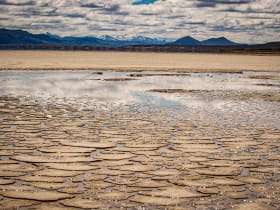
Alvord Desert
28 miles away
The Alvord playa is one of the flattest surfaces in Oregon and one of the more surreal. Looking east from the playa, the land runs flat toward Idaho with no interruption.