
McKenzie River Swimming Holes
NF-126
Blue River, OR
Turquoise pools so clear and cold they look bottomless, where the McKenzie River rises straight out of a buried lava flow in the Cascade foothills.
The McKenzie is one of Oregon's clearest rivers, so pure and low in silt that locals have long called it the Blue McKenzie. Along its upper reaches, between Blue River and McKenzie Bridge, it slows into a series of cold, glass-clear swimming holes framed by old-growth forest. The most famous of them, Tamolitch Blue Pool, glows an electric turquoise, and though it looks only waist-deep it actually drops about thirty feet, the illusion created by water so transparent it barely seems to be there.
What makes these pools so strange and beautiful is where the water comes from. Much of the upper McKenzie does not flow on the surface at all. It vanishes into a young lava flow, travels underground through porous volcanic rock, and seeps back up ice-cold and filtered clean. Swimming here means dipping into a river that has just come up out of the ground, which is why even in August the water can take your breath away.
What Travelers Love
- The unreal turquoise color of the water, so clear you can count the rocks far below
- Rising straight out of an old-growth Cascade forest of towering Douglas fir
- The hike to Tamolitch Blue Pool, where the whole river reappears from underground
- A wild, unmanicured river that stays cold and vivid even at the height of summer
Worth Knowing
- The water is frigid year-round, cold enough for shock and hypothermia; ease in and never jump into water you have not checked
- There are no lifeguards, cell service is spotty, and rescue is slow in this remote canyon, so swim conservatively
- Spring runoff makes the river run fast and dangerously cold; midsummer to early fall is the calmer, safer window
- The 2020 Holiday Farm Fire burned much of the Blue River corridor, so expect a fire-scarred landscape and check the Willamette National Forest for any site or trail closures before you go
Learn about McKenzie River Swimming Holes
The river and its people
Long before it drew swimmers, the McKenzie country belonged to the Kalapuya and Molalla peoples, who wintered in the lower valley and moved up into the high Cascades in the warm months to hunt, fish, and gather. Their descendants today are citizens of the Confederated Tribes of Grand Ronde and the Confederated Tribes of Siletz Indians, whose homelands reach across western Oregon from the crest of the Cascades to the Pacific.
Traces of that older world survive in the place names along the highway, several of them drawn from Chinook Jargon, the trade language of the Northwest. Sahalie means high or heaven, Koosah means sky, and Tamolitch, the name of the Blue Pool's basin, means bucket. The river itself carries a newer name. It honors Donald McKenzie, a Scottish-born fur trader with John Jacob Astor's Pacific Fur Company, whose men explored up the Willamette in 1812 and marked this stream as McKenzie's Fork.
The town of Blue River grew from a gold rush. Prospectors found ore in the 1860s, hard-rock mining took hold around 1890, and the Sparks family laid out the town on the river in the first years of the twentieth century, complete with a sawmill, a hotel, and, in its rowdier days, a string of saloons. As the mines gave out in the 1920s, the corridor reinvented itself around its river, its hot springs, and its fishing lodges, and travelers have been coming for the water ever since.
How the pools were made
The upper McKenzie is a river built and rebuilt by lava. Time and again over the last several thousand years, flows from Cascade vents poured down the canyon and dammed or buried the stream, forcing it to carve new channels through tuff and basalt. Clear Lake, the river's source, was created about three thousand years ago when a lava flow blocked the ancestral McKenzie and drowned a forest, and the trunks of those Douglas firs still stand upright and preserved beneath its cold water.
The Blue Pool owes its magic to a younger flow. Roughly sixteen hundred years ago, lava from the Belknap Crater area buried a stretch of the river several miles long. Today that segment runs unseen through the porous rock and rises again at the foot of Tamolitch Falls, welling up into the pool from below. The falls themselves are usually dry, coming to life only in high water, so most of the year the pool sits quietly filling from underground. Water pressed through all that volcanic rock loses its sediment and its warmth, which is why the pool is both so clear and so shockingly cold, hovering near freezing even in summer.
Farther upriver, the twin drops of Sahalie and Koosah Falls mark the downstream edge of an old lava barrier, where the river found two outlets through the rock and split into two waterfalls. The whole corridor is a lesson in what happens when a river and a volcano keep rearranging the same canyon.
Old growth, salmon, and cold clear water
The forest along these pools is classic upper Cascades, dominated by old-growth Douglas fir, some trunks broad enough that two people cannot reach around them, with a shaded understory of moss and fern. The McKenzie River Trail threads through it for miles, linking swimming holes, waterfalls, and Clear Lake.
The river's clarity and cold make it exceptional fish habitat. It carries native rainbow, cutthroat, and bull trout, along with wild spring Chinook salmon, and it is considered the single most important tributary for wild spring Chinook and bull trout in the entire Willamette Basin. That abundance draws watchers of another kind: bald eagles and osprey work the corridor, mergansers ride the current, and the American dipper, a slate-gray songbird, walks along the streambed underwater to feed.
It is a landscape that rewards slowing down. The same features that make the water so beautiful, the springs, the clarity, the chill, are what make it a living river rather than a swimming pool, and the trout and birds are part of the same story as the color.
Season by season
Summer, roughly July into early September, is the season people come to swim. Flows are at their calmest and the pools are their most inviting, though the spring-fed water stays bracingly cold no matter the month.
Spring is the river at its wildest. Snowmelt swells the current, the flow turns fast and frigid, and even the usually dry Tamolitch Falls may run. It is a dramatic time to hike the corridor but the most dangerous time to get in the water.
Fall brings quieter trails and a wash of color through the bigleaf maples and vine maples along the banks, with the water still clear and low.
Winter closes much of the high country. Snow settles over the upper corridor and the seasonal McKenzie Pass road shuts, though the lower swimming holes and river trail can still be walked on a mild day. Whatever the season, remember that the corridor is still recovering from the 2020 fire, so conditions and access can change.
Closest Boutels
The closest Boutel™ stays, so you can turn this stop into an overnight. Each is a place we chose through independent editorial review, never a paid placement.
Details
Blue River, OR
Frequently asked questions
Where can you swim along the McKenzie River?
The McKenzie is dotted with pools and gravel-bar swimming holes along its course through the Cascades, and some of the friendliest are the established spots near Trail Bridge Reservoir and farther upstream, where the water has had a chance to warm a little. Look for calm, shallow edges away from strong current. Because the river is fed by cold mountain and spring water, even in summer it stays bracing, so wade in gradually.
Is it safe to swim in the McKenzie River?
It can be, with real caution, because the biggest hazard is the cold. The water is chilly enough year-round to cause an involuntary gasp and cold-water shock, which is dangerous in deep or moving water, so ease in slowly, never dive headfirst into water of unknown depth, keep a close eye on children, and stay out during high, fast spring flows. Choose gentle, shallow spots over deep pools and swift channels.
Isn't the Blue Pool a McKenzie swimming hole?
The famous turquoise Blue Pool, or Tamolitch, is stunning but genuinely deadly to swim or jump into, and it should be treated as look-only. Its spring water hovers near freezing all year, its clarity hides how deep it is, and people have been seriously hurt or killed jumping in. For actually swimming, skip it and head to the warmer, gentler established holes downstream or upstream instead.
When is the best time to swim in the McKenzie?
Mid to late summer is best, once the snowmelt has eased, river flows have dropped, and the water has warmed as much as it will. Spring and early summer bring high, cold, fast water that is far more dangerous. Mornings are quiet, while warm afternoons are most popular and busiest at the well-known spots. Always check current flow conditions, especially after heavy rain.
What should I bring and know for McKenzie swimming holes?
Wear water shoes or sturdy sandals, since the river rocks are slick and can be sharp, and bring layers and a towel because the water is cold enough that you will want to warm up after. Pack out all your trash and avoid glass to keep these spots clean and safe. Above all, respect the cold and the current, supervise kids closely, and pick calm, shallow areas for the safest fun.
Nearby
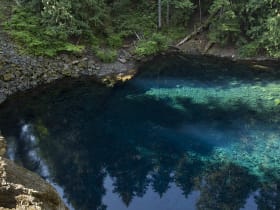
Tamolitch Falls (Blue Pool)
14 miles away
The McKenzie River disappears entirely into a porous lava field 1.5 miles upstream from Tamolitch and travels underground the whole way.

Proxy Falls
20 miles away
Proxy Falls is a pair of side-by-side waterfalls just off Hwy 242, accessible via a 1.6-mile loop through old-growth hemlock and Douglas fir. Most drivers on McKenzie Pass miss the small trailhead.

Sahalie and Koosah Falls
21 miles away
Sahalie Falls drops 100 feet and Koosah Falls drops 70 feet on the upper McKenzie River within half a mile of each other, both fed by water that surfaces from Clear Lake above.