
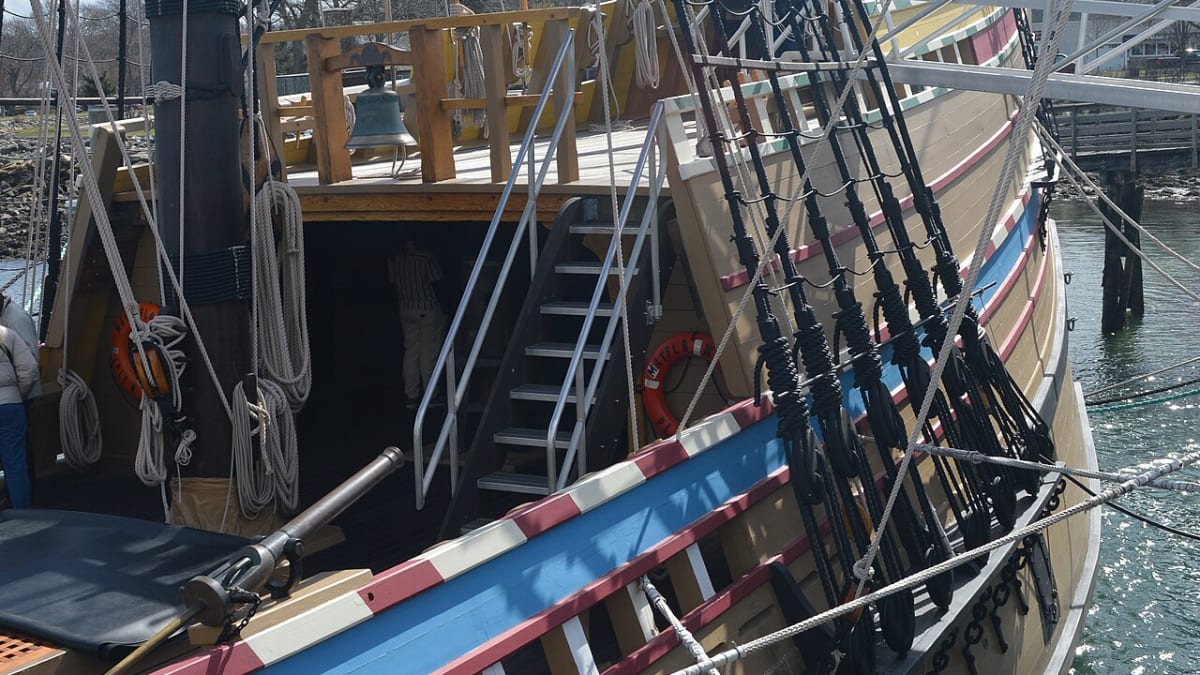
Mayflower II
74 Water St, Plymouth, MA
Plymouth, MA
A full-scale reproduction of the ship that carried the Pilgrims across the Atlantic, tied up at the same harbor where the story began.
Mayflower II is a full-scale, seaworthy reproduction of the ship that carried the Pilgrims across the Atlantic in 1620. Tied up along the Plymouth waterfront, she lets you walk the decks, duck into the cramped quarters below, and feel in your own body how a small wooden vessel, packed with families, animals, and provisions, made a punishing ten-week crossing to a coast none of them had seen.
The ship is more than a model. Built in England in the 1950s using traditional methods, she sailed the Atlantic herself as a gift symbolizing the ties between England and the United States, and she has been carefully restored to keep sailing today. She stands at the center of one of the most consequential and most contested stories in American history, and seeing her scale up close changes how you understand it.
What Travelers Love
- Standing on the deck of a full-scale reproduction of the Pilgrims' ship
- Grasping just how small and crowded the vessel was for its long crossing
- The waterfront setting steps from Plymouth Rock and the historic town
- Costumed interpreters who bring the 1620 voyage and its people to life
Worth Knowing
- The ship is a working reproduction that still sails on occasion, so check that it is in port before you visit
- Below-deck spaces are low and tight, in keeping with the real ship's cramped quarters
- It is operated by Plimoth Patuxet Museums, and a combined visit with their main site pairs well
- Summer and fall around the harvest holiday are the busiest seasons in Plymouth
Learn about Mayflower II
The crossing of 1620
In the autumn of 1620, a group of English religious separatists and other passengers, later called the Pilgrims, crowded aboard a merchant ship with crew, livestock, and their belongings and set out across the Atlantic. The voyage took roughly two months, through storms that cracked a main beam, and the passengers spent much of it below decks in dark, wet, and miserable conditions.
They had meant to settle farther south but made landfall on the tip of Cape Cod, then crossed to the harbor at Plymouth. That first winter was brutal, and about half of the roughly one hundred passengers died. The ship you can board today is built to the scale of that vessel, which makes the ordeal vivid in a way no textbook can: a hundred people and their whole world, in a space smaller than a modern house.
The Wampanoag and a fuller story
The Pilgrims did not arrive in an empty land. The shore they reached is the homeland of the Wampanoag people, who had lived, farmed, and fished along this coast for thousands of years. Just before the ship's arrival, epidemics carried by earlier European contact had devastated many Wampanoag communities, reshaping the world the newcomers entered.
The survival of the Plymouth colony depended on the Wampanoag, and figures such as Tisquantum, often called Squanto, and the leader Ousamequin, known as Massasoit, are central to what followed. The Wampanoag remain a living people today, with the Mashpee Wampanoag and the Wampanoag Tribe of Gay Head (Aquinnah) both federally recognized nations. A visit here is richest when the ship is understood as one side of an encounter, not the whole of it.
The ship that sailed the Atlantic
Mayflower II was built in Devon, England, in the mid-1950s, using traditional shipwright methods and materials to recreate a vessel of the early 1600s. In 1957 she sailed across the Atlantic herself, crewed by a small team, arriving in the United States as a symbol of friendship between the two countries. She has served as a floating exhibit at Plymouth ever since.
Because she is a real wooden ship, she needs constant care, and she recently underwent a major multi-year restoration that renewed her timbers and rigging for years of sailing to come. From time to time she leaves the harbor for voyages and events, so she is a living vessel rather than a static display, which is part of what makes standing on her deck feel so genuine.
Plymouth's historic waterfront
The ship anchors a waterfront thick with history. A short walk away, Plymouth Rock sits under its columned canopy at the shoreline, the traditional, symbolic landing spot of the Pilgrims, and the streets behind the harbor hold old houses, museums, and monuments telling the town's colonial story.
Plymouth calls itself America's Hometown, and the harbor is the natural place to begin a visit, with the water, the ship, and the rock all in view of one another. The broader living-history site of the Plimoth Patuxet Museums lies a few miles away, so many visitors pair the ship with that reconstructed 17th-century village and Wampanoag homesite for the fuller story.
Closest Boutels
The closest Boutel™ stays, so you can turn this stop into an overnight. Each is a place we chose through independent editorial review, never a paid placement.
AWOL Provincetown
Honorable Mention59 Province Lands Road, Provincetown, MA
24 miles away|Learn More ›
Details
Plymouth, MA
Frequently asked questions
What is the Mayflower II?
The Mayflower II is a full-scale reproduction of the original Mayflower, the ship that carried the Pilgrims across the Atlantic to found Plymouth Colony in 1620. Docked at the Plymouth waterfront and operated by Plimoth Patuxet Museums, it was built in England in the 1950s and actually sailed across the ocean, and it has since been meticulously restored. Stepping aboard offers a powerful, tangible sense of the cramped, perilous voyage the Pilgrims endured.
What can you do aboard the Mayflower II?
You can explore the ship's decks and see how astonishingly small and crowded it was for the passengers and crew who crossed a stormy ocean for more than two months. Staff and costumed interpreters aboard help bring the voyage and the Pilgrims' story to life, answering questions about seventeenth-century seafaring and life at sea. It is an eye-opening complement to the history you can learn on shore at Plymouth's other Pilgrim sites.
When is the Mayflower II open?
The ship is open seasonally, generally from spring through fall, so it is best to check current dates and hours before you visit, especially early or late in the season. Admission is charged, and combined tickets with the main Plimoth Patuxet living-history sites are often available. Because it involves ladders and steep steps to move around the ship, keep mobility in mind when planning your visit.
What is near the Mayflower II?
The Mayflower II is docked right on the Plymouth waterfront, just a short walk from Plymouth Rock, so the two iconic Pilgrim landmarks are easy to see together. The town's historic downtown, shops, and other colonial sites are close by, and the main Plimoth Patuxet village and homesite are a short drive away. Together they make Plymouth a rich destination for exploring the founding story of the Pilgrims.
When is the best time to visit the Mayflower II?
Late spring through fall is the season to go, with warm, dry days ideal for exploring the open ship and the waterfront, and pairing the visit with nearby Plymouth Rock and the town's other attractions. November, around Thanksgiving, carries special historical resonance. Whenever you visit, checking current operating dates ensures the ship is open, and going earlier in the day helps you beat crowds and enjoy the decks at a relaxed pace.
Nearby
Plymouth Rock
0.1 miles away
Plymouth Rock is the storied Pilgrim landing stone, sheltered under a granite portico right on the Plymouth waterfront in Pilgrim Memorial State Park.
Stephens Field
0.6 miles away
A free town waterfront park on the southern edge of Plymouth Harbor, with a scenic overlook, a refreshed playground, courts, a small beach, and a boat launch.

Plimoth Patuxet Museums
2.4 miles away
This is where the Thanksgiving story comes alive for kids. At the Plimoth Patuxet Museums the 1627 English Village is staffed by role-players who never break character: they speak, dress, cook, and wo...
Myles Standish State Forest
8.4 miles away
A few miles behind Plymouths crowded waterfront lies a landscape almost nobody expects: a true pine barrens.