

Lincoln's Boyhood Home at Knob Creek
7120 Bardstown Rd, Hodgenville, KY
Hodgenville, KY
The narrow Kentucky valley where Abraham Lincoln formed his very first memories, now a quiet unit of his birthplace national park.
Everyone remembers the marble memorial over Lincoln's birthplace, but the boy himself would not have remembered being born there at all. His first real memories were made a few miles away, here at Knob Creek, where the Lincolns farmed a strip of bottomland from 1811 until 1816. Abraham was two when they arrived and seven when they left for Indiana, and it was in this narrow valley, under these steep green knobs, that he first learned the shape of the world.
The farm sat on the old road between Louisville and Nashville, so the wider country passed right by the Lincolns' door: settlers heading west, peddlers, soldiers, and enslaved people being marched south, a sight the grown Lincoln never forgot. Today the valley is a quiet unit of Abraham Lincoln Birthplace National Historical Park, with a reconstructed cabin and tavern standing where the boy once played, waded the creek, and did his first small chores.
What Travelers Love
- Standing in the actual valley where Lincoln's earliest memories were made, not a symbol of it but the real ground
- The reconstructed log cabin and tavern that show how a frontier farm family lived
- The steep green knobs rising close on either side, a landscape a small boy would never forget
- Quiet trails and picnic spots along the creek, far less crowded than the birthplace unit
Worth Knowing
- This is a separate unit of Abraham Lincoln Birthplace National Historical Park, about seven miles from the birthplace, so plan to see both
- The site is open seasonally and the visitor programs run mainly in the warmer months, so check ahead before a long detour
- It is a small, quiet stop of an hour or so, best paired with the birthplace unit and the town of Hodgenville
- Trails follow the creek and can be muddy after rain, so wear shoes you do not mind getting wet
Learn about Lincoln's Boyhood Home at Knob Creek
The making of a boy
Thomas and Nancy Lincoln moved their young family to Knob Creek in 1811, when Abraham was about two years old, leaving the Sinking Spring farm where he had been born. The Knob Creek land was better for farming, a ribbon of fertile bottomland along the creek, and here the Lincolns raised corn and pumpkins in the rich valley soil while the wooded hills climbed steeply on both sides.
It was at Knob Creek that Lincoln's memory truly began. He later recalled planting pumpkin seeds with his father, only to watch a sudden mountain rain wash the whole crop down the valley. He remembered nearly drowning in the swollen creek and being pulled out by a friend. He remembered, too, walking a couple of miles to a rough log schoolhouse for a few weeks of the only formal schooling he would ever get as a child. These small, vivid scenes are the earliest we have of the man who would become the sixteenth president.
A road that carried the whole country
The Lincoln farm fronted the Louisville-to-Nashville road, one of the busiest routes through early Kentucky, so the traffic of a young nation flowed past the family's cabin. Wagons of settlers rolled toward the frontier, drovers pushed livestock to market, and peddlers stopped to trade. For a curious boy it was a window onto a country far larger than his valley.
It was also here, historians believe, that Lincoln first saw enslaved people being marched south in chains along that same road. Kentucky was a slave state, and the sight of coffles passing the family's door left an impression that stayed with him. The Lincolns themselves left Kentucky partly over unclear land titles and partly, Lincoln later said, because of slavery, moving north across the Ohio River to free soil in Indiana in 1816.
Preserving the valley
After the Lincolns left, the Knob Creek farm stayed in private hands and was worked and lived on for generations. In the early 1930s the Howard family opened it as a roadside historic attraction, building a log cabin and a tavern to help visitors picture the vanished frontier, and their descendants kept it going for decades.
In 2001 the family donated the site to the National Park Service, which added it to Abraham Lincoln Birthplace National Historical Park and, because the park now held two separate places, changed its name to a national historical park. Today the reconstructed cabin, the tavern, and the surrounding fields and creek are preserved so visitors can stand in the real landscape of Lincoln's boyhood, a plainer and more intimate place than the grand memorial down the road.
Visiting Knob Creek
The Knob Creek unit lies about seven miles northeast of Hodgenville along the Bardstown Road, roughly ten minutes from the birthplace unit, so the two make a natural pair on the same trip. The setting is quiet and green, with the reconstructed cabin and tavern near the road and short trails leading back along the creek and into the trees. Give yourself an hour or so to walk the ground and picture the family that once farmed it.
The site is open seasonally and its programs run mainly in the warmer months, so check ahead before a long drive. Pair it with the marble memorial at the birthplace and a stop in Hodgenville, whose town square is watched over by two Lincoln statues, for a full and unhurried day in the country where the man who held the Union together first learned to walk, wade, and wonder.
Closest Boutels
The closest Boutel™ stays, so you can turn this stop into an overnight. Each is a place we chose through independent editorial review, never a paid placement.
Details
Hodgenville, KY
Frequently asked questions
What is Lincoln's Boyhood Home at Knob Creek?
Lincoln's Boyhood Home at Knob Creek, near Hodgenville, Kentucky, preserves the site where Abraham Lincoln spent several of his earliest childhood years, part of the Abraham Lincoln Birthplace National Historical Park. After his birth nearby, the Lincoln family moved to a farm along Knob Creek, where young Abraham lived from his toddler years until the family left Kentucky, and where he later recalled his first memories. The scenic site amid rolling hills features a representative log cabin and interpretive information about Lincoln's boyhood in Kentucky. A meaningful complement to the birthplace, it deepens the story of Lincoln's early life. With its historic site and setting, Lincoln's Boyhood Home at Knob Creek offers a meaningful destination in Kentucky.
What can you see at Lincoln's Boyhood Home at Knob Creek?
You can visit the scenic Knob Creek farm site where young Abraham Lincoln lived during his earliest boyhood years, see a representative log cabin and interpretive information about his childhood, and take in the rolling hills and creek that formed the backdrop of his first memories. The historic site, the representative cabin, the beautiful setting, and the connection to Lincoln's boyhood are the draws, offering a meaningful and peaceful stop that complements the nearby birthplace. It brings his early Kentucky years to life. With its historic site and scenery, Lincoln's Boyhood Home at Knob Creek offers a meaningful visit in Kentucky.
How is Knob Creek related to the Lincoln Birthplace?
Lincoln's Boyhood Home at Knob Creek is part of the Abraham Lincoln Birthplace National Historical Park, representing the second Kentucky home of the Lincoln family, where Abraham lived as a young boy after his birth nearby. While the birthplace site marks where he was born, the Knob Creek farm is where he spent his formative early childhood and formed his first memories before the family left Kentucky. Together the two sites tell the fuller story of Lincoln's Kentucky beginnings. Visiting both deepens the experience of Lincoln's early life at the Abraham Lincoln Birthplace National Historical Park in Kentucky.
When is the best time to visit Lincoln's Boyhood Home at Knob Creek?
The mild months of spring through fall offer the most pleasant weather for exploring the scenic outdoor site and its rolling hills and creek, with fall bringing lovely foliage, while the site's facilities may be seasonal, so checking current hours before you go is wise. It pairs naturally with the nearby Lincoln birthplace. For comfortable weather to enjoy the setting, aim for spring through fall at Lincoln's Boyhood Home at Knob Creek in Kentucky.
What is near Lincoln's Boyhood Home at Knob Creek?
Lincoln's Boyhood Home at Knob Creek is near Hodgenville, Kentucky, close to the Abraham Lincoln Birthplace National Historical Park, within reach of the town of Hodgenville's Lincoln sites, Bardstown with My Old Kentucky Home State Park, and the central Kentucky countryside. That makes Lincoln's Boyhood Home at Knob Creek a meaningful stop to combine with the Abraham Lincoln Birthplace National Historical Park and the other attractions of central Kentucky on a visit to the state.
Nearby

Abraham Lincoln Birthplace National Historical Park
0.0 miles away
For a quick, moving stop near Hodgenville, pull into the Lincoln Birthplace.

My Old Kentucky Home State Park
25 miles away
The 1818 Federal Hill mansion in Bardstown that inspired Stephen Foster's ballad and became Kentucky's state song.
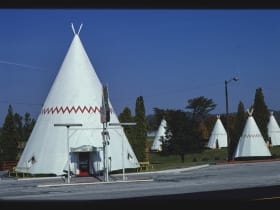
Wigwam Village No. 2
29 miles away
This is the good kind of roadside relic: still standing, still open. Wigwam Village No.

Mammoth Cave National Park
31 miles away
The longest known cave system in the world, with more than 400 mapped miles of passages.