

Abraham Lincoln Birthplace National Historical Park
2415 McDowell Rd, Hodgenville, KY
Hodgenville, KY
A grand marble-and-granite memorial rises over the humble Kentucky farm where Abraham Lincoln was born, holding a symbolic log cabin at the top of fifty-six steps.
On February 12, 1809, Abraham Lincoln was born in a one-room log cabin on his family's Sinking Spring Farm in the Kentucky wilderness south of what is now Hodgenville. The future president spent only his earliest years here before the family moved a few miles away to Knob Creek and then out of Kentucky, but the ground where he entered the world became one of the country's first true memorials to a president.
The centerpiece is a stately neoclassical building of marble and granite, dedicated in 1911, that looks more like a Greek temple than anything you would expect on a frontier farm. Inside it shelters a small log cabin meant to symbolize the one Lincoln was born in. Fifty-six granite steps climb to its door, one step for each year of Lincoln's life.
What Travelers Love
- Climbing the fifty-six granite steps, one for each year of Lincoln's life, to the memorial
- Standing beside the symbolic log cabin inside the neoclassical temple
- The quiet Sinking Spring itself, still flowing beneath the hillside
- Walking the wooded trails and picturing the frontier farm as it was
Worth Knowing
- There are two units: the Birthplace here and the Boyhood Home at Knob Creek a few miles away
- The cabin in the memorial is a symbolic one, not the actual cabin Lincoln was born in
- The trail down to the Sinking Spring is short but the steps can be slick when wet
- The visitor center orients the two sites and is worth a stop before you walk the grounds
Learn about Abraham Lincoln Birthplace National Historical Park
The story of the Sinking Spring farm
Thomas and Nancy Hanks Lincoln bought the roughly three hundred acre Sinking Spring Farm in late 1808, drawn like many settlers by the good limestone soil and the reliable spring that gave the place its name. It was hard, uncertain frontier land, and title disputes eventually cost the family the farm, part of the endless legal tangles over Kentucky land claims that pushed the Lincolns onward.
Long before any settler arrived, this country was a shared hunting ground of the Shawnee, Cherokee, Chickasaw, and other nations, whose ancestral ties to Kentucky run deep. Most were removed westward in the nineteenth century, and their descendant nations continue today, largely in Oklahoma and the Carolinas. The frontier the Lincolns knew was land these peoples had known for far longer.
The idea of protecting Lincoln's birthplace grew after the Civil War, as Americans looked back on the man who had held the Union together. In 1906 a group called the Lincoln Farm Association, backed by donations from ordinary citizens across the country, bought the land and set out to build a fitting memorial.
The Memorial Building and the symbolic cabin
The Memorial Building was designed by the architect John Russell Pope, later known for the Jefferson Memorial and the National Gallery of Art in Washington. President Theodore Roosevelt laid the cornerstone in 1909, and President William Howard Taft dedicated the finished building in 1911. Its granite came from Connecticut and its marble from Tennessee, a grand statement rising over what had been a subsistence farm.
Inside sits a small log cabin long said to be Lincoln's birthplace. Careful study later showed the logs could not be the originals, so today it is honored as a symbolic cabin rather than the genuine article. That distinction takes nothing from the place. What draws people is standing on the very ground where the story of the sixteenth president began, in the plainest of surroundings, under one of the country's grandest memorials.
The grounds, the spring, and Knob Creek
Beyond the memorial, wooded trails wind across the old farm, and a short path leads down to the Sinking Spring itself, a cool pool tucked under a limestone ledge that still runs as it did in Lincoln's day. An old white oak known as the Boundary Oak once marked a corner of the farm and stood as a living link to Lincoln's time before it finally died in the twentieth century.
A few miles northeast lies the second unit of the park, the Boyhood Home at Knob Creek, where the Lincolns moved when Abraham was about two and where he formed his first real memories. Together the two sites tell the story of his Kentucky childhood, from the farm where he was born to the creek-bottom fields where he began to grow up.
Season by season
Spring brings green to the farm country and wildflowers along the wooded trails, an easy and pleasant time to walk the grounds between the memorial and the spring.
Summer is warm and full, the busiest stretch, with school groups and travelers passing through on the Lincoln trail across Kentucky and Indiana.
Fall is many visitors' favorite, when the hardwoods around the memorial turn gold and red and the light softens over the old fields.
Winter is quiet and bare, and February brings the anniversary of Lincoln's birth, marked here with wreaths and remembrance on the steps of the memorial.
Closest Boutels
The closest Boutel™ stays, so you can turn this stop into an overnight. Each is a place we chose through independent editorial review, never a paid placement.
Details
Hodgenville, KY
Frequently asked questions
What is the Abraham Lincoln Birthplace National Historical Park?
The Abraham Lincoln Birthplace National Historical Park, near Hodgenville, Kentucky, preserves the site where Abraham Lincoln, one of the greatest American presidents, was born in a humble log cabin in the early nineteenth century. The park's centerpiece is a grand neoclassical memorial building housing a symbolic log cabin, reached by a flight of steps, honoring Lincoln's humble beginnings, along with the historic Sinking Spring that supplied the family's water and a visitor center telling his early life story. A moving tribute to Lincoln's origins and enduring legacy, it inspires visitors. With its birthplace memorial and history, the Abraham Lincoln Birthplace National Historical Park offers a meaningful destination in Kentucky.
What can you see at the Abraham Lincoln Birthplace National Historical Park?
You can visit the grand memorial building enclosing a symbolic log cabin honoring Lincoln's humble birth, climb the ceremonial steps, see the historic Sinking Spring, explore the visitor center's exhibits on Lincoln's early life and legacy, and walk the peaceful grounds. The birthplace memorial and symbolic cabin, the Sinking Spring, and the exhibits on Lincoln's origins are the highlights, offering a moving and educational experience about the president's humble beginnings. As a National Park Service site, admission is typically free. With its memorial and history, the Abraham Lincoln Birthplace National Historical Park offers a meaningful visit in Kentucky.
Why is the Abraham Lincoln Birthplace important?
The Abraham Lincoln Birthplace is important because it marks the site where Abraham Lincoln, who would become one of the greatest American presidents and lead the nation through the Civil War and toward the end of slavery, was born in a simple log cabin to a poor frontier family. The site honors his humble beginnings and the remarkable journey from a Kentucky log cabin to the presidency, symbolizing themes of opportunity and greatness rising from modest origins. Its memorial preserves this legacy. Understanding Lincoln's story enriches a meaningful visit to the Abraham Lincoln Birthplace National Historical Park in Kentucky.
When is the best time to visit the Abraham Lincoln Birthplace National Historical Park?
The mild months of spring through fall offer the most pleasant weather for exploring the outdoor grounds, memorial, and Sinking Spring, while the visitor center offers an indoor option in various weather. Fall brings lovely foliage to the grounds. Because hours can vary, checking the current schedule before you go is wise. For comfortable weather to explore the grounds and memorial, aim for spring through fall at the Abraham Lincoln Birthplace National Historical Park in Kentucky.
What is near the Abraham Lincoln Birthplace National Historical Park?
The Abraham Lincoln Birthplace National Historical Park is near Hodgenville, Kentucky, within reach of Lincoln's Boyhood Home at Knob Creek nearby, the town of Hodgenville with its Lincoln sites, Bardstown with My Old Kentucky Home State Park, and the central Kentucky countryside. That makes the Abraham Lincoln Birthplace National Historical Park a meaningful stop to combine with Lincoln's Boyhood Home at Knob Creek and the other attractions of central Kentucky on a visit to the state.
Nearby

Lincoln's Boyhood Home at Knob Creek
0.0 miles away
The narrow Kentucky valley where a young Abraham Lincoln formed his first memories, farming, wading the creek, and getting his only few weeks of childhood schooling from ages two to seven.

My Old Kentucky Home State Park
25 miles away
The 1818 Federal Hill mansion in Bardstown that inspired Stephen Foster's ballad and became Kentucky's state song.
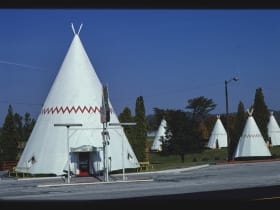
Wigwam Village No. 2
29 miles away
This is the good kind of roadside relic: still standing, still open. Wigwam Village No.

Mammoth Cave National Park
31 miles away
The longest known cave system in the world, with more than 400 mapped miles of passages.