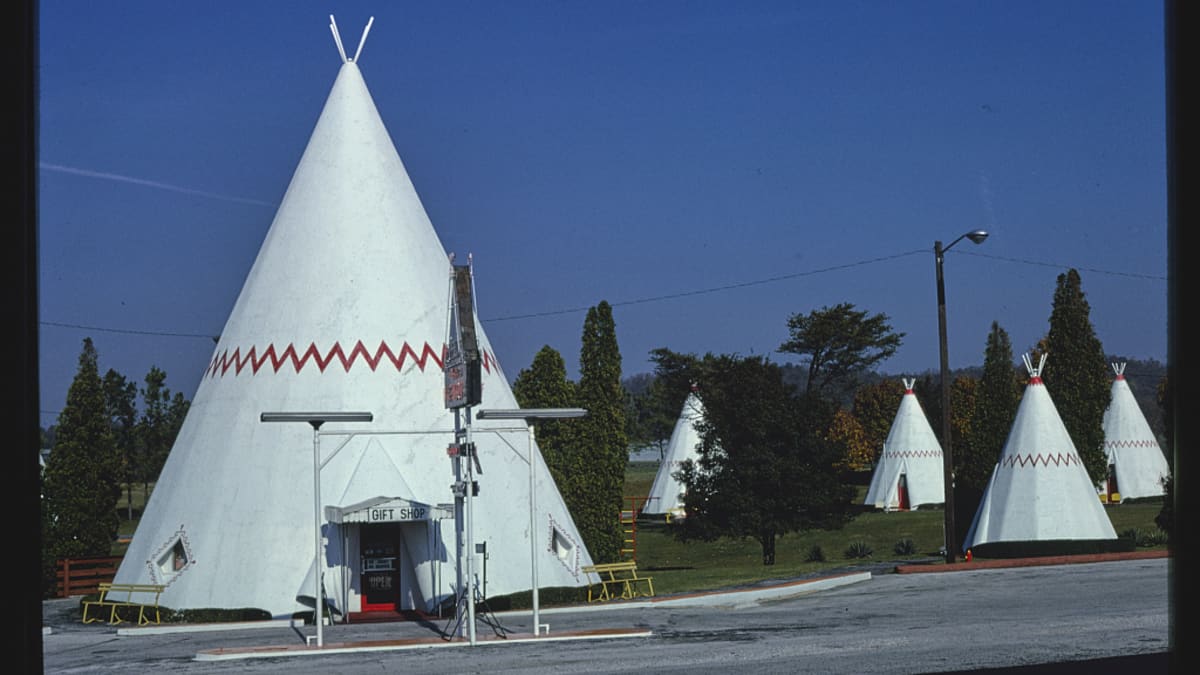
Wigwam Village No. 2
601 N Dixie Hwy, Cave City, KY
Cave City, KY
A ring of white concrete teepees from the 1930s, a rare survivor of roadside America still standing near Mammoth Cave.
Wigwam Village No. 2 is a rare survivor from the golden age of the American road trip, a 1930s motor court in Cave City, Kentucky, where the guest rooms are shaped like white concrete teepees arranged in a ring. Built in 1937 along the old Dixie Highway, it is one of only a handful of such novelty villages left standing anywhere in the country.
It belongs to a small chain of Wigwam Villages dreamed up by a man named Frank Redford, whose fascination with a teepee shape led to a series of roadside courts built to lure travelers off the highway. Despite the name, the structures follow the conical form of a Plains teepee rather than a true wigwam. Preserved and still welcoming visitors, it is a beloved landmark of highway kitsch near Mammoth Cave.
What Travelers Love
- The whimsical sight of a ring of white concrete teepees
- A rare, preserved piece of 1930s American roadside architecture
- Its place on the old Dixie Highway near Mammoth Cave
- The nostalgic pull of a golden-age motor court still standing
Worth Knowing
- The structures are teepees, not historically accurate wigwams, despite the name
- It is one of only a small number of such villages that survive
- The area around Cave City is full of caves and roadside attractions
- Mammoth Cave National Park is a short drive to the west
Learn about Wigwam Village No. 2
A roadside idea in concrete
The Wigwam Villages were the creation of Frank Redford, a Kentucky businessman who became captivated by the teepee form and used it to build eye-catching roadside lodging. His idea was pure roadside marketing: a cluster of giant white teepees along a highway would catch the eye of passing motorists and pull them in for the night, a novelty that sold itself.
Redford built a small chain of these villages across the country, numbering them, and the Cave City court is No. 2, completed in 1937. Each unit is a freestanding conical structure of steel frame and stuccoed concrete, painted white with zigzag trim, ringed around a central lodge. Only a few of the villages survive today, and the Kentucky one is among the best preserved.
The name and a note of respect
The village's name and design draw on romanticized 20th-century imagery of Native American life rather than accurate representation. The white concrete cones follow the shape of a Plains teepee, a portable hide dwelling, not a wigwam, which is a different, dome-shaped structure of other Native peoples. The two words were often used loosely in the era's popular culture.
Kentucky itself was long a shared hunting ground and homeland of Native nations, including the Shawnee, Cherokee, Chickasaw, Yuchi, and Osage, whose descendant nations continue today, most having been removed westward to Oklahoma and southward to the Carolinas. The village is best appreciated as a period piece of American roadside marketing and architecture, a window into how mid-century highway culture packaged imagery, rather than as any authentic reflection of Native heritage.
The golden age of the motor court
Wigwam Village No. 2 dates from the heyday of the automobile motor court, when the rise of the family car and long-distance driving created a new kind of roadside lodging. Before interstate highways and chain motels, courts like this one lined the two-lane highways, competing for travelers with novelty, comfort, and easy parking right at the door.
The old Dixie Highway on which it sits was a major early auto route running south toward Florida, carrying vacationers through Kentucky's cave country. As interstates later bypassed such roads, most of the era's motor courts vanished. The Wigwam Village endured, and today it stands as a rare, intact example of the architecture and optimism of the early American road trip.
Cave City and Mammoth Cave
The village sits in Cave City, a town whose whole economy grew up around the caves that riddle the limestone beneath this part of Kentucky. The streets nearby are lined with show caves, roadside attractions, and the kind of family stops that have drawn travelers for generations.
Just to the west lies the crown jewel of the region, Mammoth Cave National Park, protecting the longest cave system known on earth, with hundreds of miles of mapped passages and ranger-led tours into its depths. Between the underground wonder of Mammoth Cave and the concrete teepees of a 1930s motor court, this stretch of Kentucky offers both natural grandeur and a heavy dose of classic roadside Americana.
Closest Boutels
The closest Boutel™ stays, so you can turn this stop into an overnight. Each is a place we chose through independent editorial review, never a paid placement.
Details
Cave City, KY
Frequently asked questions
What is Wigwam Village No. 2?
Wigwam Village No. 2, in Cave City, Kentucky, near Mammoth Cave, is a historic and beloved roadside motel where guests stay in individual rooms shaped like giant tepees, a charming survivor of a bygone era of American road-trip lodging. Built in the 1930s, this rare and picturesque motor court features a cluster of white, tepee-shaped concrete units arranged around a central green, offering a nostalgic taste of classic roadside Americana. One of only a few such wigwam villages remaining in the country, it is listed on the National Register of Historic Places and delights lovers of vintage motels and road-trip history. With its tepee-shaped units and nostalgic charm, Wigwam Village No. 2 offers a fascinating destination in Kentucky.
What can you do at Wigwam Village No. 2?
You can stay overnight in one of the distinctive tepee-shaped rooms for a nostalgic road-trip experience, photograph the charming and unusual historic motor court, and enjoy its convenient location near Mammoth Cave and the attractions of the Cave City area. The unique tepee-shaped units, the vintage roadside charm, and the nostalgic atmosphere are the draws, making it a memorable and photogenic stop or stay for lovers of classic Americana. Its rarity and history add to the appeal. With its tepee-shaped units, Wigwam Village No. 2 offers a delightful experience in Kentucky.
Why is Wigwam Village No. 2 historically significant?
Wigwam Village No. 2 is historically significant as one of only a few surviving examples of the wigwam villages, a distinctive style of roadside motor court built in the mid-twentieth century when quirky, themed motels drew travelers on America's growing highways. Built in the 1930s, it is a rare and well-preserved survivor of this golden age of road-trip lodging and is listed on the National Register of Historic Places. Its nostalgic tepee-shaped units capture a vanished era of American travel. This heritage makes Wigwam Village No. 2 a cherished landmark in Cave City, Kentucky.
When is the best time to visit Wigwam Village No. 2?
The mild months of spring through fall offer the most pleasant weather for a visit or stay and for combining it with the outdoor attractions of the Cave City area and nearby Mammoth Cave, with the vintage motor court charming and photogenic year-round. Because it is a small historic motel, checking current availability and details before you go is wise, especially if you hope to stay overnight. For the most pleasant weather to explore the area too, aim for spring through fall at Wigwam Village No. 2 in Kentucky.
What is near Wigwam Village No. 2?
Wigwam Village No. 2 is in Cave City, Kentucky, near Mammoth Cave National Park, within reach of Dinosaur World, the Cave City area attractions, Bowling Green with the National Corvette Museum and Lost River Cave, and the central Kentucky countryside. That makes Wigwam Village No. 2 a fun stop to combine with Dinosaur World, the Mammoth Cave area, and the other attractions of central Kentucky on a visit to the state.
Nearby
Dinosaur World
0.6 miles away
Dinosaur World is a straightforward win with younger kids. A shaded trail winds through the Cave City woods past more than 150 life-size dinosaur models, each with a sign, so children can walk from on...

Frozen Niagara
7.3 miles away
Frozen Niagara is a richly decorated feature of Mammoth Cave, a towering cascade of flowstone and dripstone that looks like a frozen waterfall of stone.

The Rotunda
8.4 miles away
The Rotunda is a grand chamber just inside the Historic Entrance of Mammoth Cave, a vast room where the ceiling soars high overhead.

Historic Entrance
8.4 miles away
The Historic Entrance is the natural mouth of Mammoth Cave, a wide opening where a stream tumbles into the earth and cool air pours out.

Mammoth Cave National Park
8.4 miles away
The longest known cave system in the world, with more than 400 mapped miles of passages.

Green River
9.8 miles away
The Green River winds through Mammoth Cave National Park above the cave, a quiet, tree-lined waterway good for canoeing, kayaking, and fishing.