

Fruitlands Museum
55 Candleberry Ln, Bolton, MA
Harvard, MA
A hilltop where a famous utopian commune failed, now a cluster of small museums with one of the finest valley views in the state.
Fruitlands Museum sits on a hilltop in Harvard, Massachusetts, on the very ground where one of the most famous experiments in American idealism briefly rose and quickly fell. In 1843 the philosopher Bronson Alcott, father of the writer Louisa May Alcott, and the English reformer Charles Lane founded a utopian commune here called Fruitlands, meant to be a pure new way of living. It lasted only about seven months.
In the twentieth century a collector named Clara Endicott Sears preserved the old farmhouse and gathered around it several small museums, so that today the site holds not only the Transcendentalist farmhouse but a Shaker house, galleries of Native American art, and a collection of Hudson River School landscape paintings. All of it stands on a hillside commanding one of the most beautiful views in the state, a place as rewarding for its scenery as for its history.
What Travelers Love
- One of the most sweeping valley views in Massachusetts from the hilltop grounds
- The original farmhouse of Bronson Alcott's short-lived Transcendentalist commune
- A rare early collection of Native American art and artifacts
- Hudson River School landscape paintings and a preserved Shaker house on one campus
Worth Knowing
- The museum is spread across several buildings and trails on a hillside, so wear good walking shoes
- The grounds and view are a highlight in themselves, so allow time to walk and take in the vista
- It follows a seasonal schedule, so check the calendar before visiting
- The site is rural, so plan for a drive through country roads to reach it
Learn about Fruitlands Museum
The utopia that failed
In the summer of 1843 Bronson Alcott and Charles Lane gathered a small band of idealists on this hilltop to try to live a perfectly pure life. They called it Fruitlands, and their rules were strict: they ate no meat and no animal products, wore only linen so as to use nothing taken from animals, refused to use animal labor to work the land, and sought to free themselves from the corruptions of ordinary society. It was Transcendentalism, the New England philosophy of self-reliance and the divinity of nature, pushed to a radical extreme.
The experiment was doomed almost from the start. The members were better at philosophy than farming, the growing season slipped away, winter loomed, and by the beginning of 1844 the commune had collapsed. Among those who lived through that hard, hungry season was young Louisa May Alcott, who later wrote a wry account of the whole venture. The failure of Fruitlands became one of the most famous cautionary tales of American idealism, and the plain farmhouse where it all unfolded still stands.
Clara Endicott Sears and her museums
The site owes its second life to Clara Endicott Sears, a wealthy author and collector who bought the land in the early twentieth century, saved the old Fruitlands farmhouse, and turned it into a museum of the Transcendentalist story. Fascinated by the history and cultures of the region, she went on to gather other collections and buildings on the same hilltop.
She moved a Shaker house to the grounds from a nearby community and filled it with Shaker furniture and objects, preserving the memory of that remarkable religious sect. She assembled a collection of Native American art and artifacts, and she gathered landscape paintings by artists of the Hudson River School. The result is an unusual cluster of small, distinct museums, all on one scenic hill, each opening a different window onto the American past.
Native American and landscape art
The Native American gallery holds one of the earlier collections of its kind in the region, with objects and artworks representing peoples from across the continent. Collections like this were assembled in a very different era, and the museum today works to present them with greater care and respect for the living Native nations whose heritage they reflect, including the Nipmuc and other peoples of this part of New England.
The landscape gallery gathers paintings from the Hudson River School, the nineteenth-century movement whose artists made grand, luminous images of the American wilderness. Their reverence for nature echoes the very Transcendentalist ideals that once animated Fruitlands, so that the paintings on the walls and the philosophy born on the hilltop speak to one another, both celebrating the natural world as something close to sacred.
The hilltop view and the countryside
Perhaps the single greatest pleasure of Fruitlands is simply the view. The museum grounds slope across an open hillside that looks out over the Nashua River valley toward Mount Wachusett and the distant hills, a vista that is glorious in every season and especially in the blaze of autumn. Trails wind across the grounds, and there is a tearoom on the property with the same commanding outlook.
The museum sits in the gentle, orchard-dotted countryside of north-central Massachusetts, near the quiet towns of Harvard and Bolton. It makes a fine anchor for a country drive through this rural landscape, and pairs well with the wider attractions of the central region, from Wachusett Mountain to the museums of Worcester. Few places combine history, art, and scenery quite so richly on a single hill.
Closest Boutels
The closest Boutel™ stays, so you can turn this stop into an overnight. Each is a place we chose through independent editorial review, never a paid placement.
Details
Harvard, MA
Frequently asked questions
What is Fruitlands Museum?
Fruitlands Museum, in Harvard, is a unique museum campus set on a scenic hillside and cared for by the Trustees of Reservations. It grew up around the site of Fruitlands, the short-lived 1840s Transcendentalist utopian farm community founded by Bronson Alcott, father of author Louisa May Alcott. Today the property combines several small museums, outdoor art, and beautiful landscape with sweeping valley views, blending history, art, and nature into one memorable destination.
What can you see at Fruitlands Museum?
The campus includes the original Fruitlands farmhouse, telling the story of the idealistic utopian experiment, along with a Shaker museum, a Native American museum, and an art gallery, each offering its own window into history and culture. Outdoors, you will find sculpture, gardens, and hiking trails with spectacular views over the Nashua River valley toward Mount Wachusett. The combination of thoughtful museums and gorgeous scenery gives the site broad, lasting appeal.
When is Fruitlands Museum open, and when should I go?
Fruitlands is generally open from spring through fall, so it is best to check current dates and hours before you visit, especially early or late in the season. The warm-weather months are ideal for combining the indoor museums with the outdoor trails and views, and autumn is spectacular for foliage across the valley. Sunset from the hillside is particularly beautiful, making a late-afternoon visit rewarding.
What can you do at Fruitlands besides the museums?
The grounds are a highlight in their own right, with walking trails that wind across the hillside and open meadows, offering some of the finest valley and mountain views in the area, along with outdoor sculpture to discover. Many visitors bring a picnic or simply relax and take in the scenery. Combining the small museums with a leisurely walk and the views makes for a rich, well-rounded outing.
What is near Fruitlands Museum?
Fruitlands sits in the Nashoba Valley region of central Massachusetts, within reach of Boston's western suburbs and historic towns like Concord, with its Revolutionary and literary sites, including connections to the Alcott family. The surrounding countryside offers orchards, farms, and scenic drives. That makes Fruitlands easy to combine with regional history, apple-picking in season, or a scenic day exploring this pretty corner of the state.
Nearby
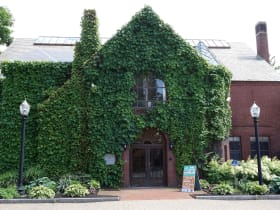
Fitchburg Art Museum
11 miles away
Few travelers detour to Fitchburg, which is exactly why this one surprises them.

New England Botanic Garden at Tower Hill
12 miles away
This hilltop garden above the Wachusett Reservoir stays alive in every season, which is unusual this far north.
Wachusett Mountain State Reservation
14 miles away
Wachusett is the big mountain of central Massachusetts, standing alone above the hill country and topping out at 2,006 feet, the highest ground in the state east of the Connecticut River.

Walden Pond
15 miles away
The water is the surprise: Walden is a glacial kettle pond, over a hundred feet deep and startlingly clear, formed when a buried block of ice melted after the last ice age.

Minute Man National Historical Park
18 miles away
This is where kids can actually stand on the spot the Revolution started.
EcoTarium
18 miles away
A science center built for touching, climbing, and running. The EcoTarium at 222 Harrington Way pairs indoor hands-on exhibits and a planetarium with a wooded campus where kids meet rescued animals, c...

Worcester Art Museum
19 miles away
People expect a museum this deep in Boston, not in Worcester, but the Worcester Art Museum at 55 Salisbury St has quietly held a first-rate collection since 1898.