
Elliott State Forest
Reedsport, OR
Reedsport, OR
Oregon's first state forest, a vast, roadless expanse of Coast Range ridges and old growth that shelters spotted owls, marbled murrelets, and coho salmon, remade into a research forest for the future.
The Elliott State Forest is a large, rugged expanse of the Oregon Coast Range, spread across steep forested ridges and deep, stream-cut canyons between Coos Bay and Reedsport. It was Oregon's very first state forest, and it holds something increasingly rare on the coast: substantial stands of old-growth timber, the tall, mossy, centuries-old forest that once blanketed this country and now survives only in fragments.
For most of its life the Elliott was managed to be logged, its timber sold to raise money for Oregon's public schools. In recent years it has been reinvented as something new, a publicly owned research forest, freed from that obligation and set aside to study how these forests work and how to care for them. It is less a tidy destination than a wild, working landscape with an unusually thoughtful mission.
What Travelers Love
- Some of the last big stands of old-growth forest left in Oregon's Coast Range
- A genuinely wild, uncrowded backcountry of steep ridges, deep canyons, and clear streams
- Habitat for rare species, from spotted owls and marbled murrelets to some of the coast's strongest coho salmon runs
- Its unusual second life as a publicly owned research forest with a mission beyond logging
Worth Knowing
- This is remote working forest, not a developed park, so services, signage, and facilities are limited
- Many roads are gravel logging roads that can be rough, gated, or affected by weather
- The Coast Range is very wet; expect rain, mud, and washouts outside the drier summer months
- Come prepared and self-sufficient, with a map, supplies, and a plan, since help is far away
Learn about Elliott State Forest
The story of the Elliott
This forested coast is the homeland of the Hanis Coos and the Lower Umpqua peoples, who lived along these rivers, estuaries, and forested slopes for countless generations, fishing the salmon runs and gathering from the land and shore. Their descendants today are part of the Confederated Tribes of Coos, Lower Umpqua and Siuslaw Indians, whose ancestral territory includes this stretch of the Coast Range and coastline.
The forest is named for Francis Elliott, Oregon's first state forester, and it holds the distinction of being the state's first state forest, established in the early twentieth century. From the beginning it carried an unusual job: much of it was tied to the Common School Fund, meaning the timber cut from it was meant to raise money for Oregon's K-12 public schools. For decades that shaped how the forest was run.
Over time that arrangement grew fraught. The forest had been heavily logged, and the presence of rare, federally protected species living in its remaining old growth brought lawsuits and sharp limits on further cutting, leaving the school-funding mission increasingly hard to sustain. The Elliott became the center of a long, contentious debate over what a public forest is really for.
From timber to research
The resolution was striking. Rather than sell the forest off or keep logging it to fund schools, the state chose to keep it in public hands and change its purpose entirely. It severed the forest's ties to the school fund, compensating the fund so that the Elliott no longer had to generate money from timber, and set the land on a new course.
In its place the state established the Elliott as a research forest, the first of its kind in Oregon, a large, publicly owned forest devoted to studying how coastal forests grow, how they can be managed, and how to balance timber, wildlife, and old-growth habitat. Instead of being valued mainly for the boards it could yield, the forest became a place to learn.
That transformation is a big part of what makes the Elliott worth knowing. It is a rare example of a public landscape being deliberately redirected away from extraction and toward long-term study and stewardship, an experiment in what a state forest can be in the twenty-first century.
Old growth and rare wildlife
The Elliott's greatest ecological treasure is its old growth. Large, unbroken tracts of ancient forest have become extremely rare in Oregon's Coast Range, and the Elliott holds some of the best that remain, towering conifers over a deep, layered understory that has taken centuries to form.
That habitat supports species that depend on old forest and are in trouble across the region. The northern spotted owl, which needs mature, complex forest to nest and hunt, lives here, as does the marbled murrelet, a small, elusive seabird that feeds at sea but flies inland to nest high in the branches of old-growth trees, a habit that ties its survival directly to forests like this one.
The forest's cold, clear streams are just as important. The Elliott is known for producing some of the strongest coho salmon runs on the entire Oregon Coast, its watersheds feeding fish that hatch in these headwaters, journey to the ocean, and return to spawn. Protecting that combination of old forest, rare birds, and healthy salmon streams is central to the forest's new purpose.
Visiting the forest
The Elliott is wild country rather than a developed park, and it rewards visitors who come prepared and self-reliant. Access is largely by gravel logging roads winding through steep terrain, and there is little in the way of visitor facilities, so this is a place for those comfortable with backcountry travel and navigation.
Summer and early fall are the most reliable times to explore, when the roads are driest and the notoriously wet Coast Range weather relents. Even then, the forest is remote, so a good map, supplies, and a plan matter, and conditions can change with weather and management activity.
Through the long, rainy months from fall into spring, the Coast Range turns green, dripping, and often muddy, with washouts and closures possible on unpaved roads. It is a landscape at its most lush in that season, but also its most demanding to reach, so checking current access before any visit is wise.
Closest Boutels
The closest Boutel™ stays, so you can turn this stop into an overnight. Each is a place we chose through independent editorial review, never a paid placement.
Details
Reedsport, OR
Frequently asked questions
What is the Elliott State Forest?
It is a vast, rugged coastal forest of roughly ninety thousand acres in southwestern Oregon, inland from the Reedsport and Coos Bay area, cloaked in dense Douglas fir and hemlock with pockets of towering old growth. Now managed as a research forest, it is remote, largely undeveloped, and laced with salmon streams and steep, forested ridges. It is a place for quiet, self-reliant exploration far from crowds and services.
What can you do in the Elliott State Forest?
It offers dispersed, back-to-nature recreation: hiking old roads and trails, fishing its streams, hunting in season, wildlife watching, and simply soaking up deep forest solitude. This is habitat for sensitive species like the marbled murrelet and spotted owl, so it is a special place for nature lovers. There are few developed facilities, so it appeals to those who like their forests wild and unpolished.
How do you get around the Elliott State Forest, and is it remote?
Very remote. Access is by a network of gravel and dirt logging roads that can be rough, muddy, and confusing, so a capable vehicle, a good map or GPS, and a full tank of gas are essential, and cell service is unreliable at best. Watch for active logging and forestry traffic, drive slowly on blind curves, and tell someone your plans before heading in, since help is far away.
When is the best time to visit the Elliott State Forest?
Late spring through early fall is the most practical window, when the roads are driest and the weather mildest. This is coastal Oregon rainforest, so the wet season brings heavy rain, mud, and slick, sometimes impassable roads. Even in summer, come prepared for cool, damp conditions and bring rain gear, layers, water, and food, since there are no services once you are in the forest.
What is nearby to combine with the Elliott State Forest?
The surrounding region is rich with accessible nature. Nearby Loon Lake offers swimming, boating, and camping, and the dramatic Golden and Silver Falls State Natural Area protects two tall waterfalls a reasonable drive away. The dunes, bays, and beaches of the Reedsport and Coos Bay coast are also close, so the forest pairs well with more developed stops for a fuller southwest Oregon trip.
Outside the Park

Darlingtonia Botanical Wayside
25 miles away
Darlingtonia is a quick and genuinely weird roadside stop: a bog full of carnivorous cobra lilies that most people have never heard of, 5 minutes north of Florence.

Oregon Dunes, Florence
25 miles away
The Oregon Dunes are a sandbox at continental scale: 40 miles of sand up to 500 feet tall where kids can run down, roll down, sandboard, and dig for as long as they like.
Sea Lion Caves
35 miles away
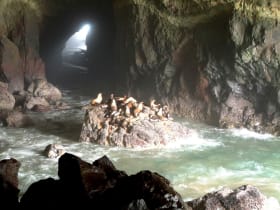
Sea Lion Caves delivers on its promise: an elevator drops you into a cathedral-sized sea cave packed with Steller sea lions hauled out on the rocks.