

Darlingtonia Botanical Wayside
Mercer Lake Rd, Florence, OR
Florence, OR
A short boardwalk into a coastal fen where thousands of hooded, snake-headed plants quietly eat insects, the only site in Oregon set aside to protect a single flower.
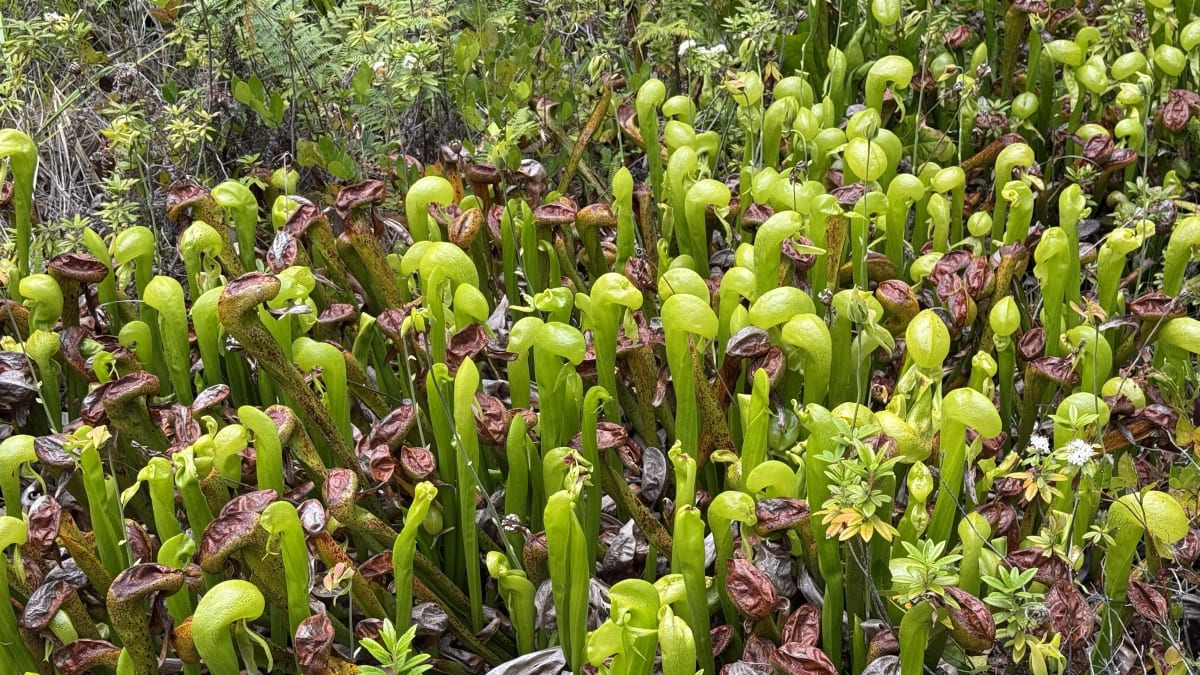
Darlingtonia Botanical Wayside is a small, easy-to-miss pull-off north of Florence that protects one very unusual resident: the cobra lily, Darlingtonia californica, a carnivorous pitcher plant found nowhere else in Oregon in the numbers you see here. A flat boardwalk carries you out over the bog, and from it you look down on a crowd of hooded green tubes, each one arched over like a striking snake, with a forked, tongue-like flap hanging beneath the hood.
It is a strange and quietly thrilling place. The plants trap and consume insects, yet the whole spectacle plays out in near silence a few steps from the highway. Set aside specifically to preserve this single species and its fragile wetland, it is one of the more unusual little parcels in the Oregon state park system, and one of the easiest wonders on the coast to reach.
What Travelers Love
- Standing over a bog full of the strange, hooded cobra lily, a plant most people have never seen in the wild
- A short, flat, easy boardwalk loop that takes only a few minutes yet feels genuinely otherworldly
- Peak bloom in late spring, when nodding yellow-and-red flowers rise above the pitchers
- A quiet, shaded roadside stop that rarely feels crowded
Worth Knowing
- It is a small site, best paired with other stops rather than treated as a destination on its own
- The plants are protected; touching, picking, or digging them is not allowed
- This is a wet coastal bog, so mosquitoes can be out in warm months
- The boardwalk is short and level, but the surrounding fen is fragile, so stay on the path
Learn about Darlingtonia Botanical Wayside
A wayside built around one plant
The lands along the central coast are the homeland of the Siuslaw people, who lived along this river and shoreline for thousands of years before settlers arrived, fishing, gathering, and traveling the estuaries. Their descendants today are enrolled in the Confederated Tribes of Coos, Lower Umpqua and Siuslaw Indians, whose ancestral territory takes in this stretch of the Oregon Coast.
Unlike most state parks, which are set aside for a waterfall, a headland, or a beach, this small tract exists to protect a plant. The state assembled the wayside from parcels acquired in the mid-twentieth century, drawn together to preserve the bog and the colony of cobra lilies growing in it. The site is modest in size, an island of wet ground held apart from the development that has grown up along Highway 101, and the boardwalk was built so that visitors could see the plants without trampling the delicate wetland they depend on.
That is the quiet importance of the place. The cobra lily needs a very particular kind of habitat, and that habitat is easily drained, filled, or paved. By fencing off this patch of bog and inviting people to walk over rather than through it, the wayside keeps one of Oregon's oddest natives alive and visible to anyone who pulls off the road.
The cobra lily, and how it eats
The cobra lily is the only member of the pitcher plant family native to Oregon. Each leaf grows into a hollow, twisting tube, sometimes rising to knee height, topped by an inflated hood and a two-lobed appendage that hangs beneath it like a tongue. The overall shape, hooded and poised, is what earns it the cobra name.
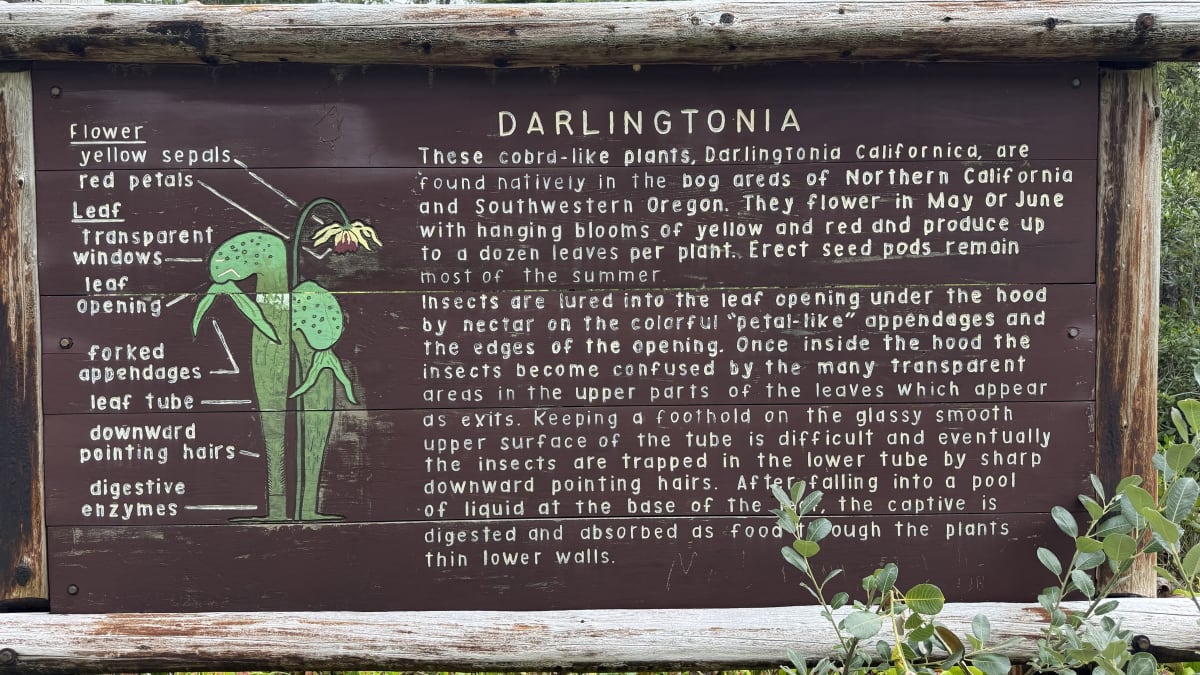
Its trap is a slow, patient piece of engineering. Nectar draws insects to the hidden opening under the hood. Once inside, an insect finds the dome above it dotted with translucent, window-like patches that look like ways out but are not, and in the confusion it works its way downward. Slick walls and stiff, downward-pointing hairs make climbing back up nearly impossible, so the insect eventually tumbles into a pool of water at the base of the tube.
Here the cobra lily does something unusual for a carnivorous plant. Rather than producing strong digestive enzymes of its own, it relies on a community of bacteria and other tiny organisms living in that pool to break the insect down, then absorbs the nutrients that result. Trapping prey this way lets the plant thrive in the poor, nutrient-starved soil of a bog, where it can get from insects what the ground cannot provide.
The fen it needs
A cobra lily cannot grow just anywhere. It needs a fen, a particular kind of wetland fed by cool, moving groundwater and small streams rather than by rain alone. That steady flow keeps the soil wet and its temperature low, conditions the plant seems to require, and it is part of why this species is uncommon and localized rather than widespread.
The rest of the bog is a low tangle of sedges, mosses, and other wetland plants adapted to soggy, acidic, nutrient-poor ground. Walking the boardwalk, you are passing over a self-contained little ecosystem, one that would be easy to destroy simply by draining the water table that feeds it. That fragility is exactly why the site is protected and why visitors are asked to stay on the path.
Because the cobra lily is native to a narrow band of southern Oregon and northern California, seeing it thriving in the open, in the wild, and in numbers is genuinely rare. This wayside is one of the surest places anywhere to do it.
Season by season
Late spring is the showpiece. Roughly around May and June the cobra lilies send up their flowers on tall stalks, nodding blooms of yellow and dark red held above the crowd of green pitchers. It is the most colorful and photogenic time to come.
Summer keeps the pitchers standing tall and green, and the wayside makes an easy, shaded break from the sunnier beaches and dunes nearby. Warm, still days can bring out mosquitoes in the bog, so it is worth being prepared.
Fall and winter are quieter and grayer, the flowers gone and the pitchers weathering the wet season. The coast here is often misty and rain-soaked in the cold months, which suits a bog just fine, though the plants are past their showiest. Whatever the season, the boardwalk is short and level, making this one of the more accessible natural curiosities on the coast.
Closest Boutels
The closest Boutel™ stays, so you can turn this stop into an overnight. Each is a place we chose through independent editorial review, never a paid placement.
Details
Florence, OR
Frequently asked questions
What is the cobra lily at Darlingtonia?
The cobra lily is a carnivorous pitcher plant, the only one native to Oregon, and this small preserve exists to protect a whole bog full of them. Each plant forms a hooded, hollow tube that really does look like a rearing cobra, luring insects inside with nectar and trapping them. Seeing thousands of them clustered together in the bog is a genuinely surreal sight.
How long does a visit to Darlingtonia take?
Not long, which is part of its charm as a roadside stop. A short, flat boardwalk loops from the parking area through the forest to the bog and back in roughly ten to fifteen minutes, so it is easy to fold into a coastal drive. The boardwalk is level and accessible, making it friendly for nearly all visitors.
When is the best time to see the cobra lilies?
The plants are there to see year-round, but spring into early summer is the best window, when the cobra lilies send up their strange, dangling flowers alongside the hooded traps. The bog is greenest and most striking then. It is a quick stop any time you are passing, and it is free to visit.
Can you touch or pick the cobra lilies?
No. This is a protected natural site set aside specifically to preserve these rare plants, so visitors stay on the boardwalk and look without touching, picking, or feeding them. The plants catch their own insects and need no help. Keeping to the boardwalk also protects the fragile bog they grow in.
Is Darlingtonia worth stopping for with kids?
Very much so. Carnivorous plants that trap bugs are endlessly fascinating to children, the boardwalk is short and easy, and the whole thing takes only a few minutes, so it makes a memorable, low-effort break on a longer coastal trip. There are restrooms and a small picnic spot if you want to linger a little.
Nearby

Oregon Dunes, Florence
3.8 miles away
The Oregon Dunes are a sandbox at continental scale: 40 miles of sand up to 500 feet tall where kids can run down, roll down, sandboard, and dig for as long as they like.
Sea Lion Caves
11 miles away
Sea Lion Caves delivers on its promise: an elevator drops you into a cathedral-sized sea cave packed with Steller sea lions hauled out on the rocks.
Cape Perpetua Tidepools
21 miles away
Cape Perpetua tidepools are among the best kid-friendly tide pool spots on the coast: giant green anemones, purple sea urchins, hermit crabs, and sea stars in pools that are waist-deep for an adult an...