
Assateague Beach and the Wild Ponies
Woodland Trail, Chincoteague, VA
Chincoteague, VA
A long, undeveloped Atlantic beach backed by salt marsh where wild ponies graze, on a barrier island that has never been built over.
Assateague is a long, thin barrier island shared by Virginia and Maryland, and its Virginia end is one of the wildest stretches of Atlantic coast you can drive to. There are no houses, no boardwalk, and no beach town on the sand, just dunes, marsh, pine, and open ocean, all protected within Chincoteague National Wildlife Refuge and Assateague Island National Seashore. It is the beach much of the mid-Atlantic coast looked like before it was built over.
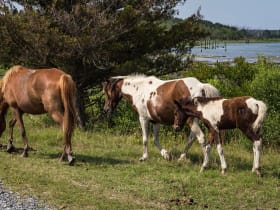
The island is famous above all for its wild ponies, small, hardy horses that live out on the marsh and dune grass year round. Rooted in local lore and made world-famous by the children's book Misty of Chincoteague, the ponies have grazed here for generations, and seeing a band of them standing knee-deep in the marsh grass is the kind of sight that stays with you.
What Travelers Love
- Spotting the wild ponies grazing in the marshes from the wildlife loop and trails
- A wide, natural Atlantic beach with no boardwalk, no high-rises, and no crowds pressing in
- The famous annual pony swim, when the herd crosses the channel to Chincoteague
- Shorebirds, waterfowl, and the chance of a sika deer or a bald eagle overhead
Worth Knowing
- The ponies are truly wild; keep well back, never feed them, and watch from a safe distance as they can bite and kick
- Bring bug protection in the warm months, since the salt marsh breeds mosquitoes and biting flies
- There is no development on the beach, so pack water, sun protection, and anything else you will need
- The pony swim and auction happen in late July; expect big crowds on the island those days
Learn about Assateague Beach and the Wild Ponies
The wild ponies and how they came to be here
No one is entirely certain how the ponies first reached Assateague. The romantic story holds that they swam ashore from a wrecked Spanish galleon, but the more likely explanation is that colonial-era settlers grazed livestock on the island in the 1600s to avoid fencing laws and taxes, and the animals simply stayed and went feral. Whatever their origin, the ponies have adapted to a hard, salty life, growing stocky and shaggy on marsh grass and drinking twice the water a domestic horse would, which gives them their rounded, bloated look.
The Virginia herd is owned and cared for by the Chincoteague Volunteer Fire Company, which has managed the ponies since the 1920s. Each summer they hold the celebrated pony swim, guiding the herd across the narrow Assateague Channel to Chincoteague at slack tide, followed by an auction of some of the foals that keeps the herd size in balance and raises money for the fire company. The event, immortalized in Marguerite Henry's 1947 book Misty of Chincoteague, draws visitors from around the world.
A barrier island left wild
Assateague is a barrier island, a long ribbon of sand thrown up by wind and wave that shields the mainland from the open Atlantic. Such islands are always on the move, their sand shifting north and south and their whole form migrating slowly landward as storms wash sand over the dunes. In the 1950s developers laid out a beach town here and even paved streets, but a ferocious 1962 nor'easter destroyed nearly everything, and the land was set aside for wildlife instead.
That accident of history is why the beach stays undeveloped today. The refuge protects it as habitat rather than real estate, so the shoreline is free to shift and rebuild as barrier islands naturally do. Walking it, you get a rare sense of a wild coast doing what coasts did before people fixed them in place with seawalls and rows of houses.
Birds, marsh, and a crossroads of migration
Assateague sits squarely on the Atlantic Flyway, the great migratory highway that funnels birds up and down the East Coast each spring and fall. The refuge's marshes, mudflats, and impoundments become a staging ground for tens of thousands of ducks, geese, and shorebirds, and the birdwatching here is among the best in the mid-Atlantic. Snow geese, egrets, herons, ibis, and the occasional peregrine falcon all pass through.
Beyond the birds and ponies, the island shelters sika deer, a small elk introduced from Asia in the 1920s that now roams the pine woods, along with white-tailed deer, muskrat, and the delaware fox squirrel. Bald eagles nest here, loggerhead sea turtles sometimes come ashore, and the whole braided system of marsh, dune, and forest holds far more life than the empty beach first suggests.
The beach through the seasons
Summer is peak season, when the water warms up, the beach draws swimmers and sunbathers, and the late-July pony swim fills the island with visitors. It is also the buggiest time on the marsh side, so most people stick to the breezy oceanfront in the heat of the day.
Spring and fall are quieter and, for many, the finest times to come. Migrating birds pour through, the light softens, and the beach empties out. Winter is stark and beautiful, cold and windswept, with the ponies growing thick coats and the refuge loop offering long views over a hushed, gray marsh. Any season rewards an early start, when the low sun and calm air bring the wildlife out.
Closest Boutels
The closest Boutel™ stays, so you can turn this stop into an overnight. Each is a place we chose through independent editorial review, never a paid placement.
Cape Motel
Honorable Mention26460 Charles M Lankford Jr Memorial Hwy, Cape Charles, VA
57 miles away|Learn More ›
Details
Chincoteague, VA
Frequently asked questions
What is Assateague Beach and the wild ponies?
Assateague Beach, on Assateague Island off Virginia's Eastern Shore near Chincoteague, is a beautiful, pristine barrier-island beach famous for the wild ponies that roam the island. Accessed through the Chincoteague National Wildlife Refuge, the wide, natural beach offers swimming, shelling, and sunbathing along the Atlantic, while the island's herds of wild ponies, made famous by the beloved book Misty of Chincoteague, graze the marshes and can often be seen. The combination of unspoiled beach and wild ponies is magical. With its pristine Atlantic beach and famous wild ponies, Assateague Beach offers an enchanting destination on Virginia's Eastern Shore.
Can you see the wild ponies at Assateague?
Yes, the wild ponies of Assateague are one of the island's greatest draws, and the herds can often be seen grazing in the marshes and open areas of the Chincoteague National Wildlife Refuge, sometimes visible from roads, trails, or on wildlife tours. Because they are truly wild animals, it is essential to keep a safe distance, never approach, touch, or feed them, as feeding harms them and they can bite or kick, and to observe them from afar, ideally with binoculars. Seeing the wild ponies from a respectful distance is a magical highlight of a visit to Assateague on Virginia's Eastern Shore.
What safety tips apply at Assateague Beach and with the wild ponies?
When swimming in the Atlantic, be cautious of currents and rip currents, watch children closely, and note lifeguard coverage may be limited on the natural beach. Keep a safe distance from the wild ponies, never approaching or feeding them, as they are wild and can bite or kick, and give them plenty of room. Bring sun protection, water, and insect repellent, as the marshes are buggy. Being cautious in the water and respecting the wild ponies from a distance ensure a safe and magical visit to Assateague Beach on Virginia's Eastern Shore.
When is the best time to visit Assateague Beach and the wild ponies?
Late spring through early fall is the best time for the beach and warm-weather recreation, with summer the peak season for swimming, though busiest, while the wild ponies can be seen year-round grazing the marshes. The famous annual pony swim and roundup, when ponies cross from Assateague to Chincoteague, takes place in late July, drawing big crowds, so check the current date if that is your goal. For beach time aim for the warm months, and to witness the pony swim, late July, at Assateague on Virginia's Eastern Shore.
What is near Assateague Beach and the wild ponies?
Assateague Beach is on Assateague Island off Virginia's Eastern Shore, reached through the Chincoteague National Wildlife Refuge and the town of Chincoteague, near the Assateague Lighthouse, the Museum of Chincoteague Island, and the NASA Wallops Visitor Center. That makes Assateague Beach an enchanting stop to combine with the Chincoteague National Wildlife Refuge, the Assateague Lighthouse, and the other attractions of Virginia's Eastern Shore on a visit to the state.
Nearby

Assateague Lighthouse
2.5 miles away
People drive to the refuge for ponies and beach and miss the striped tower hiding in the pines. The Assateague Lighthouse, lit in 1867, wears bold red-and-white bands and still works.
Chincoteague National Wildlife Refuge
3.1 miles away
This refuge protects something increasingly rare: a long stretch of wild Atlantic barrier island left largely as it is.
Museum of Chincoteague Island
3.9 miles away
Most visitors head straight for the beach and never learn what the town is actually about.
NASA Wallops Visitor Center
7.6 miles away
A genuine rocket launch site right next to the beach towns, and the visitor center is free.