
NASA Wallops Visitor Center
31 Jensen St, Wallops Island, VA
Wallops Island, VA
A real, working NASA launch range on the marshy edge of Virginia's Eastern Shore, where rockets still lift off toward the sea within sight of the Chincoteague ponies.
The NASA Wallops Visitor Center is the public front door to one of the oldest continuously operating rocket-launch ranges in the world. Wallops has been sending rockets skyward from this stretch of the Eastern Shore since 1945, and it still does, launching everything from small research rockets that study the upper atmosphere to large vehicles that carry cargo toward the International Space Station.
What makes it a genuine hidden gem is that it is not a museum recreation but the real thing, a working facility where scientists and engineers still fly missions. The visitor center gathers the story into one place, with rockets on the lawn, exhibits inside, and, on the right day, the chance to watch a launch lift off over the salt marsh.
What Travelers Love
- Standing next to real rockets and recovered spacecraft hardware on the grounds
- Timing a visit to an actual launch and watching it climb over the marsh
- Hands-on exhibits and flight simulators that let kids fly and build
- How close it all is to the Chincoteague ponies and the Assateague beaches
Worth Knowing
- This is an active federal launch range, so the visitor center keeps limited days and can close around launch operations
- Launch schedules shift often with weather and mission needs, so check the current status before you plan around one
- The site welcomes visitors and is a strong rainy-day stop paired with the nearby refuge and beaches
- Bring bug spray in the warm months; the surrounding marsh is prime mosquito country
Learn about NASA Wallops Visitor Center
A launch range older than NASA itself
Rocket flights began at Wallops in 1945 under an agency called NACA, the National Advisory Committee for Aeronautics, the research body that became the core of NASA when it was created in 1958. From the start the marshy, thinly settled coast made an ideal spot, open to the empty Atlantic and far from crowded airspace, so rockets could fly out over the water in safety.
In its early decades Wallops was a proving ground for aircraft and spaceflight research, testing wing shapes at high speeds and helping develop the hardware that carried the first Americans into space. It has since flown many thousands of launches, more than almost any other range in the country, and today it supports missions for NASA, the military, universities, and commercial companies, including resupply flights to the space station.
What you see at the visitor center
The grounds display real flight hardware, including rockets standing on the lawn and pieces of recovered spacecraft, so you can walk right up to machines that flew or were built to fly. Inside, the exhibits trace the range's history and explain how a launch actually works, from countdown to stage separation.
The center leans hands-on, with simulators and interactive stations aimed squarely at curious kids, letting them try piloting a craft, building and testing ideas, and seeing the science of flight up close. Staff and volunteers, many with long careers at the range, often bring an insider's perspective that no static exhibit can match.
Watching a launch
The real prize is catching a launch. When a mission flies, the rocket climbs from the pads on nearby Wallops Island and can be seen and heard for miles up and down the shore, a genuine spacecraft arcing out over the Atlantic. Larger launches to the space station are visible across much of the mid-Atlantic on a clear night.
Because this is a live range, schedules move constantly with weather, technical checks, and mission windows, so a launch is never guaranteed on any given visit. It pays to check the current launch status ahead of time, and to treat any launch you do catch as a lucky bonus on top of the exhibits and the barrier-island scenery.
The coast around Wallops
Wallops sits at the top of Virginia's Eastern Shore, a long, low peninsula between the Chesapeake Bay and the Atlantic that has kept its old rhythm of watermen, small farms, and marsh. Just across the water lies Chincoteague, gateway to the Chincoteague National Wildlife Refuge and the wild ponies of Assateague, so a space-history stop pairs naturally with beaches, birds, and horses.
This is quiet, uncrowded coast for much of the year, with tidal creeks, working harbors, and long stretches of undeveloped shoreline. The combination is unusual: cutting-edge rocketry on one side of the road and one of the East Coast's great wildlife refuges on the other, all within a short drive.
Closest Boutels
The closest Boutel™ stays, so you can turn this stop into an overnight. Each is a place we chose through independent editorial review, never a paid placement.
Details
Wallops Island, VA
Frequently asked questions
What is the NASA Wallops Visitor Center?
The NASA Wallops Visitor Center, on Virginia's Eastern Shore near Chincoteague, is the public visitor center for NASA's Wallops Flight Facility, one of the agency's oldest launch sites, used for rocket launches, scientific balloons, and aeronautics research. The center offers exhibits on space, rockets, and Earth science, hands-on displays, models, real spacecraft and rocket artifacts, and information about the launches that take place at the facility. It is an exciting and educational stop, especially for space enthusiasts and families. With its space exhibits, rocket displays, and launch connection, the NASA Wallops Visitor Center offers a fascinating destination on Virginia's Eastern Shore.
Can you see a rocket launch at NASA Wallops?
Yes, NASA's Wallops Flight Facility conducts rocket launches, and when launches are scheduled, they can sometimes be viewed from the visitor center or public viewing areas, offering an exciting spectacle, though launches happen on a periodic schedule and are subject to change, delays, and weather. Checking NASA's current launch schedule and viewing information before planning a trip is essential if seeing a launch is your goal, as they are not everyday events. Even without a launch, the visitor center's exhibits are engaging. The chance to see a launch makes the NASA Wallops Visitor Center especially thrilling on Virginia's Eastern Shore.
What can you do at the NASA Wallops Visitor Center?
You can explore exhibits on space, rockets, satellites, and Earth science, see real rocket and spacecraft artifacts and models, enjoy hands-on interactive displays, learn about the launches and research conducted at Wallops, and, when scheduled, view or learn about rocket launches. The center often offers programs and activities, especially for families and young space enthusiasts. The exhibits and the launch connection are highlights. With its space exhibits, rocket displays, and hands-on activities, the NASA Wallops Visitor Center offers an engaging and educational experience on Virginia's Eastern Shore.
When is the best time to visit the NASA Wallops Visitor Center?
The visitor center keeps regular hours that can vary by season, so checking current days and hours before you go is wise, and as an indoor attraction it is enjoyable in any weather. The most exciting time is when a rocket launch is scheduled, so checking NASA's launch schedule can help you time a visit to a launch, though these are periodic and weather-dependent. Summer often brings more programs and visitors. For a chance at a launch, plan around the schedule, otherwise the center is a rewarding stop any open day on Virginia's Eastern Shore.
What is near the NASA Wallops Visitor Center?
The NASA Wallops Visitor Center is on Virginia's Eastern Shore near Chincoteague, within reach of the Chincoteague National Wildlife Refuge, Assateague Beach and the wild ponies, the Assateague Lighthouse, and the Museum of Chincoteague Island. That makes the NASA Wallops Visitor Center a fascinating stop to combine with the Chincoteague refuge, Assateague Beach, and the other attractions of Virginia's Eastern Shore on a visit to the state.
Nearby
Museum of Chincoteague Island
5.8 miles away
Most visitors head straight for the beach and never learn what the town is actually about.
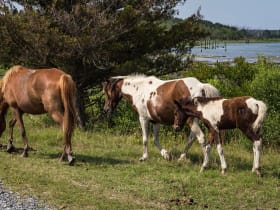
Chincoteague National Wildlife Refuge
6.1 miles away
This refuge protects something increasingly rare: a long stretch of wild Atlantic barrier island left largely as it is.

Assateague Lighthouse
6.6 miles away
People drive to the refuge for ponies and beach and miss the striped tower hiding in the pines. The Assateague Lighthouse, lit in 1867, wears bold red-and-white bands and still works.
Assateague Beach and the Wild Ponies
7.6 miles away
A real wild beach that still works for young families. The Assateague beach inside the refuge has lifeguarded stretches in summer, gentle surf for wading and shell-hunting, and open sand with no crowd...