
Aiken County Historical Museum
433 Newberry St SW, Aiken, SC
Aiken, SC
A rambling old winter mansion turned museum, telling the story of a Southern railroad town that became a playground for the Gilded Age rich and their horses.
The Aiken County Historical Museum is housed in Banksia, a sprawling mansion built in the 1930s during Aiken's era as a Winter Colony, when wealthy families from the Northeast came south each cold season to ride, hunt, and socialize. The house itself is the first exhibit, a grand relic of that Gilded Age migration, and its rooms now hold the layered story of the whole county.
Inside, the collections range from Native American and early settler history to the railroad that put Aiken on the map, the Civil War, and the thoroughbred and polo culture that made the town famous. On the grounds sit a relocated one-room schoolhouse and a log cabin, small buildings that ground the mansion's grandeur in the everyday lives of ordinary South Carolinians.
What Travelers Love
- Touring a genuine Winter Colony mansion with its period rooms and grand scale
- Learning how a small railroad town became a haven for wealthy Northern winter visitors
- Exhibits on the thoroughbred and polo culture that still defines Aiken
- A relocated one-room schoolhouse and log cabin on the grounds
Worth Knowing
- The museum is donation-based, which keeps it easy to fold into a walk around the historic district
- The house is large and best explored at an unhurried pace
- It pairs naturally with a stroll through Aiken's shaded downtown and horse district
- Check current days open before visiting, as a local museum keeps its own schedule
Learn about Aiken County Historical Museum
A railroad town that drew the rich
Aiken owes its start to the railroad. In the 1830s it grew up along one of the longest rail lines in the world at the time, the route running inland from Charleston, and it was named for a railroad executive. That early rail connection, combined with a mild, pine-scented winter climate that doctors once prescribed for lung ailments, set the town on an unusual path.
By the late 1800s Aiken had been discovered by wealthy families from New York, Boston, and beyond, who built winter estates, stables, and clubs and came south each year for the riding season. This Winter Colony, as it was known, reshaped the town with wide streets, bridle paths, and grand homes like Banksia. The museum tells that story from the inside, in a house that was itself part of that world.
Horses, polo, and the sandy training tracks
Aiken became one of America's great horse towns, and it remains so. The Winter Colony families brought thoroughbreds, polo ponies, and steeplechasers, and the town's sandy soil proved ideal for training. Whole neighborhoods were left unpaved on purpose so horses could move freely, and that tradition survives in the dirt roads of the historic horse district today.
The museum's exhibits trace this equestrian heritage, which connects directly to Aiken's other landmarks, from the polo field to the racing hall of fame. Together they explain why a Midlands town of modest size carries a national reputation among people who follow horses, and why the clop of hooves is still an ordinary sound in parts of town.
The wider county story
Banksia's rooms reach well beyond the Gilded Age. The collections cover the Native American peoples of the region, the arrival of European settlers, the plantation and enslavement history that shaped the antebellum county, and the Civil War, including the 1865 Battle of Aiken fought nearby. The museum handles these harder chapters as part of an honest local record rather than a genteel highlight reel.
Twentieth century Aiken added another dimension: the enormous Savannah River Site, a Cold War nuclear facility built in the early 1950s that transformed the county's economy and population almost overnight. The museum documents that upheaval too, which makes it a fuller portrait of a place than its elegant mansion setting might first suggest.
Visiting and the district around it
The museum sits within Aiken's historic district, so a visit folds easily into a walk through one of the most attractive small downtowns in the state. Aiken's streets are famously wide, planted with parkways of trees and flowers down their centers, a legacy of the town's careful early planning that makes strolling a pleasure in any season.
Give the mansion an unhurried hour or two, then wander the surrounding blocks, the horse district's sandy lanes, and the nearby parks and gardens. Because the museum is donation-based and close to Aiken's other equestrian sites, it is an easy and rewarding anchor for a day in town.
Closest Boutels
The closest Boutel™ stays, so you can turn this stop into an overnight. Each is a place we chose through independent editorial review, never a paid placement.
The Station by Compo Hotels
Boutel745 Old Buncombe Rd, Travelers Rest, SC 29690, Travelers Rest, SC
105 miles away|Learn More ›
Details
Aiken, SC
Frequently asked questions
What is the Aiken County Historical Museum?
The Aiken County Historical Museum, in the town of Aiken in South Carolina, is a local history museum housed in a grand historic mansion, telling the story of Aiken County and its region. Aiken is famous as a winter colony where wealthy Northerners once came for the mild climate and equestrian sports, and the museum's exhibits cover this Winter Colony heritage along with the area's Native American history, the local railroad and industry, and daily life through the eras, all set in an elegant historic estate with period rooms and grounds. With its historic mansion and regional history exhibits, the Aiken County Historical Museum offers an engaging destination in South Carolina.
What can you see at the Aiken County Historical Museum?
You can explore exhibits on Aiken County's history, including its famous Winter Colony era when wealthy Northerners wintered here for the equestrian sports, the region's Native American heritage, the railroad and local industry, and everyday life through the decades, all displayed in a grand historic mansion with elegant period rooms and grounds. The historic mansion setting and the varied regional history are highlights. It offers a rich look at Aiken's distinctive past. With its historic estate and regional exhibits, the Aiken County Historical Museum offers an educational and engaging visit in Aiken, South Carolina.
What was Aiken's Winter Colony?
Aiken's Winter Colony refers to the era, especially in the late nineteenth and early twentieth centuries, when wealthy Northern families came to spend the winter in Aiken, drawn by the mild climate, the sandy soil ideal for horses, and the thriving equestrian sports of polo, fox hunting, and thoroughbred training. These winter residents built grand estates and helped make Aiken a renowned center of horse culture, a legacy that endures in the town's equestrian traditions today. This colorful history is a key part of Aiken's identity, and the Aiken County Historical Museum interprets it in South Carolina.
When is the best time to visit the Aiken County Historical Museum?
As an indoor museum in a historic mansion, the Aiken County Historical Museum is enjoyable year-round in any weather, though checking current days and hours before you go is wise, as they can vary. Spring and fall offer the most pleasant weather for combining a visit with exploring Aiken's charming historic town, gardens, and equestrian sites, and the winter months are when Aiken's horse events are in season. For the museum any time paired with pleasant weather, aim for spring or fall at the Aiken County Historical Museum in South Carolina.
What is near the Aiken County Historical Museum?
The Aiken County Historical Museum is in the town of Aiken in South Carolina, within reach of Hopelands Gardens and the Aiken Thoroughbred Racing Hall of Fame, Hitchcock Woods, Aiken Polo at Whitney Field, and the horse country of Aiken. That makes the Aiken County Historical Museum an engaging stop to combine with Hopelands Gardens, Hitchcock Woods, and the other attractions of Aiken's horse country on a visit to South Carolina.
Nearby

Hitchcock Woods
0.2 miles away
It is rare for a town this size to hold a wild forest this large right against its downtown.
Aiken Thoroughbred Racing Hall of Fame
0.5 miles away
Most visitors wander into Hopelands Gardens for the live oaks and camellias and only then discover the racing museum tucked inside the old estate stable.

Hopelands Gardens
0.6 miles away
For a quick, free breather in Aiken, walk the paths of Hopelands Gardens.
Aiken Polo at Whitney Field
0.9 miles away
People assume polo is invitation-only, but in Aiken you can pull up on a Sunday and watch from the grass.

Living History Park
15 miles away
This is history kids can watch happen. Living History Park in North Augusta is a recreated 1700s village where costumed volunteers actually forge iron, dip candles, spin thread, and cook over open fir...

Augusta Canal
15 miles away
Most people passing through Augusta for the golf never learn about the canal that built the city.
Congaree National Park
55 miles away
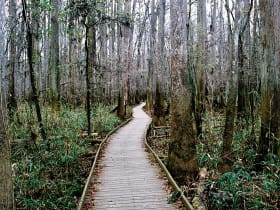
One of the tallest deciduous forests left in the world, a floodplain of champion old-growth hardwoods.