
Whitman Mission National Historic Site
328 Whitman Mission Rd
Walla Walla, WA
A quiet field of grass along the Walla Walla River holds one of the hardest and most consequential stories on the Oregon Trail, told here with growing honesty about the Cayuse people whose homeland this is.
Whitman Mission National Historic Site protects a place the Cayuse people call Waiilatpu, which means the place of the rye grass. For thousands of years this was Cayuse homeland, a gathering and living place along the Walla Walla River. In 1836 the missionaries Marcus and Narcissa Whitman settled here, and over the next eleven years the mission became a well-known stop for wagon trains on the Oregon Trail. The story that unfolded is one of the most difficult and important on the entire trail.
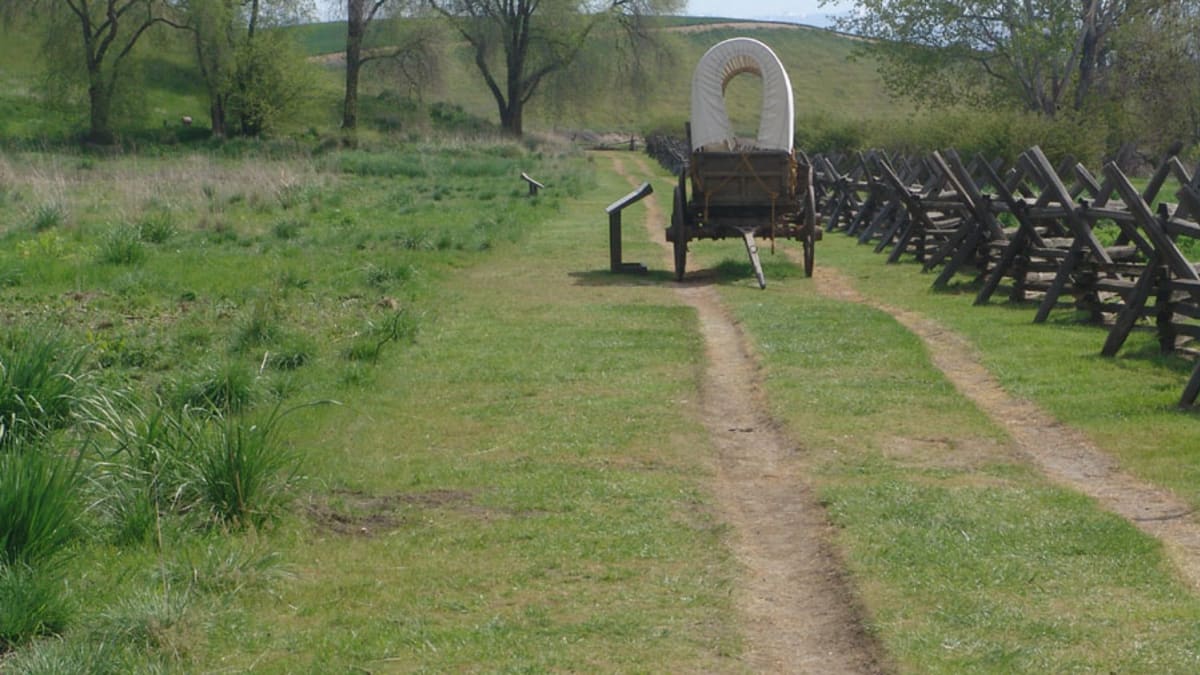
What you find today is deliberately quiet: a grassy field with the outlines of vanished buildings, a restored millpond, a memorial on the hill, and a visitor center that has worked hard, in recent decades, to tell the whole truth rather than a comfortable half of it. It is not a triumphant place. It is a place to slow down and understand.
What Travelers Love
- A thoughtful visitor center that tells the story from more than one side
- Walking the quiet grounds where the mission stood, with the old millpond and marked building outlines
- Standing on the hill at the memorial shaft, looking out over the whole valley
- Seeing swales of the actual Oregon Trail still pressed into the ground nearby
Worth Knowing
- This is a place of real tragedy and loss, especially for the Cayuse people, and it asks to be visited with respect rather than as a simple monument
- The interpretation has changed over the years, moving away from a one-sided telling; the National Park Service works with descendant tribes on how the story is shared
- It is an outdoor site on the open plateau, hot and dry in summer and cold in winter, so dress for the weather
- Give yourself time for the visitor center; the grounds make far more sense once you know the full story
Learn about Whitman Mission National Historic Site
The Cayuse homeland
Long before any wagon rolled west, the Cayuse lived across the plateau of what is now southeastern Washington and northeastern Oregon, moving with the seasons to fish salmon, dig roots, hunt, and gather. They were known as skilled horse people, and Waiilatpu was one of their places. Their descendants are alive and well today, enrolled with the Umatilla and Walla Walla peoples as the Confederated Tribes of the Umatilla Indian Reservation.
When the Whitmans arrived in 1836, the Cayuse welcomed them, curious about what they offered and expecting a relationship of exchange. Over time that relationship frayed. The mission's real purpose, to change Cayuse belief and life, sat uneasily with a people who had their own deep traditions, and the growing river of wagons the Whitmans helped guide west carried a threat the Cayuse could see clearly: more and more settlers moving onto their land.
The mission and the Oregon Trail
Marcus Whitman was a physician as well as a missionary, and his wife Narcissa was among the first non-Native women to travel overland to the Northwest. Their mission grew into a small complex of house, mill, and fields beside the river. From about 1843 onward, as the Oregon Trail filled with emigrants, Waiilatpu became an important waystation where exhausted travelers could rest, resupply, and winter over before the last push to the Willamette Valley.
That traffic changed everything. Each season brought more wagons, more strangers, and more pressure on Cayuse land and resources, and it also brought disease. The newcomers carried illnesses to which the tribes had little immunity, and the consequences were catastrophic.
1847 and its long shadow
In the autumn of 1847 a measles epidemic swept through the valley. It killed emigrants and Cayuse alike, but it fell hardest on the Native community, taking roughly half of the local Cayuse, including many children. Marcus Whitman treated both groups as a doctor, yet Native patients kept dying while many settlers recovered, and in a system of belief where a healer bore responsibility for the outcome, suspicion turned toward the mission.
On November 29, 1847, a group of Cayuse attacked the mission. Thirteen people were killed, among them Marcus and Narcissa Whitman, and others were held for weeks before a Hudson's Bay Company official named Peter Skene Ogden negotiated their release. The event was long called the Whitman Massacre, though the park and the tribes increasingly frame it with more care, as a violent act born of epidemic, grief, fear, and the crushing pressure of invasion. It set off the Cayuse War and was used to justify still more loss of Native land in the years that followed.
Visiting with respect today
A visit begins in the visitor center, where exhibits lay out the mission's story and, crucially, the Cayuse perspective that older tellings left out. From there a short walk leads to the mission grounds, where low markers trace the footprints of the buildings around the restored millpond, and a path climbs the hill to a tall memorial shaft and the Great Grave. Nearby, you can still see swales worn into the earth by the wagons of the Oregon Trail.
Come to Waiilatpu ready to listen. This is not a place that offers easy heroes or a tidy ending. It is a place that holds grief on more than one side, and its greatest value is in how honestly it now tries to hold all of it at once.
Closest Boutels
The closest Boutel™ stays, so you can turn this stop into an overnight. Each is a place we chose through independent editorial review, never a paid placement.
Walla Walla Garden Motel
Honorable Mention2279 E Isaacs Ave, Walla Walla, WA
9 miles away|Learn More ›
Details
Walla Walla, WA
Frequently asked questions
What is the Whitman Mission National Historic Site?
The Whitman Mission National Historic Site, near Walla Walla in southeastern Washington, preserves the site of a mission established in 1836 by Marcus and Narcissa Whitman among the Cayuse people, along the route that would become the Oregon Trail. The mission became a well-known stop for emigrants, but tensions, cultural conflict, and a devastating measles epidemic that killed many Cayuse led to the tragic events of 1847, when the Whitmans and others were killed. The site memorializes this pivotal and painful history, telling the story of the missionaries, the Cayuse, and the era of westward expansion. With its historic grounds, memorial, and museum, the Whitman Mission National Historic Site offers a reflective look at a significant and sobering chapter of Pacific Northwest history.
What can you see at the Whitman Mission National Historic Site?
You can walk the grounds where the mission stood, seeing the outlines of the mission buildings, the emigrant Oregon Trail ruts, the memorial shaft on the hill, and the mass grave, along with a visitor center and museum that tell the history of the Whitmans, the Cayuse people, the mission, and the tragic events and their aftermath. Interpretive information presents the complex and painful history, increasingly including Cayuse perspectives. The peaceful setting invites reflection. With its historic grounds, memorial, museum, and the story it tells, the Whitman Mission National Historic Site offers a moving and educational experience in southeastern Washington.
Why is the Whitman Mission historically significant?
The Whitman Mission is historically significant as an early mission and a notable stop on the Oregon Trail, and especially for the tragic events of 1847 that became a pivotal moment in the history of the Pacific Northwest. The killing of the Whitmans and others by Cayuse people, amid cultural conflict and a deadly measles epidemic that devastated the tribe, had far-reaching consequences, contributing to conflict and the eventual establishment of formal U.S. governance over the region. The site reflects the complex, often tragic history of missionaries, Native peoples, disease, and westward expansion, making it an important place for understanding this consequential era.
When is the best time to visit the Whitman Mission National Historic Site?
Spring through fall offers the most pleasant weather for walking the outdoor grounds and trails, with spring bringing green and wildflowers and fall offering comfortable temperatures, while summer can be hot in southeastern Washington, so morning visits are more comfortable then, and the visitor center is enjoyable in any weather. Checking current hours before you go is wise. A visit is fairly reflective and can be combined with the Walla Walla wine country. For the best combination of comfortable weather and enjoyment of the grounds, aim for spring or fall at the Whitman Mission National Historic Site.
What is near the Whitman Mission National Historic Site?
The Whitman Mission National Historic Site is near Walla Walla in southeastern Washington, known for its acclaimed wine country and charming downtown, near the Blue Mountains, and within reach of the Palouse country to the north and the Columbia River. That makes the Whitman Mission National Historic Site a reflective historical stop to combine with the Walla Walla wineries, the Blue Mountains, and the other attractions of southeastern Washington on a visit to the state.
Nearby
Tamástslikt Cultural Institute
29 miles away
The only museum on the entire Oregon Trail that tells the story from a Native point of view, run by the Cayuse, Umatilla, and Walla Walla tribes.

Blue Mountains
36 miles away
The dark, blue-hazed forested range that rises straight out of the golden wheat hills southeast of Walla Walla, most of it the public Umatilla National Forest.

Palouse Falls State Park
45 miles away
Palouse Falls is on the Palouse River where it enters a basalt canyon carved by the Missoula Floods 15,000 years ago, 50 miles west of the Snake River confluence.