
Watervliet Shaker Historic District
25 Meeting House Rd
Colonie, NY
The very first Shaker settlement in America, where a small band of English believers built a peaceable community of plain buildings, gardens, and quiet craft.
The Watervliet Shaker Historic District marks the birthplace of the Shakers in America, the very first settlement of a religious community that would become famous for its plain, beautiful craftsmanship and its distinctive way of life. Here, in the 1770s, a small group of English believers led by a woman known as Mother Ann Lee established the first Shaker community in the New World, on a patch of swampy ground near Albany.
From this modest beginning the Shaker movement spread across the young country, founding villages known for their farms, their inventions, and their famously spare and graceful furniture. The surviving buildings, meeting house, gardens, and cemetery at Watervliet preserve the place where it all started, a quiet corner of history where the first American Shakers built their peaceable community.
What Travelers Love
- Standing on the ground of the first Shaker settlement in the country
- The plain, elegant Shaker buildings and the historic meeting house
- The story of Mother Ann Lee and the community she founded
- Herb gardens, orchards, and grounds that recall Shaker farm life
Worth Knowing
- The site is a historic district run by a heritage group, so check what is open when you visit
- It is a place of quiet history and reflection rather than a busy attraction
- The Shaker cemetery on the grounds holds the grave of the community's founder
- It welcomes visitors and hosts seasonal programs, markets, and craft events
Learn about Watervliet Shaker Historic District
Mother Ann Lee and the first believers
The Shakers, formally the United Society of Believers in Christ's Second Appearing, took shape in England before a small band of them sailed to America in 1774, led by Ann Lee, whom her followers called Mother Ann. They sought a place to practice their faith freely, and they settled on wooded, swampy land near Albany that they cleared and farmed by hand.
Mother Ann preached a life of celibacy, equality, hard work, and simplicity, and her followers organized themselves into a communal society that shared property and labor. She died in the 1780s and is buried in the Shaker cemetery on the grounds, and the community she founded here became the mother settlement from which the movement grew across the eastern states and beyond.
The Shaker way of life
The Shakers built their communities around a set of guiding ideals: equality of the sexes, communal ownership, pacifism, celibacy, and a belief that work itself was a form of worship. Men and women lived and worshiped separately but shared authority, an unusual arrangement for the era, and they welcomed converts and orphans into a life of order and industry.
Their faith expressed itself in ecstatic worship, the shaking and dancing that gave them their name, and in a devotion to doing every task well. That devotion produced the famously simple, functional, and beautiful objects the Shakers are remembered for: their furniture, boxes, tools, and buildings, all made with a plainness that later generations came to see as a kind of art.
The buildings and the grounds
The historic district preserves a cluster of Shaker buildings, including a meeting house and other structures from the community's working life, along with the fields, orchards, and gardens that fed it. The architecture is characteristically Shaker, plain and well proportioned, with an honesty of line and material that still feels modern.
Herb gardens on the grounds recall the Shakers' renown as growers and sellers of medicinal herbs and seeds, an enterprise that helped support the community. The Shaker cemetery holds the graves of the early believers, including Mother Ann Lee herself, so the site brings together the community's homes, its work, its worship, and its final resting place in one quiet landscape.
Seasons and a visit
The site is a place for unhurried history, best appreciated at a slow pace, and it takes on different moods with the seasons. Spring and summer bring the herb gardens and orchards to life, echoing the community's farming rhythms, while fall lights the surrounding trees and lends the plain buildings a warm glow.
The heritage group that cares for the district hosts seasonal programs, craft demonstrations, markets, and events through the year that bring the Shaker story and its handwork to life. A visit rewards those interested in early American religious history, in fine craftsmanship, and in a peaceful, reflective corner of the Capital Region.
Closest Boutels
The closest Boutel™ stays, so you can turn this stop into an overnight. Each is a place we chose through independent editorial review, never a paid placement.
Details
Colonie, NY
Frequently asked questions
What is the Watervliet Shaker Historic District?
Located just outside Albany in Colonie, it is the first Shaker settlement in America, founded in the 1770s by Mother Ann Lee, who led her followers from England and is buried here. Now a National Historic District cared for by the Shaker Heritage Society, it preserves original Shaker buildings, gardens, orchards, a cemetery, and a nature preserve, offering a peaceful and fascinating window into a remarkable American religious community.
What can you see at the Watervliet Shaker site?
The centerpiece is the 1848 Meeting House, which today holds a small museum of Shaker products and artifacts and a gift shop of locally made crafts, alongside other original Shaker buildings, herb gardens, and orchards. A short distance away is the Shaker cemetery where Mother Ann Lee rests, and the adjacent Ann Lee Pond nature preserve offers a quiet walk. Guided tours bring the community's history vividly to life.
Who were the Watervliet Shakers?
The Shakers were a religious community known for communal living, celibacy, pacifism, hard work, and a striking commitment to gender and racial equality, as well as their beautifully simple craftsmanship. The Watervliet Shakers were notably innovative, credited as the first to package and sell garden seeds and with inventing the flat broom, and they were involved in abolitionist causes. Their story is a fascinating and often surprising chapter of American history.
When is the best time to visit, and should I take a tour?
Spring through fall is loveliest for enjoying the historic grounds, gardens, and nature preserve, and the museum and guided tours run on a seasonal schedule, so it is worth checking current hours before you go. A guided tour, often led by knowledgeable volunteers, is highly recommended, as it provides invaluable context and brings the Shaker residents' stories to life far beyond what self-guided exploration offers.
How much time do you need at the Watervliet Shaker district?
You can comfortably spend two to three hours exploring the remaining buildings, especially the Meeting House museum, walking the historic grounds and gardens, and visiting the cemetery and nature preserve. While the museum itself is relatively small, the peaceful setting and rich history reward an unhurried visit. Its location very near Albany makes it an easy and worthwhile addition to a Capital Region trip.
Nearby
Cohoes Falls
5.2 miles away
For a big waterfall you can reach in two minutes from the car, stop at Cohoes Falls.
Million Dollar Staircase
7.3 miles away
Most visitors to Albany photograph the Capitol from outside and never go in to see its best feature.

New York State Museum
7.4 miles away
This is a rare thing: a big, first-rate museum that costs nothing to enter.
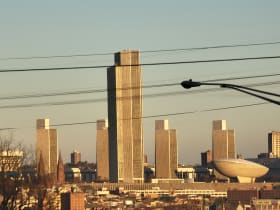
The Egg and Empire State Plaza
7.4 miles away
Kids tend to stop and stare at The Egg, and that reaction is the whole appeal.