
Tintic Mining District
Eureka, UT
Eureka, UT
Weathered headframes and a proud old main street in the hills southwest of Provo, the heart of one of Utah's richest mining districts.
The Tintic Mining District was one of Utah's richest and most productive mining regions, a cluster of hills and camps southwest of Provo that yielded vast quantities of silver, gold, lead, and other metals from the late nineteenth century onward. At its heart sits Eureka, a town whose historic main street and mine-scarred hills still tell the story of the boom.
Today the district is a living monument to Utah's mining heritage, with weathered headframes standing over old shafts, historic buildings lining the streets of Eureka and neighboring camps, and a local museum preserving the artifacts and memory of the era. For those drawn to ghost towns and industrial history, the Tintic district offers an atmospheric window into a vanished way of life.
What Travelers Love
- Eureka's preserved historic main street and mining-era buildings
- Old mine headframes and structures scattered across the hills
- A local mining museum telling the district's rich story
- The atmospheric ghost-town feel of the surrounding camps
Worth Knowing
- Old mine sites are dangerous, so never enter shafts or climb on unstable structures
- Much of the land and many structures are private, so respect posted boundaries
- The mining museum has seasonal or limited hours, so check ahead
- Cleanup work has occurred in the area, so heed any posted safety notices
Learn about Tintic Mining District
A rich silver district
Mining began in the Tintic district in the 1860s and 1870s, and rich veins of silver, gold, lead, and copper soon made it one of the most productive districts in Utah. Towns sprang up around the mines, railroads arrived to haul the ore, and for decades the hills rang with the work of extracting mineral wealth.
Eureka became the district's principal town, a bustling community with all the trappings of a prosperous mining center. Neighboring camps like Mammoth, Silver City, and Diamond grew alongside it, together forming a thriving industrial landscape in the otherwise quiet West Desert hills.
What remains today
As the ore played out and mining declined, the district faded, leaving Eureka a small town and the surrounding camps largely ghostly remnants. Yet much survives: Eureka's historic main street retains many of its old commercial buildings, and mine headframes and structures still stand over the hills.
A local mining museum preserves photographs, tools, ore samples, and stories of the boom years, helping visitors make sense of the ruins scattered across the landscape. Wandering the town and hills, one can read the rise and fall of a great mining district in the surviving buildings and machinery.
Exploring safely and respectfully
The relics of the Tintic district are fascinating but require caution. Old mine shafts and workings are genuinely dangerous, and visitors should never enter them or climb on unstable structures. Much of the land and many buildings are private, so it is important to respect posted boundaries and view from public roads and areas.
The district has also seen environmental cleanup work related to its mining past, so posted safety notices should be heeded. Approached with care and respect, the towns and hills offer a rewarding, atmospheric encounter with Utah's industrial history.
The land and the setting
The Tintic country lies in the West Desert hills, part of the ancestral homeland of the Ute and Goshute peoples, whose presence in this region long predates the mines. The mining era brought a rush of newcomers and dramatic change to a landscape people had inhabited for a very long time.
Set amid quiet high-desert hills, the district today feels far removed from its boomtown past. Spring and fall offer the most pleasant weather for exploring the towns and back roads, while summer is hot and winter cold, and the surrounding country invites a leisurely drive among the remnants of a once-roaring industry.
Closest Boutels
The closest Boutel™ stays, so you can turn this stop into an overnight. Each is a place we chose through independent editorial review, never a paid placement.
Details
Eureka, UT
Frequently asked questions
What is the Tintic Mining District?
The Tintic Mining District, centered on the town of Eureka in central Utah, was once one of the state's richest mining regions, producing enormous amounts of silver, gold, and lead from the late 1800s into the twentieth century. Today it is a fascinating living relic of that boom, with historic mining towns, towering mine headframes, and old buildings scattered across the hills, plus a mining museum. It offers an evocative, off-the-beaten-path glimpse into Utah's rugged mining heritage.
What can you see in the Tintic Mining District?
You can explore the historic town of Eureka, a designated historic district still lined with old commercial buildings, and drive to nearby near-ghost towns like Mammoth and Silver City, where weathered structures and rusting mine equipment remain. Old headframes stand above former shafts, and the Tintic Mining Museum helps interpret the area's rich history. It is a rewarding destination for those who enjoy ghost towns, industrial history, and atmospheric relics of the mining era.
Is it safe to explore the Tintic Mining District?
Take real care. Many old mine workings, including open shafts and adits, are extremely dangerous and must never be entered, since they can collapse or contain bad air and hidden drops. Much of the land is also privately owned, so respect posted property and stay on public roads and areas. Watch your footing around old structures and debris, keep children close, and admire the historic sites from a safe distance rather than climbing on fragile ruins.
When is the best time to visit the Tintic Mining District?
Spring and fall offer the most comfortable temperatures for exploring the towns and driving the backroads, while summer can be hot and winter cold and potentially snowy at the higher elevations. The soft light of morning and evening is lovely on the weathered buildings and headframes for photography. Whenever you go, bring water and be prepared for a remote, rural area with limited services as you explore the scattered sites.
What is near the Tintic Mining District?
The district lies in central Utah near the town of Eureka, along the US-6 corridor southwest of Provo and the Utah Valley. The surrounding region includes wide-open desert and mountain scenery and other historic and outdoor sites. That makes the Tintic Mining District an intriguing detour for travelers crossing central Utah, especially those drawn to ghost towns and the dramatic story of the state's mining past.
Nearby
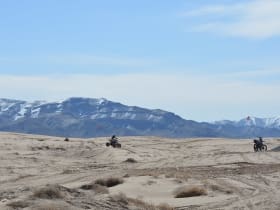
Little Sahara Recreation Area
28 miles away
Little Sahara Recreation Area covers 60,000 acres of BLM land northwest of Nephi in Juab County and preserves one of the largest active sand dune systems in Utah.

Bridal Veil Falls
38 miles away
Bridal Veil Falls drops in two tiers down the canyon wall, and the base is reachable in a flat five-minute walk from the parking area off the Provo Canyon road.

Mount Timpanogos
40 miles away
Mount Timpanogos is the second highest peak in the Wasatch Range and the most visually dominant mountain above the Utah Valley.