
Tinaja Overlook on US-64
US-64, Tres Piedras, NM
Tres Piedras, NM
A quiet pullout on the high road west of Taos, where the sage plateau rolls out toward the Rio Grande Gorge and the peaks of the Sangre de Cristo stand on the horizon.
The Tinaja Overlook is one of those simple pleasures of a New Mexico road trip, a pullout on the high scenic stretch of US-64 west of Taos where the land opens into a vast sweep of sage plateau. From here the mesa rolls gently toward the deep slash of the Rio Grande Gorge, with the great wall of the Sangre de Cristo Mountains standing blue on the eastern horizon beyond Taos.
US-64 across this country is one of the finest drives in northern New Mexico, climbing through pine forest around Tres Piedras and out onto an open, wind-scoured plateau dotted with volcanic outcrops. The overlook is a chance to pull over and take in the scale of it, the kind of enormous, quiet, high-desert view that rewards a few unhurried minutes far more than a photo from a moving car.
What Travelers Love
- A sweeping, uncrowded view over the sage plateau toward the Rio Grande Gorge
- The wall of the Sangre de Cristo Mountains rising beyond Taos to the east
- Enormous skies and clean high-desert light, especially near sunrise and sunset
- A quiet place to stop and stretch on the scenic drive west of Taos
Worth Knowing
- This is a high, exposed plateau, so weather changes fast and the wind can be strong and cold
- Winter can bring snow and ice to US-64, so check conditions before a cold-season drive
- Facilities are minimal at a roadside overlook, so carry water and fuel up before the drive
- The high elevation means thinner air and stronger sun, so pace yourself and bring protection
Learn about Tinaja Overlook on US-64
The high road west of Taos
US-64 is one of northern New Mexico's great scenic corridors, running west from the Taos area, across the dramatic Rio Grande Gorge Bridge, and up onto the plateau toward Tres Piedras and beyond. Along the way it climbs from the river country into ponderosa pine and out onto open sagebrush mesa, changing character with the elevation.
The Tinaja Overlook falls on this high, open stretch, where the road runs across a broad tableland with long views in every direction. It is a natural place to break the drive, a quiet turnout where you can feel the wind, take in the distances, and appreciate just how big and empty this part of the state remains.
The plateau and the Rio Grande Gorge
The country here is part of the Taos Plateau, a high volcanic tableland built up by ancient lava flows and studded with small volcanic hills and cones. From a distance it reads as flat and featureless sage, but it is cut by the Rio Grande Gorge, a deep basalt-walled canyon the river has carved hundreds of feet into the plateau, one of the defining features of the northern landscape.
From an overlook out on the mesa, the gorge often reveals itself as a shadowed line in the middle distance, where the flat land suddenly drops away. Beyond it rise the Sangre de Cristo Mountains, snow-capped much of the year, closing the horizon with the high peaks that shelter Taos and its valley.
A land of many peoples
This high country lies within the ancestral homeland of Taos Pueblo, one of the oldest continuously inhabited communities in North America, whose people have lived and traveled across this plateau and its river country for many centuries. The land also carries the deep Hispano heritage of northern New Mexico, whose villages, land grants, and traditions have shaped the region since Spanish colonial times.
Later came the ranchers, artists, and travelers drawn to the light and space of the Taos country, but the plateau remains largely open and undeveloped, much as it has long been. A stop at an overlook here is a chance to take in a landscape that has meant home, hunting ground, and sacred country to the peoples of this region across a very long span of time.
Weather, light, and the seasons
Light is everything on this plateau. The clean, thin air of the high desert makes distant mountains sharp and colors intense, and the low sun of morning and evening rakes across the sage and the gorge, turning the whole scene gold and violet. Midday can flatten the view, so the edges of the day are the ones to aim for.
The elevation means real weather. Summer brings warm days and dramatic afternoon thunderstorms marching across the mesa, fall is crisp and clear, and winter can be genuinely cold and snowy, with US-64 subject to ice and closures in bad conditions. Whatever the season, the wind is a near-constant companion up here, part of the character of standing out on the roof of northern New Mexico.
Closest Boutels
The closest Boutel™ stays, so you can turn this stop into an overnight. Each is a place we chose through independent editorial review, never a paid placement.
Pinon Court by La Fonda
Honorable Mention201 Montezuma Avenue, Santa Fe, NM
89 miles away|Learn More ›
Details
Tres Piedras, NM
Frequently asked questions
What is the Tinaja Overlook on US 64?
The Tinaja Overlook, along U.S. Highway 64 in northwestern New Mexico, is a scenic roadside viewpoint offering sweeping views of the surrounding high-desert landscape, canyons, and rugged terrain of the San Juan Basin region. Named for the tinajas, or natural rock basins that collect water in the area, the overlook provides a convenient place to stop, stretch, and take in the beautiful and expansive scenery of northwestern New Mexico. A pleasant scenic pause along the highway, the Tinaja Overlook lets travelers appreciate the wide-open beauty and dramatic geology of this part of the state while exploring the Four Corners and San Juan Basin country.
What can you see at the Tinaja Overlook?
From the Tinaja Overlook, you can take in expansive views of the high-desert landscape, with its canyons, mesas, badlands, and rugged terrain stretching across the San Juan Basin region, and appreciate the geology and wide-open scenery of northwestern New Mexico. It is a convenient roadside stop for photography and enjoying the vista, especially beautiful in the soft light of morning and evening. As a quick scenic pause rather than a lengthy attraction, the overlook rewards travelers with a lovely perspective on the landscape. With its sweeping high-desert views, the Tinaja Overlook offers a scenic stop along U.S. Highway 64 in northwestern New Mexico.
What safety tips apply at the Tinaja Overlook?
As a roadside overlook, use caution when pulling off and parking along the highway, watching for traffic, and stay within the designated viewing area. Near any edges or drop-offs, watch your footing on the rocky terrain and keep children close. The high-desert setting is exposed to sun and can be hot, so bring water and sun protection, and be aware of afternoon storms. Because it is a remote stretch of highway, be prepared with supplies for your drive. Being cautious with the roadside parking and traffic, and prepared for the sun and remote conditions, ensures a safe stop at the overlook.
When is the best time to visit the Tinaja Overlook?
Spring and fall offer the most comfortable temperatures for enjoying the overlook, while the beautiful light of morning and evening enhances the high-desert views and is best for photography, and clear days offer the best visibility across the landscape. Summer can be hot on the exposed overlook, so bring water, and winter can be cold and occasionally snowy. As a quick roadside stop, it is easy to fit into a drive any time the weather is clear. For the best combination of comfortable weather and beautiful views, aim for a clear day in the milder months at the Tinaja Overlook.
What is near the Tinaja Overlook on US 64?
The Tinaja Overlook is along U.S. Highway 64 in northwestern New Mexico, within the San Juan Basin region, within reach of the city of Farmington, the Aztec and Salmon ruins, the Angel Peak Scenic Area, the Bisti/De-Na-Zin Wilderness, and the broader Four Corners area. That makes the Tinaja Overlook a scenic roadside stop to combine with Farmington, the Four Corners ruins, the badlands areas, and the other attractions of northwestern New Mexico on a visit to the state.
Nearby
Cimarron Canyon State Park
8.1 miles away
Cimarron Canyon is the best surprise on US-64. The canyon begins abruptly, the walls go vertical, and the river is right next to the road for 9 miles.
Philmont Scout Ranch Museum
10 miles away
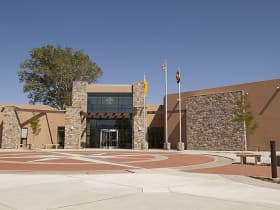
Most non-Scouters drive past Philmont without stopping. The Villa Philmonte tours are free, run on a schedule from June through August, and show a house that has been preserved as it was in the 1940s...
Dorsey Mansion
32 miles away
The fun of the Dorsey Mansion is how out of place it is: a fancy Victorian mansion with a tower and a fountain courtyard, standing alone on empty grassland miles from anywhere.