
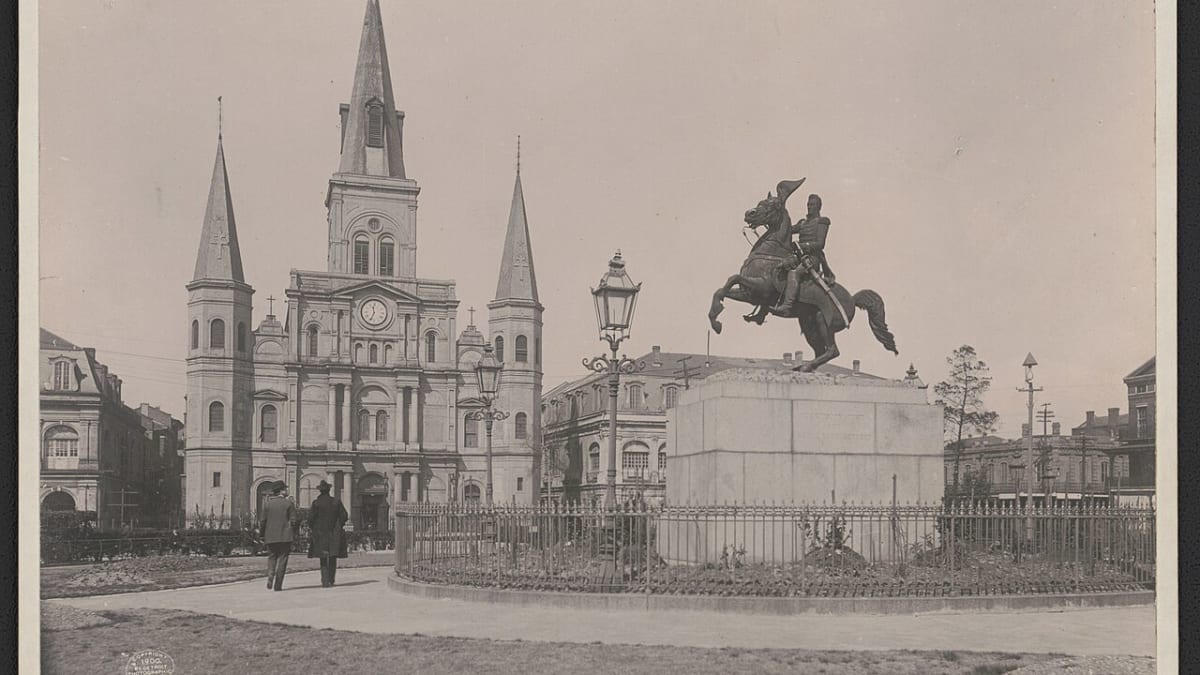
St. Louis Cathedral and Jackson Square
615 Pere Antoine Alley, New Orleans, LA
New Orleans, LA
The triple-spired cathedral rising over a lively public square in the heart of the French Quarter, the ceremonial center of New Orleans since the city's earliest days.
St. Louis Cathedral rises at the heart of the French Quarter, its three slender spires forming perhaps the single most recognizable image of New Orleans. It is the oldest cathedral in continuous use in the United States, standing on a site where a church has served the city since its founding in the early eighteenth century. The present building, completed in the mid-1800s, looks out over Jackson Square with a serene, storybook grace.
In front of it lies Jackson Square, a public plaza that has been the ceremonial heart of the city for three centuries. Once a military parade ground called the Place d'Armes, it was here that Louisiana passed from France to the United States as part of the Louisiana Purchase. Today the square is alive with artists, street musicians, and visitors, a place where the layered history of New Orleans is on constant, joyful display.
What Travelers Love
- The iconic three-spired cathedral facade, one of the most photographed sights in the South
- Artists, musicians, and fortune tellers filling the square outside the fence
- The manicured garden of the square with its statue of Andrew Jackson
- The quiet, historic interior of the cathedral, open to visitors
Worth Knowing
- The cathedral is an active place of worship, so dress and behave respectfully and mind services
- The square is busiest midday and on weekends; early morning is calm and photogenic
- The cathedral welcomes visitors; donations support its upkeep
- The surrounding streets are pedestrian-friendly, so plan to explore on foot
Learn about St. Louis Cathedral and Jackson Square
The cathedral through three centuries
A church has stood on this spot since the founding of New Orleans by the French in 1718, dedicated to Louis the Ninth, the sainted king of France. The first modest structures gave way over time, and after a great fire swept the city in the late eighteenth century, a more substantial church rose in its place, funded in part by a wealthy Spanish benefactor during the years Spain governed Louisiana.
The cathedral seen today, with its three tall spires, took shape in the mid-nineteenth century when the earlier building was largely rebuilt and expanded. It remains an active Roman Catholic cathedral and one of the enduring symbols of the city, having witnessed centuries of celebration, mourning, and change, from colonial ceremonies to the recoveries that followed storms and hard times.
Jackson Square and the Louisiana Purchase
The open ground in front of the cathedral began as the Place d'Armes, a military parade ground laid out when the French planned the city. It was the civic and ceremonial center of colonial New Orleans, the place where troops drilled, proclamations were read, and public gatherings took place, ringed by the buildings of church and government.
In 1803 this square witnessed one of the great turning points in American history, when Louisiana was formally transferred to the United States following the Louisiana Purchase, doubling the size of the young country. The square was later renamed for Andrew Jackson, the general who defended the city at the Battle of New Orleans in 1815, and his mounted statue still stands at its center, framed by the cathedral behind.
The artists and life of the square
For generations, Jackson Square has been the outdoor gathering place of New Orleans, and today its iron fence is hung with the work of local painters and photographers, while fortune tellers set up their tables and street musicians fill the air with jazz and brass. The scene captures the improvisational, creative spirit that has always defined the city.
The buildings framing the square are landmarks in their own right, from the twin Pontalba apartment rows, among the oldest in the country, to the historic Cabildo and Presbytere flanking the cathedral, now museums of Louisiana history and culture. A visit here easily becomes a walk through several centuries of the city's story.
The river, the seasons, and the surrounding Quarter
Just beyond the square, a set of steps climbs the levee to a promenade above the Mississippi River, where riverboats glide past and the working port of New Orleans stretches along the water. The French Quarter spreads out from the square in every direction, a grid of pastel townhouses, wrought-iron balconies, courtyards, and streets made for wandering.
New Orleans is at its most pleasant in the milder months of fall, winter, and early spring, when the square fills with life under comfortable skies. Summer is hot and humid with afternoon thunderstorms, though early mornings are lovely. The city's great festival seasons, above all Carnival in the weeks before Lent, bring the square and the whole Quarter to a joyful roar.
Closest Boutels
The closest Boutel™ stays, so you can turn this stop into an overnight. Each is a place we chose through independent editorial review, never a paid placement.
Details
New Orleans, LA
Frequently asked questions
What are St. Louis Cathedral and Jackson Square?
St. Louis Cathedral and Jackson Square, in the heart of the French Quarter in New Orleans, Louisiana, are among the most iconic and beloved landmarks in the city, a beautiful historic cathedral overlooking a lively and picturesque public square. The graceful St. Louis Cathedral, one of the oldest cathedrals in the country and an active Catholic church, rises with its distinctive spires above Jackson Square, a historic park ringed by grand buildings, filled with artists, musicians, and visitors, and centered on a statue of Andrew Jackson. Together they form the historic and cultural heart of the French Quarter. A gorgeous and iconic landmark, it delights visitors. With its cathedral and square, the site offers a compelling destination in Louisiana.
What can you do at St. Louis Cathedral and Jackson Square?
You can admire and visit the beautiful historic St. Louis Cathedral, stroll the lively Jackson Square with its artists, musicians, and street performers, see the Andrew Jackson statue and grand surrounding buildings, and soak in the vibrant atmosphere of the French Quarter's heart. The historic cathedral, the picturesque square, the street artists and musicians, and the French Quarter atmosphere are the draws, making it a memorable and quintessential New Orleans experience. The cathedral and the lively square are highlights. With its landmarks, the site offers a rewarding experience in New Orleans, Louisiana.
Can you visit inside St. Louis Cathedral?
Yes, St. Louis Cathedral is an active Catholic church that generally welcomes visitors to admire its beautiful historic interior outside of services, so visiting respectfully, being mindful of any Mass or services, dressing appropriately, and being quiet and reverent inside are important. Because it is a working place of worship, checking any current visiting guidance and being considerate of worshippers matter. Visiting respectfully ensures a meaningful experience at St. Louis Cathedral in New Orleans, Louisiana.
When is the best time to visit St. Louis Cathedral and Jackson Square?
Jackson Square and the cathedral's exterior can be enjoyed year-round, with the mild months of fall through spring especially pleasant for strolling the square in New Orleans' subtropical climate, avoiding the intense summer heat and humidity, while mornings are quieter and lovely. Because the square is liveliest at certain times and the cathedral has its own hours, checking current information is wise. For the most pleasant weather, aim for the cooler months, and mornings, at St. Louis Cathedral and Jackson Square in Louisiana.
What is near St. Louis Cathedral and Jackson Square?
St. Louis Cathedral and Jackson Square are in the French Quarter of New Orleans, Louisiana, within reach of the French Quarter's streets, shops, and music, the Backstreet Cultural Museum, the National WWII Museum, and the other attractions of New Orleans. That makes St. Louis Cathedral and Jackson Square a compelling stop to combine with the other attractions of New Orleans on a visit to Louisiana.
Nearby
Backstreet Cultural Museum
0.6 miles away
Most Quarter visitors never cross into Treme, and they miss the deepest culture in the city.
National WWII Museum
1.1 miles away
This museum turns history into something kids can walk through and feel.

St. Roch Chapel and Shrine
1.2 miles away
This one rewards the traveler willing to leave the Quarter. In the St.

Lafayette Cemetery and the Garden District
2.4 miles away
Everyone photographs the mansions, but the reason the cemeteries look like little cities is the real story.
City Park and Couturie Forest
3.3 miles away
City Park holds a natural treasure hiding in plain sight: the largest stand of mature live oaks on earth, some centuries old, their heavy limbs bending all the way to the grass under drapes of Spanish...

Audubon Zoo
4.9 miles away
Audubon Zoo is a manageable, shady zoo that leans into Louisiana itself.
Lake Pontchartrain Causeway Overlook
6.9 miles away
For a genuine only-here moment, take in the Lake Pontchartrain Causeway, the longest continuous bridge over water in the world at nearly 24 miles.
Jean Lafitte NHP Barataria Preserve
12 miles away
The Barataria Preserve puts the living delta swamp within a half-hour of the French Quarter.