
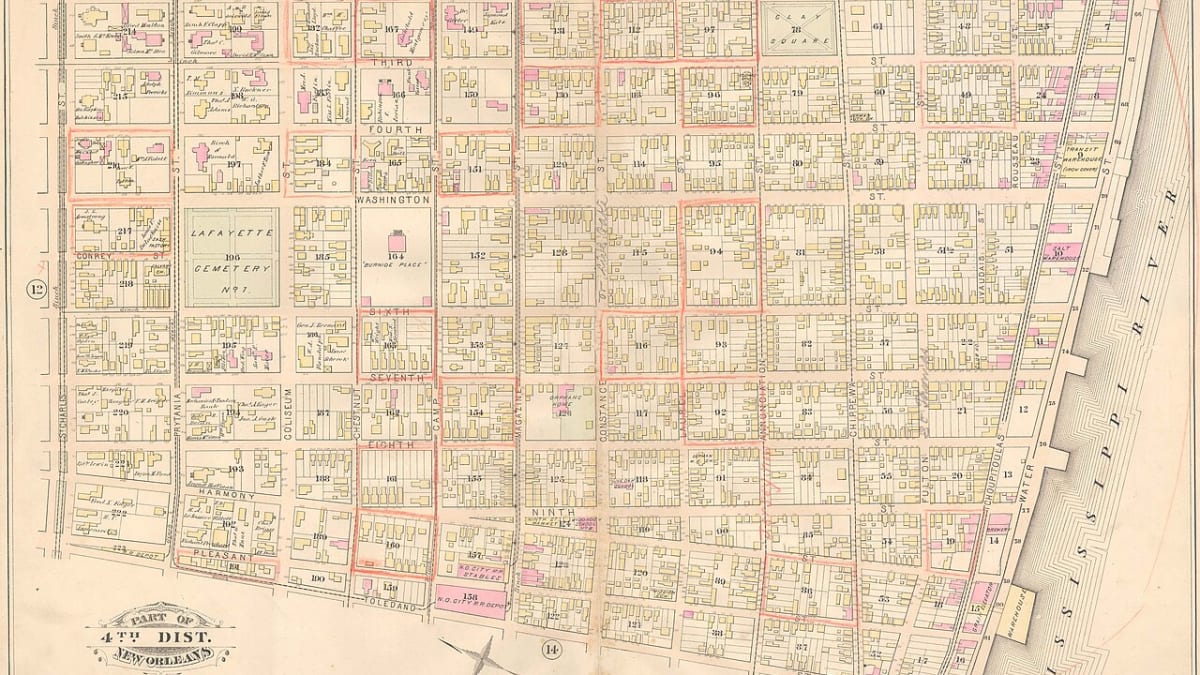
Lafayette Cemetery and the Garden District
1403 Washington Ave, New Orleans, LA
New Orleans, LA
Rows of above-ground tombs behind a whitewashed wall, ringed by oak-shaded streets of grand old mansions in the heart of the Garden District.
Lafayette Cemetery No. 1 is one of the oldest and most atmospheric of the New Orleans cities of the dead, a walled block of above-ground tombs on Washington Avenue in the Garden District. Because New Orleans sits below sea level with a high water table, the dead here are laid to rest above ground in brick-and-stone tombs, and the cemetery's crumbling family crypts, iron gates, and mossy statues give it a haunting beauty.
The cemetery is the still center of one of the loveliest neighborhoods in America. The Garden District grew up in the nineteenth century as a district of grand homes on generous, garden-filled lots, shaded today by enormous live oaks. Walking from the cemetery out into those oak-canopied streets, past columned mansions and iron fences, is one of the classic New Orleans experiences.
What Travelers Love
- Rows of weathered above-ground tombs and family crypts behind a whitewashed brick wall
- The oak-canopied streets of the Garden District lined with antebellum mansions
- A ride on the historic St. Charles Avenue streetcar to and from the neighborhood
- Nearby Magazine Street with its cafes, shops, and galleries
Worth Knowing
- The cemetery's public access has varied over the years, so check its current status before you go
- The Garden District mansions are private homes, so admire them from the sidewalk
- New Orleans summers are hot and humid, and the streets offer welcome shade under the oaks
- The St. Charles streetcar is a scenic and easy way to reach the neighborhood from downtown
Learn about Lafayette Cemetery and the Garden District
The Garden District and the city that built it
The Garden District was laid out in the first half of the nineteenth century as part of the city of Lafayette, then a separate town upriver from New Orleans that was later absorbed into the growing city. It was settled largely by wealthy Americans who arrived after the Louisiana Purchase and preferred to build here rather than in the older, French- and Spanish-flavored French Quarter, and their fortunes raised the mansions that still line the streets.
This part of the Mississippi River crescent was long the homeland of the Chitimacha, Houma, and other Native peoples of the lower delta, and New Orleans itself grew from a French colonial founding in 1718 on that ground. The city's later wealth, including the fortunes behind many Garden District homes, was deeply tied to slavery and the sugar and cotton trades, a history that runs beneath the neighborhood's beauty.
A city of the dead above ground
Lafayette Cemetery No. 1 was established in the 1830s to serve the growing community, and it holds people from many of the cultures that made New Orleans, buried in family tombs and in the wall vaults that ring the grounds. In the city's crowded nineteenth century it saw waves of burials during epidemics of yellow fever and other diseases that swept the port.
The above-ground tombs are a practical answer to a high water table, but they also created the distinctive look that draws visitors: rows of whitewashed and weathered vaults, some sprouting ferns and stained by time, arranged along narrow lanes. Novelists and filmmakers have long been drawn here, and the writer Anne Rice set scenes from her New Orleans stories among these tombs, cementing the cemetery's place in the city's gothic imagination.
Mansions, oaks, and the streetcar
Out beyond the cemetery wall, the Garden District is an open-air museum of nineteenth-century architecture, from Greek Revival columns to Italianate and Queen Anne detailing. The homes sit behind cast-iron fences on lots planted with camellias, magnolias, and sprawling live oaks whose limbs arch over the streets. Because the houses are private, the pleasure is in a slow walk, reading the details and imagining the eras that built them.
The St. Charles Avenue streetcar, one of the oldest continuously operating streetcar lines in the world, rumbles along the neighborhood's edge beneath a tunnel of oaks. Riding it to the Garden District, then walking in to the cemetery and out along Magazine Street with its cafes and shops, makes for one of the most rewarding half-days in New Orleans.
Exploring the neighborhood
The best way to experience this corner of New Orleans is on foot and unhurried. Start at the cemetery on Washington Avenue, then wander the surrounding blocks to take in the mansions, pausing in the shade of the oaks when the heat rises. A guided walking tour can bring out the stories behind particular houses and tombs if you want more than the view.
Magazine Street, a few blocks toward the river, offers a stretch of shops, galleries, and restaurants to round out the day, and the streetcar is always waiting to carry you back toward downtown. The whole neighborhood rewards patience, and it makes a gentle, beautiful counterpoint to the busier French Quarter.
Closest Boutels
The closest Boutel™ stays, so you can turn this stop into an overnight. Each is a place we chose through independent editorial review, never a paid placement.
Details
New Orleans, LA
Frequently asked questions
What are Lafayette Cemetery and the Garden District?
Lafayette Cemetery and the Garden District, in New Orleans, Louisiana, are among the most beautiful and atmospheric places in the city, a historic above-ground cemetery and an elegant neighborhood of grand mansions shaded by ancient live oaks. The Garden District is renowned for its stunning nineteenth-century mansions, lush gardens, and oak-lined streets, one of the loveliest neighborhoods in the country, while Lafayette Cemetery, with its historic above-ground tombs, reflects the distinctive New Orleans tradition of burial in raised tombs. Together they offer a gorgeous and evocative glimpse of the city's history and beauty. A beautiful and historic area, it delights visitors. With its mansions and cemetery, the area offers a compelling destination in Louisiana.
Why are New Orleans cemeteries above ground?
New Orleans cemeteries, like Lafayette Cemetery, feature above-ground tombs largely because of the city's high water table and low elevation, which made traditional in-ground burial difficult, leading to the tradition of raised tombs and vaults. These distinctive above-ground tombs, sometimes called cities of the dead, have become an iconic and atmospheric feature of New Orleans. They reflect the city's unique geography and history. Understanding this tradition enriches a visit to Lafayette Cemetery in Louisiana.
How should visitors treat Lafayette Cemetery?
Because Lafayette Cemetery is a historic burial ground and a place of remembrance, visitors should treat it with respect and reverence, being quiet and considerate, not touching or climbing on the fragile historic tombs, and heeding any rules or restrictions, as some New Orleans cemeteries limit access or require guided tours to protect them. Approaching the cemetery with respect honors those buried there and preserves the site. Visiting respectfully, and checking any current access rules, ensure a meaningful visit to Lafayette Cemetery in Louisiana.
When is the best time to visit Lafayette Cemetery and the Garden District?
The milder months of fall through spring are the most pleasant for strolling the Garden District and the cemetery area in New Orleans' subtropical climate, avoiding the intense summer heat and humidity, with mornings especially lovely and quiet. Because cemetery access can vary and require tours, checking current information before you go is wise. For the most pleasant strolling, aim for the cooler months at Lafayette Cemetery and the Garden District in Louisiana.
What is near Lafayette Cemetery and the Garden District?
Lafayette Cemetery and the Garden District are in New Orleans, Louisiana, within reach of the historic streetcar line, the National WWII Museum, the Audubon Zoo, the French Quarter, and the other attractions of New Orleans. That makes Lafayette Cemetery and the Garden District a compelling stop to combine with the other attractions of New Orleans on a visit to Louisiana.
Nearby
National WWII Museum
1.3 miles away
This museum turns history into something kids can walk through and feel.

St. Louis Cathedral and Jackson Square
2.4 miles away
The cathedral is the picture everyone knows, but the square in front is the real heart of the Quarter. St.
Backstreet Cultural Museum
2.8 miles away
Most Quarter visitors never cross into Treme, and they miss the deepest culture in the city.

Audubon Zoo
3.1 miles away
Audubon Zoo is a manageable, shady zoo that leans into Louisiana itself.

St. Roch Chapel and Shrine
3.5 miles away
This one rewards the traveler willing to leave the Quarter. In the St.
City Park and Couturie Forest
4.6 miles away
City Park holds a natural treasure hiding in plain sight: the largest stand of mature live oaks on earth, some centuries old, their heavy limbs bending all the way to the grass under drapes of Spanish...
Lake Pontchartrain Causeway Overlook
7.6 miles away
For a genuine only-here moment, take in the Lake Pontchartrain Causeway, the longest continuous bridge over water in the world at nearly 24 miles.
Jean Lafitte NHP Barataria Preserve
10 miles away
The Barataria Preserve puts the living delta swamp within a half-hour of the French Quarter.