
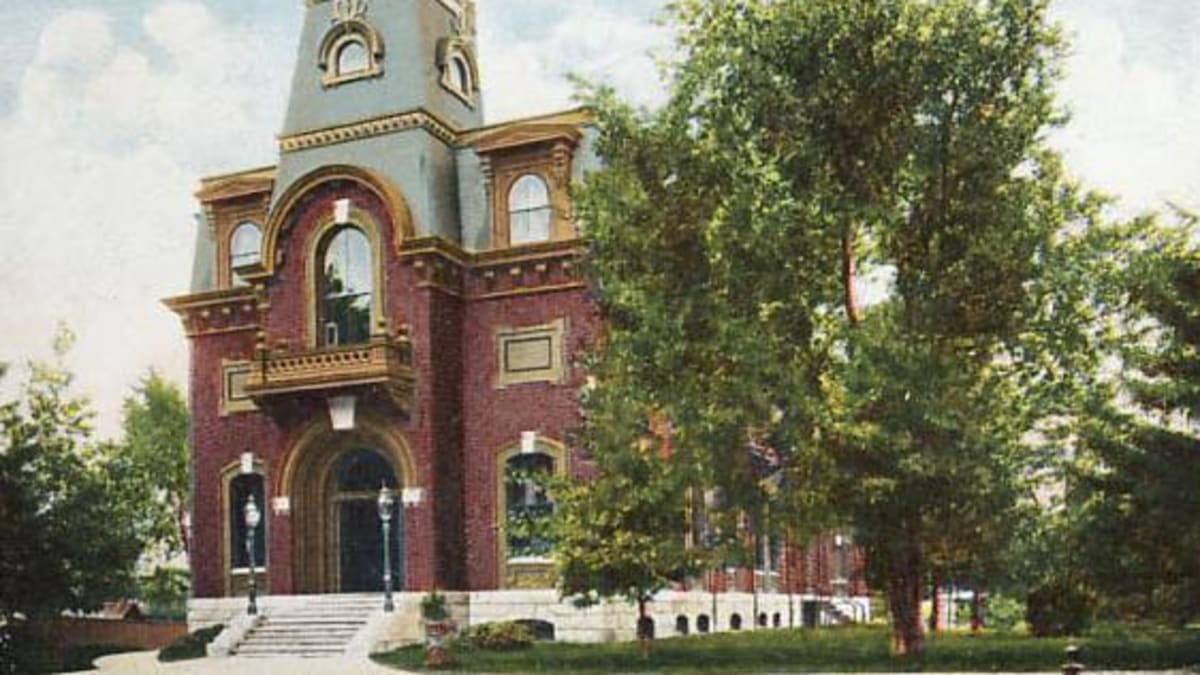
St. Johnsbury Athenaeum
1171 Main Street
St. Johnsbury, VT
A Victorian library with a hushed art gallery out back, built around a single enormous painting of Yosemite that has hung in the same spot since 1873.
The St. Johnsbury Athenaeum opened in 1871 as a gift to the town from Horace Fairbanks, whose family had made a fortune manufacturing the platform scale, an invention that put this small Vermont city on the map. Built as a public library and, two years later, expanded with an art gallery, it was an act of civic generosity meant to bring books and fine art to an ordinary working community.
What makes it extraordinary today is how completely it survives. The library remains a Victorian interior of dark woodwork and iron balconies, and the art gallery behind it is considered one of the oldest unaltered art galleries in the United States. At its center hangs the reason for the gallery's existence: Albert Bierstadt's monumental painting Domes of the Yosemite, which has occupied the same wall since 1873.
What Travelers Love
- Standing before Albert Bierstadt's huge Domes of the Yosemite in the gallery built to hold it
- A working public library that still looks and feels like 1871
- An intact Victorian art gallery, one of the oldest unaltered in the country
- The sense of a small city's outsized cultural ambition preserved whole
Worth Knowing
- It is a functioning library, so keep voices low, especially in the reading rooms
- The art gallery is the reason many people come, so leave time for it beyond the books
- Admission to view the gallery is welcoming, in keeping with its founding as a gift to the public
- Pair it with the nearby Fairbanks Museum for a full picture of St. Johnsbury's golden age
Learn about St. Johnsbury Athenaeum
A gift from the scale kings
St. Johnsbury owed its prosperity to the Fairbanks family, whose invention of the platform scale in the 1830s grew into a global manufacturing business. That wealth, and a strong sense of civic duty, led the family to endow the town with institutions far grander than its size would suggest.
Horace Fairbanks built the Athenaeum as a free public library, a place where anyone could read and learn, and gave it to the town. In 1873 he added an art gallery wing, filling it with paintings he had collected, and again opened it to the public.
The library's name, an athenaeum, signals its ambition: a temple of learning and culture for a small industrial city, and a statement that the good things of the world belonged to everyone in it.
The Domes of the Yosemite
The gallery was built, in part, to house one painting. Albert Bierstadt, the great painter of the American West, created Domes of the Yosemite, an enormous canvas capturing the grandeur of Yosemite Valley in the sweeping, luminous style that made him famous. Horace Fairbanks acquired it, and the gallery's design centers on it.
The painting has hung in the same place since 1873, and the room was arranged around it, with a skylight and seating meant to let visitors take in its scale. Standing before it, you see Yosemite through the eyes of a nineteenth-century audience for whom such a view was almost mythical.
That a monumental image of the far West found a permanent home in a small Vermont city, and has never moved, is part of what makes the Athenaeum's gallery so remarkable.
A Victorian interior preserved
Beyond the great painting, the gallery itself is the artifact. It survives largely as it was built, with its original layout, fittings, and hang, a rare unaltered example of a Victorian art gallery. Walking into it is like stepping into the way art was displayed a century and a half ago.
The library alongside it is equally intact, with spiral stairs, iron balconies, and dark polished wood, still lending books to the community it was built for. It has never stopped being a working library, which keeps it alive rather than frozen.
The combination, a living library wrapped around a preserved gallery, gives the Athenaeum a doubled character: both a daily civic resource and a time capsule of taste and craft.
Season by season
The Athenaeum keeps regular hours through the year as a working library, so it is one of the Northeast Kingdom sights you can count on in any season, a warm refuge on a cold day.
Fall brings the Kingdom's celebrated foliage to the hills around St. Johnsbury, and pairing the Athenaeum with a leaf-peeping drive is a classic autumn outing. Summer is easy and green, ideal for combining it with the region's lakes.
Winter turns the Kingdom quiet and snowbound, and the Athenaeum's hushed rooms and glowing gallery make an especially good indoor stop, best paired with the Fairbanks Museum just up the street.
Closest Boutels
The closest Boutel™ stays, so you can turn this stop into an overnight. Each is a place we chose through independent editorial review, never a paid placement.
Profile Motel & Cottages
Honorable Mention391 Styles Bridges Highway, Lincoln, NH
27 miles away|Learn More ›
Details
St. Johnsbury, VT
Frequently asked questions
What is the St. Johnsbury Athenaeum?
The St. Johnsbury Athenaeum, in St. Johnsbury in Vermont's Northeast Kingdom, is a beautiful and historic public library and art gallery, a National Historic Landmark treasured as one of the finest surviving examples of its kind. Built in the late nineteenth century, the elegant Victorian building houses a lovely library along with an art gallery that is considered the oldest art gallery in the country still in its original form, displaying a notable collection of nineteenth-century American and European paintings, crowned by an enormous, celebrated landscape painting. A gem of Victorian architecture, literature, and art, it delights visitors. With its historic library and art gallery, the St. Johnsbury Athenaeum offers a fascinating destination in Vermont.
What can you see at the St. Johnsbury Athenaeum?
You can admire the beautiful Victorian library with its elegant woodwork and atmosphere, and visit the historic art gallery, considered the oldest unaltered art gallery in the country, to see its collection of nineteenth-century American and European paintings, including an enormous and celebrated grand landscape painting that anchors the gallery. The historic library, the remarkable art gallery, and the great landscape painting are the highlights, offering a rich blend of literature, art, and Victorian architecture. Its preserved character is remarkable. With its library and gallery, the St. Johnsbury Athenaeum offers an engaging visit in Vermont.
Why is the St. Johnsbury Athenaeum historically important?
The St. Johnsbury Athenaeum is historically important as a beautifully preserved Victorian public library and art gallery, a National Historic Landmark, whose art gallery is celebrated as the oldest art gallery in the country still in its original, unaltered form. Built and endowed by a wealthy local family in the late nineteenth century, it embodies the era's ideals of bringing literature and fine art to the public, and its collection and architecture survive remarkably intact. This exceptional preservation makes the St. Johnsbury Athenaeum a treasured destination in Vermont.
When is the best time to visit the St. Johnsbury Athenaeum?
As an indoor library and art gallery, the St. Johnsbury Athenaeum can be visited year-round in any weather, making it a great stop in any season, and it pairs naturally with the nearby Fairbanks Museum for a day of St. Johnsbury culture. As a working library, its hours follow a schedule, so checking current hours before you go is wise. Because it is indoors, the St. Johnsbury Athenaeum makes a rewarding stop any time of year in St. Johnsbury, Vermont.
What is near the St. Johnsbury Athenaeum?
The St. Johnsbury Athenaeum is in St. Johnsbury in Vermont's Northeast Kingdom, within reach of the Fairbanks Museum and Planetarium, Dog Mountain, the Bread and Puppet Museum in Glover, Lake Willoughby, and the Northeast Kingdom countryside. That makes the St. Johnsbury Athenaeum a fascinating stop to combine with the Fairbanks Museum and Planetarium, Dog Mountain, and the other attractions of the Northeast Kingdom on a visit to Vermont.
Nearby

Fairbanks Museum and Planetarium
0.1 miles away
The Fairbanks Museum is a perfectly preserved Victorian wonder-cabinet, the kind of museum that has almost vanished elsewhere. Opened in 1891 by the family that made St.

Dog Mountain
2.3 miles away
Nothing quite prepares you for the Dog Chapel. On a hilltop above St.

The Frost Place
19 miles away
The Frost Place is Robert Frost's White Mountain farmhouse, where he wrote some of his best-loved poems, now a small museum and working poetry center.
Bread and Puppet Museum
20 miles away
The Bread and Puppet Museum is like walking into a giant's attic full of characters.