
South Dakota Cultural Heritage Center
1815 Flag Mountain Dr, Pierre, SD
Pierre, SD
The state's story from the Great Sioux Nation to the present, told inside an earth-sheltered museum tucked into a prairie hilltop above the capital.
South Dakota's story is bigger and older than the pioneers and presidents most travelers picture, and the Cultural Heritage Center in Pierre is where the state tells it in full. Built into a hilltop above the capital, the museum is earth-sheltered, its galleries tucked under a grassy prairie mound so that from a distance it reads more as landscape than building.
Inside, the exhibits begin where the state's human history begins, with the Oceti Sakowin, the Great Sioux Nation, and the Plains peoples who have lived here for millennia, and carry through the fur trade, treaties, homesteading, statehood, and the present day. The signature collection of Plains beadwork, quillwork, clothing, and everyday objects is one of the finest anywhere, and the effect is a museum that treats Native history not as a prologue but as the heart of the story.
What Travelers Love
- Exhibits that put the Oceti Sakowin and Plains history at the center of the state's story
- The striking earth-sheltered building, half-buried in a prairie hill
- A deep collection of artifacts, from beadwork and quillwork to pioneer and territorial pieces
- A quiet, unhurried museum in a small capital far from the crowds
Worth Knowing
- The museum is home to the State Historical Society and its archives, a resource for researchers as well as visitors
- Exhibits and traveling shows change, so it rewards repeat visits
- It pairs naturally with a Capitol tour just down the hill
- Pierre is central and remote, a long drive from the Black Hills or Sioux Falls, so plan an overnight
Learn about South Dakota Cultural Heritage Center
Telling the whole story
The Cultural Heritage Center is the museum of the South Dakota State Historical Society, and its permanent exhibits set out to tell the state's history from its Indigenous foundation forward. The Oceti Sakowin, the Great Sioux Nation of the Lakota, Dakota, and Nakota peoples, stand at the center of that story, present-tense nations whose homeland this is and whose culture the museum works to represent with care and in partnership.
From there the galleries move through the fur trade and the river highway of the Missouri, the treaty era and its broken promises, the rush of homesteaders, the coming of statehood in 1889, and life on the Northern Plains up to the present. It is a museum that tries to hold the whole of South Dakota, the beautiful and the painful alike, in one honest telling.
A building in the earth
The center's architecture is part of its appeal. Rather than rise above the prairie, the building is set into a hill and covered with earth and native grasses, so it stays cool in summer and warm in winter and blends into the rolling land of the capital city. It is a design in keeping with the landscape and with the idea of history layered in the ground.
Opened in the late 1980s, the museum draws its name and mission from cultural heritage in the broadest sense, gathering the material of many peoples under one roof. The earth-sheltered form has become a small landmark of Pierre, understated on the outside and rich within.
The collections
The museum's collections are among the strongest in the region, especially its holdings of Plains material culture, beadwork, quillwork, hide clothing, pipes, and everyday tools that carry the artistry and daily life of the Oceti Sakowin. These are handled and presented in consultation with Native communities, as living heritage rather than trophies.
Beyond the Native collections, the museum holds fur-trade goods, territorial and pioneer artifacts, military and political items, and the vast archives and photographs of the State Historical Society. Traveling and temporary exhibits rotate through as well, so the museum offers something new on return visits.
Visiting Pierre
Pierre is one of the smallest state capitals in the country, a quiet town on the Missouri River in the geographic center of South Dakota. The Cultural Heritage Center sits on a hill just above the State Capitol, so the two make a natural pairing for a day of the state's history and civic life.
The seasons shape a visit less here than at the outdoor attractions, since the museum is a year-round indoor destination, though summer and fall bring the mildest weather for exploring the capital and the riverfront. Because Pierre is central and remote, a long drive from either coast of the state, it rewards travelers who make it a deliberate overnight rather than a passing stop.
Closest Boutels
The closest Boutel™ stays, so you can turn this stop into an overnight. Each is a place we chose through independent editorial review, never a paid placement.
Details
Pierre, SD
Frequently asked questions
What is the South Dakota Cultural Heritage Center?
The South Dakota Cultural Heritage Center, in Pierre, the state capital, is the state history museum, telling the rich story of South Dakota from ancient times to the present, with a strong emphasis on the heritage of the Native peoples. The museum features excellent exhibits on the state's Native American cultures, especially the Lakota, Dakota, and Nakota peoples, along with the region's natural history, pioneer settlement, and modern history, presented with quality and care and including significant Native artifacts. Its comprehensive and thoughtful exhibits make it the best place to understand South Dakota's story. A superb and comprehensive heritage museum, it educates visitors. With its exhibits, the center offers a compelling destination in South Dakota.
What can you see at the South Dakota Cultural Heritage Center?
You can see exhibits on the state's Native American cultures, especially the Lakota, Dakota, and Nakota peoples, including significant artifacts, along with displays on the region's natural history, pioneer settlement, and modern history. The Native American heritage exhibits, the historical artifacts, and the story of South Dakota are the draws, offering a rich and educational experience. The Native cultural exhibits are a highlight, and approaching them with respect enriches the visit. With its exhibits, the center offers a rewarding visit in Pierre, South Dakota.
When is the best time to visit the South Dakota Cultural Heritage Center?
As an indoor museum, the South Dakota Cultural Heritage Center is enjoyable year-round in any weather, making it a great stop in any season and a welcome refuge from the heat or cold. Because hours can vary, checking the current schedule before you go is wise. Because it is indoors, the center makes a rewarding stop any time of year in Pierre, South Dakota.
Is the South Dakota Cultural Heritage Center good for families?
Yes, the Cultural Heritage Center is enjoyable for families, with engaging Native American, natural history, and pioneer exhibits, and interactive elements that interest children and adults alike. The rich history and artifacts enrich the whole family, and its indoor setting is comfortable in any weather. It offers a meaningful introduction to the state's story. Its family appeal makes the South Dakota Cultural Heritage Center a rewarding destination in South Dakota.
What is near the South Dakota Cultural Heritage Center?
The South Dakota Cultural Heritage Center is in Pierre, the state capital, in central South Dakota, within reach of the South Dakota State Capitol, the Oahe Dam and Lake Oahe, the Missouri River, and the routes across central South Dakota. That makes the center a compelling stop to combine with the State Capitol and the other attractions of Pierre on a visit to South Dakota.
Nearby
South Dakota State Capitol
0.7 miles away
South Dakota State Capitol: 500 E Capitol Ave, Pierre. Free to visit, with self-guided and staffed tours on weekdays.

Oahe Dam and Lake Oahe
6.6 miles away
Oahe Dam and Lake Oahe: about 6 miles north of Pierre off SD-1804 and SD-1806. Free to visit. The visitor overlook gives a sense of the scale of the earthen dam and the reservoir behind it.
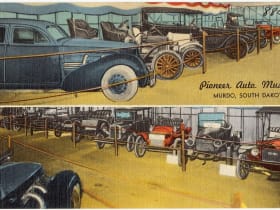
Pioneer Auto Show
38 miles away
Pioneer Auto Show: on 5th Street in Murdo, just off I-90. Admission charged, and one ticket covers the whole rambling complex.