

Soo Locks
329 W Portage Ave, Sault Ste. Marie, MI
Sault Ste. Marie, MI
Thousand-foot freighters slide right past you and drop twenty-one feet in minutes, at one of the busiest and most consequential shipping locks on earth.
The Soo Locks are among the busiest and most important shipping locks in the world, the single passage that lets freighters move between Lake Superior and the four lower Great Lakes. Superior sits about twenty-one feet higher than Lake Huron, and the St. Marys River tumbles down over rapids between them, so for centuries there was no way for a boat to pass. The locks solved that, raising and lowering ships between the levels in a matter of minutes.
For visitors, the appeal is simple and enormous: you can stand at a public viewing platform in Sault Ste. Marie and watch thousand-foot lake freighters slide into a lock only feet away, then rise or fall as the water is let in or out. It is a front-row seat to working maritime industry on a colossal scale, one that Great Lakes families have made a pilgrimage of for generations.
What Travelers Love
- Standing at the viewing platform as an enormous freighter fills the lock beside you
- Watching the water rise or fall to lift a ship between the levels of the lakes
- The waterfront park and visitor center that tell the story of the locks
- The rare feeling of watching working industry up close, for anyone
Worth Knowing
- Ship traffic is heaviest in the shipping season from spring through late fall; the locks close in deep winter
- There is no fixed schedule, so a wait may be rewarded by a giant laker gliding through
- The viewing park and visitor center welcome the public along the water
- Boat tours that actually lock through the system run seasonally from the waterfront
Learn about Soo Locks
The rapids at the heart of it
Sault Ste. Marie takes its name from the rapids of the St. Marys River, and those rapids were a gathering place long before the locks. This is Anishinaabe country, the homeland of the Ojibwe, part of the Three Fires Confederacy of the Ojibwe, Odawa, and Potawatomi. The Ojibwe called the place Bawating, the place of the rapids, and gathered here to fish the whitefish that ran thick in the fast water.
The Sault Ste. Marie Tribe of Chippewa Indians and the Bay Mills Indian Community continue to live in and steward this region. The rapids that once fed the fishery were also the barrier that made the locks necessary, and the same place that drew people together for thousands of years became one of the great crossroads of North American shipping.
Building a way past the falls
For early traders and travelers, the only way past the rapids was to unload and portage everything overland, a slow and costly haul. As the copper and iron of Lake Superior's shores began to matter to the wider country in the 1800s, the need for a real passage grew urgent, and the first ship canal and locks opened at the Soo in the mid-1850s.
The locks were rebuilt and enlarged again and again as ships grew larger, until they could handle the giant thousand-foot freighters that carry iron ore, grain, and stone across the lakes today. The passage became so vital to American industry that it was heavily guarded during wartime, recognized as one of the most strategically important points in the nation's transportation network.
How the locks work
A lock is a water elevator. A ship enters a long chamber and the gates close behind it. To lift the vessel, water is let into the chamber until it rises to the higher level; to lower it, water is drained out. No pumps are needed, only gravity and the difference in the levels of the two lakes, which is why the whole operation is quiet, smooth, and strangely gentle for the size of the ships involved.
Standing at the viewing platform, you watch a freighter creep into the chamber until it nearly fills it, the gates swing shut, and then the water surges in or out. Within minutes a ship the length of several football fields has risen or dropped twenty-one feet, and the far gates open to let it continue on its way. Seen up close, it never quite loses its wonder.
Season by season on the St. Marys
The shipping season runs roughly from late winter's end through the following winter's freeze, and that is when the locks are busy and the viewing is best. Spring and summer bring the fullest ship traffic and the warmest weather along the waterfront, and boat tours that lock through the system run in the warmer months.
Fall is a fine time, with color across the eastern Upper Peninsula and freighters hurrying to move cargo before the ice. In the depth of winter the locks close and the river freezes, quiet after the long season, and the town settles into the snow that blankets this far-north corner of the state.
Closest Boutels
The closest Boutel™ stays, so you can turn this stop into an overnight. Each is a place we chose through independent editorial review, never a paid placement.
Details
Sault Ste. Marie, MI
Frequently asked questions
What are the Soo Locks?
The Soo Locks, in Sault Ste. Marie in Michigan's Upper Peninsula, are a marvel of engineering that allows ships to travel between Lake Superior and the lower Great Lakes. Because Lake Superior sits about twenty-one feet higher than Lake Huron, the locks raise and lower vessels around the rapids of the St. Marys River. Among the busiest and most important locks in the world, they let visitors watch enormous Great Lakes freighters rise and fall right before their eyes, a genuinely awe-inspiring sight.
Can you watch ships go through the Soo Locks?
Yes, and it is the main attraction. A free public observation platform and a visitor center let you watch giant freighters, some over a thousand feet long, enter the locks, get raised or lowered, and continue on their way, often close enough to wave to the crew. The visitor center provides shipping schedules, history, and exhibits. For an even closer experience, seasonal boat tours actually take passengers through the locks themselves, a memorable way to feel the process firsthand.
When is the best time to visit the Soo Locks?
The shipping season runs roughly from spring through late fall, so summer offers the most freighter traffic and the best chance to see big ships locking through, along with open visitor facilities and boat tours. Checking the daily vessel schedule, often posted at the visitor center or online, helps you time your visit for when a large freighter is passing through. Fall adds color to the area, while winter sees the locks close for maintenance during the frozen months.
Is visiting the Soo Locks good for families?
Very much so. Children and adults alike are amazed to watch enormous ships rise and fall in the locks up close, and the free observation deck and visitor center make it an easy, budget-friendly outing. The visitor center's exhibits explain how the locks work in an engaging way, and a seasonal boat tour through the locks adds excitement. It is an educational, hands-on look at Great Lakes shipping that captivates kids and grown-up ship-watchers alike.
What is near the Soo Locks?
The locks are in Sault Ste. Marie, one of the oldest cities in the Midwest, at the eastern edge of the Upper Peninsula on the Canadian border, with historic sites, a riverfront, and a museum ship nearby. The wild Lake Superior shoreline, Tahquamenon Falls, and Whitefish Point lie within driving distance to the west. That makes the Soo Locks a fascinating anchor for exploring the eastern U.P. and its blend of maritime history and natural beauty.
Nearby

Whitefish Point
33 miles away
Whitefish Point reaches into Lake Superior at the top of Michigan's Upper Peninsula, guarding the Shipwreck Coast where over 200 vessels lie lost.
Tahquamenon Falls State Park
42 miles away
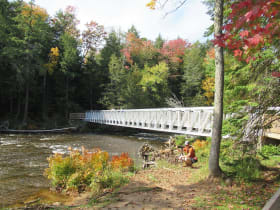
The huge amber-colored Upper Falls, one of the largest waterfalls east of the Mississippi, plus the braided Lower Falls, set in a 50,000-acre Upper Peninsula wilderness.

Mackinac Island
47 miles away
A car-free Lake Huron island in the Straits of Mackinac, once America's second national park and now more than eighty percent state parkland. Reach it only by ferry from Mackinaw City or St.