

Mackinac Island
Mackinac Island
Mackinac Island, MI
A Lake Huron island where cars have been banned since 1898, once the nation's second national park, all horses, bicycles, limestone cliffs, and Victorian charm.
Mackinac Island is a genuine time capsule in the middle of the Great Lakes, a small forested island in the Straits of Mackinac where motor vehicles have been banned since 1898. Step off the ferry and the sounds are of hooves on pavement, bicycle bells, and lake water, not engines. Horse-drawn carriages carry visitors and freight alike, and the whole island runs at the pace of a Victorian summer resort that never quite let the twentieth century in.
There is real history under the charm. Mackinac was set aside in 1875 as only the second national park in the country, after Yellowstone, then handed to Michigan in 1895 to become the state's first state park. Today more than eighty percent of the island is protected parkland and the entire island is a National Historic Landmark, so behind the fudge shops lie limestone cliffs, a hilltop fort, and centuries of Great Lakes history.
What Travelers Love
- No cars anywhere, so travel is by bicycle, on foot, or by horse-drawn carriage
- A car-free perimeter road that circles the whole island in about eight flat, scenic miles
- Fort Mackinac on the bluff, with original buildings and cannon and rifle demonstrations
- Victorian streets, thirteen fudge shops, and the vast front porch of the Grand Hotel
Worth Knowing
- You reach the island only by ferry from Mackinaw City or St. Ignace, or by small plane, so plan your crossing and timing
- Since there are no cars, pack light and expect to walk, bike, or ride a carriage everywhere
- The island is busiest in summer, and many businesses close in the off-season, so check what is open before a shoulder-season trip
- Bring layers even in summer, because the lake breeze off the Straits can turn cool and brisk
Learn about Mackinac Island
The island that banned cars
The famous car ban was not born of nostalgia but of horses. In 1898 the village council, pressed by the carriage operators whose horses were spooked by the first noisy automobiles, voted to keep the horseless carriage off the island, and Michigan later wrote the ban into state law. More than a century on, that decision has become the island's whole identity.
Everything moves by foot, bicycle, or horse. Freight arrives by dray wagon, the police patrol on bikes, and even the fire trucks are hitched to horses, with only a few emergency exceptions and winter snowmobiles. The result is a place that genuinely feels different the moment you arrive, quieter and slower, where the eight-mile loop of M-185, the only state highway in the country that has never seen a car crash, rings the shore for cyclists and walkers.
Fort Mackinac and the fur-trade past
High on the bluff above the harbor sits Fort Mackinac, built by the British during the American Revolution when they moved their stronghold here from the mainland. Its whitewashed stone and wood buildings are among the oldest in Michigan, and inside them costumed interpreters bring the frontier garrison to life, firing cannon and rifles and telling the story of a post that guarded the Straits through the fur-trade era and the War of 1812.
The Straits of Mackinac were the crossroads of the Great Lakes fur trade, and whoever held Mackinac held the key to it. Long before the forts, the island was sacred ground to the Anishinaabe, who saw in its turtle-backed shape the great turtle of creation, which gave Mackinac its name. That layering, Indigenous homeland, French and British outpost, then American resort, is what makes a walk up to the fort so much more than a photo stop.
Arch Rock, fudge, and the Grand Hotel
The island's natural showpiece is Arch Rock, a graceful limestone arch nearly a hundred and fifty feet above the water on the eastern shore, carved by wind and waves and framing a brilliant blue slice of Lake Huron. Trails and the shore road lead to it, and to other quiet corners of the wooded interior that most day-trippers never reach.
Downtown, Mackinac earns its nickname as the Fudge Capital of the World, with a fudge-making tradition going back to the 1880s and more than a dozen shops turning marble slabs in the windows. Above it all stands the Grand Hotel of 1887, whose front porch, said to be the longest in the world, looks out over the Straits. Between the natural wonders, the history, and the Victorian resort spell, Mackinac rewards an overnight far more than a rushed afternoon.
Closest Boutels
The closest Boutel™ stays, so you can turn this stop into an overnight. Each is a place we chose through independent editorial review, never a paid placement.
Details
Mackinac Island, MI
Frequently asked questions
What is Mackinac Island?
Mackinac Island is a beloved historic island in the Straits of Mackinac, between Michigan's Upper and Lower Peninsulas, famous for banning cars for well over a century. Reached only by ferry, it moves at the pace of horse-drawn carriages, bicycles, and footsteps. With its grand Victorian hotels, historic fort, quaint downtown known for handmade fudge, and a shoreline road ringed by Lake Huron, the island offers a charming, timeless escape that feels like stepping back in time.
How do you get to Mackinac Island and get around?
You reach the island by passenger ferry from Mackinaw City or St. Ignace on the mainland, since no private cars are allowed on the island. Once there, you get around on foot, by bicycle, or by horse-drawn carriage or taxi. A popular thing to do is rent a bike and ride the roughly eight-mile paved road that circles the entire island along the water, a flat, scenic loop that is one of the great simple pleasures of a visit.
What can you do on Mackinac Island?
You can bike or stroll the eight-mile shoreline loop, explore the historic Fort Mackinac, admire the grand Victorian architecture and the famous Grand Hotel, sample the island's legendary fudge, and hike inland trails to natural landmarks like the striking Arch Rock. Most of the island is state parkland laced with trails and dotted with rock formations. The blend of history, natural beauty, and old-fashioned charm makes for a relaxed, unforgettable day or weekend.
When is the best time to visit Mackinac Island?
Late spring through fall is the prime season, when the ferries run frequently, the shops and hotels are open, and the weather is pleasant, with the famous Lilac Festival in June and brilliant foliage in fall as highlights. Summer is busiest, so weekdays or shoulder seasons offer a quieter feel. The island largely winds down in winter, so plan a visit for the warm-weather months to enjoy the full experience of biking, dining, and exploring.
What is near Mackinac Island?
The island sits in the Straits of Mackinac, with the ferry towns of Mackinaw City and St. Ignace on the mainland, near the iconic Mackinac Bridge linking Michigan's two peninsulas. Mackinaw City offers historic Fort Michilimackinac and a lighthouse, while the Upper Peninsula's forests and Lake Superior wonders lie just across the bridge. That makes Mackinac Island a centerpiece of any northern Michigan trip, easily combined with the bridge and the attractions on both peninsulas.
Nearby

Mackinac Bridge View
5.2 miles away
Every U.P. road trip crosses or begins at the Mackinac Bridge, and the St. Ignace side is the place to actually stop and look at it.
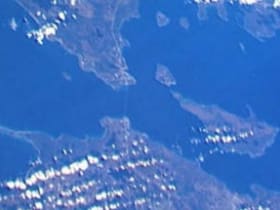
Straits of Mackinac
6.9 miles away
The five-mile channel where Lake Michigan meets Lake Huron between Michigan's two peninsulas, long the crossroads of the Great Lakes fur trade.

Legs Inn
25 miles away
At the far end of the famous Tunnel of Trees drive stands one of the strangest and most wonderful buildings in Michigan.