
Sonnenberg Gardens and Mansion
151 Charlotte St
Canandaigua, NY
One widow's grief turned into nine themed gardens, a glass palm house, and a 40-room stone mansion, all kept whole in the Finger Lakes.
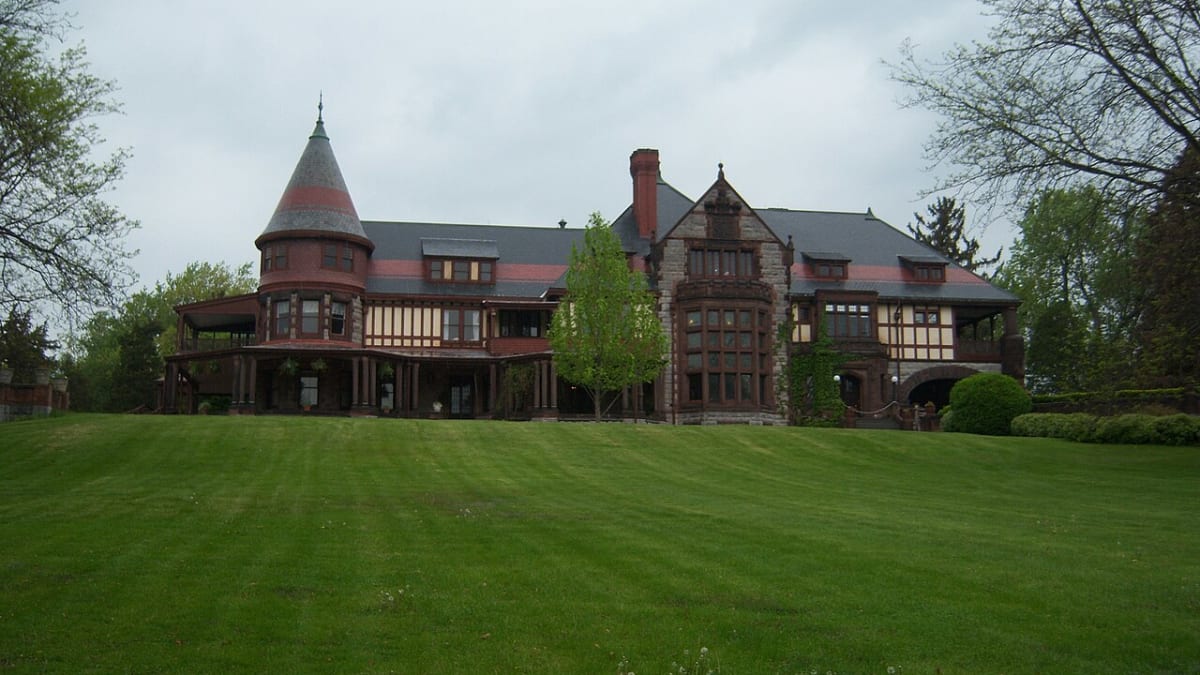
Sonnenberg is what happens when great wealth meets great grief. Frederick Ferris Thompson, a New York City banker, and his wife Mary Clark Thompson bought a plain brick farmhouse on this hill above Canandaigua Lake in 1863, and over the years turned it into a grand summer estate, replacing the farmhouse with a forty-room Queen Anne mansion of gray stone in 1887. It was a happy place, but the couple had no children, and when Frederick died in 1899 Mary was left alone with the house and the memory of him.
So she built gardens. Between 1902 and about 1919 Mary Thompson laid out nine formal gardens across the grounds as a living memorial to her husband, hired the best designers and glassmakers of the age, and filled the place with color and craft. The name Sonnenberg means Sunny Hill in German. After her death the estate passed out of the family and nearly vanished, but volunteers rescued it in the 1970s, and today New York State keeps it as a rare, nearly complete Gilded Age garden estate open to anyone who wants to walk it.
What Travelers Love
- Nine distinct formal gardens, each with its own theme, laid out across the grounds
- A Japanese garden with a torii gate, arched bridges, and a tea house, one of the earliest of its kind in America
- The huge Lord and Burnham glass conservatory, a domed palm house full of tropical plants and orchids
- Touring the 40-room stone mansion and reading the love story that built the whole place
Worth Knowing
- The gardens are seasonal and at their fullest from late spring through early fall; the grounds are quiet and bare in winter
- It is a large site, so wear comfortable shoes for the walking, or ride the tram that runs from the parking lot up to the mansion
- The mansion has two furnished floors open for guided or self-guided tours, so give yourself time for both house and gardens
- Rose lovers should aim for peak bloom in June, when thousands of roses are out in the formal rose garden
Learn about Sonnenberg Gardens and Mansion
A banker, his wife, and a farmhouse on the hill
Frederick Thompson made his fortune in New York banking, but his wife had deep roots here: Mary Clark was the daughter of Myron Holley Clark, a governor of New York, and Canandaigua was her home ground. When the couple bought the property in 1863 it was just fourteen acres and a brick farmhouse, but as the bank prospered they added land and ambition, until in 1885 they began building the mansion that still crowns the hill.
The house was designed by the Boston architect Francis R. Allen and finished in 1887, a rambling forty-room pile of rusticated gray stone trimmed in reddish Medina sandstone, with a slate roof and all the turrets and gables of the Queen Anne style. The Thompsons summered here for years, and by every account it was a warm and well-loved home rather than a cold showpiece, which is part of why what Mary did next feels so personal.
Nine gardens built out of grief
Frederick died in 1899, and Mary, childless and grieving, poured herself into the grounds. Beginning around 1902 she created a whole series of themed formal gardens, nine in all, as a memorial to her husband and a place to lose herself in beauty. There was a grand Italian garden with clipped hedges and a fleur-de-lis pattern, a rose garden that today holds thousands of blooms, a rock garden threaded with streams and small waterfalls, and quieter spaces with names like the Blue and White Garden, the Moonlight Garden, and the Sub Rosa Garden tucked behind walls.
The showpiece is the Japanese garden, created in 1906 by a New York artist named K. Wadamori. Little arched bridges cross a narrow stream, a red torii gate frames the path, and a Kyoto-style tea house sits at the center, and it is often called the first residential Japanese garden built in America. Walking from one garden to the next, each with its own mood and planting, you get a rare, complete picture of how a wealthy family of the era thought a landscape should be shaped.
The glass palm house and the estate that almost disappeared
Between 1903 and 1915 Mary commissioned the great greenhouse firm of Lord and Burnham, the same builders behind the famous conservatories at the New York Botanical Garden, to raise a whole complex of glasshouses at Sonnenberg. At its heart is a domed palm house, and around it run greenhouses filled with orchids, cacti, ferns, and tropical plants, so that even in a hard Finger Lakes winter there is a warm, green, blooming room to step into. A neoclassical bathhouse and pool round out the grounds.
The estate nearly did not survive. After Mary died in 1923 the property left the family, and by 1931 it had been sold to the federal government, which built a veterans hospital on the surrounding farmland and turned the mansion into a nurses residence. The gardens fell into decades of neglect. In the 1970s local volunteers stepped in, formal restoration began in 1973, the site was placed on the National Register of Historic Places, and Sonnenberg opened to the public for the first time.
New York State officially bought the estate in the mid-2000s, and it is now run as a state historic park. It stands today as one of the very few surviving Country Place Era estates in the country where the mansion, the greenhouses, and all the formal gardens still exist together, so you can read the whole vision of the place instead of a fragment of it.
Visiting Sonnenberg
Sonnenberg sits on Charlotte Street on the north side of Canandaigua, an easy few minutes from the lakefront and Main Street, at the northern tip of Canandaigua Lake in the Finger Lakes. It is an open, walkable site, and a tram runs from the parking lot up to the mansion if you would rather save your legs for the gardens themselves.
Plan on at least a couple of unhurried hours to do it justice: time to walk all nine gardens, step inside the palm house among the tropical plants, and tour the two furnished floors of the mansion. It is at its most glorious from late spring through early fall, with the roses peaking in June, and it quiets down for the winter. For a Gilded Age estate built out of one woman's love and loss, and kept whole against long odds, it is one of the most rewarding stops in the whole Finger Lakes region.
Closest Boutels
The closest Boutel™ stays, so you can turn this stop into an overnight. Each is a place we chose through independent editorial review, never a paid placement.
Pines Motel on Lake Erie
Honorable Mention10684 West Lake Road, Ripley, NY
133 miles away|Learn More ›
Details
Canandaigua, NY
Frequently asked questions
What is Sonnenberg Gardens and Mansion?
It is one of the best-preserved Victorian-era country estates in the nation, a state historic park in Canandaigua in the Finger Lakes. The roughly fifty-acre grounds surround a grand forty-room Queen Anne mansion with nine distinct themed gardens, a historic greenhouse complex, and lovely views toward Canandaigua Lake. Blending gilded-age architecture with exquisite landscaping, it is a serene, richly detailed place to spend a few hours wandering.
What are the themed gardens at Sonnenberg?
The estate features nine themed gardens developed in the early 1900s in a range of styles, including Italian, Japanese, colonial, and Victorian, along with a rose garden and a rock garden. A special highlight is the historic Lord and Burnham greenhouse complex, one of the few of its kind remaining in the country. Each garden has its own character, so wandering from one to the next is like moving through a series of distinct outdoor rooms.
Can you tour the Sonnenberg mansion?
Yes, tours of both the mansion and the gardens are typically available during the warm-weather season, roughly May through September. The elegant Queen Anne house offers a glimpse into the life of its gilded-age owners, complementing the surrounding gardens beautifully. Checking current hours and tour availability before you go is wise, especially early or late in the season, so you can plan time for both the house and the grounds.
When is the best time to visit Sonnenberg Gardens?
The gardens are at their best in the warm months, roughly May through September, as different plantings bloom through the season, and the estate hosts popular events like an orchid show, rose week, and moonlight strolls. Timing a visit to a favorite bloom or event adds to the experience. Choose a fair-weather day for comfortable strolling, and check the current calendar to catch any special happenings.
What should I know before visiting Sonnenberg Gardens?
There is an admission fee, and you should wear comfortable shoes, since exploring the expansive grounds involves a lot of walking, though a tram shuttle runs from the parking lot to the mansion to help. Bring a camera for the constant photo opportunities. On site, the Finger Lakes Wine Center offers tastings, and the estate pairs naturally with nearby Canandaigua Lake and the region's many wineries.
Nearby

Canandaigua Lake
6.7 miles away
The Seneca called it The Chosen Spot, a clear seventeen-mile Finger Lake dropping to 276 feet.
The Windmill Farm and Craft Market
19 miles away
Most wine-country visitors never leave the lakeshore and miss this ridge-top market entirely.
George Eastman Museum
24 miles away
Rochester built its fortune on film, and this is where you feel it. The George Eastman Museum sits in the restored 50-room mansion of the Kodak founder, the man who put a camera in everyone's hands.