
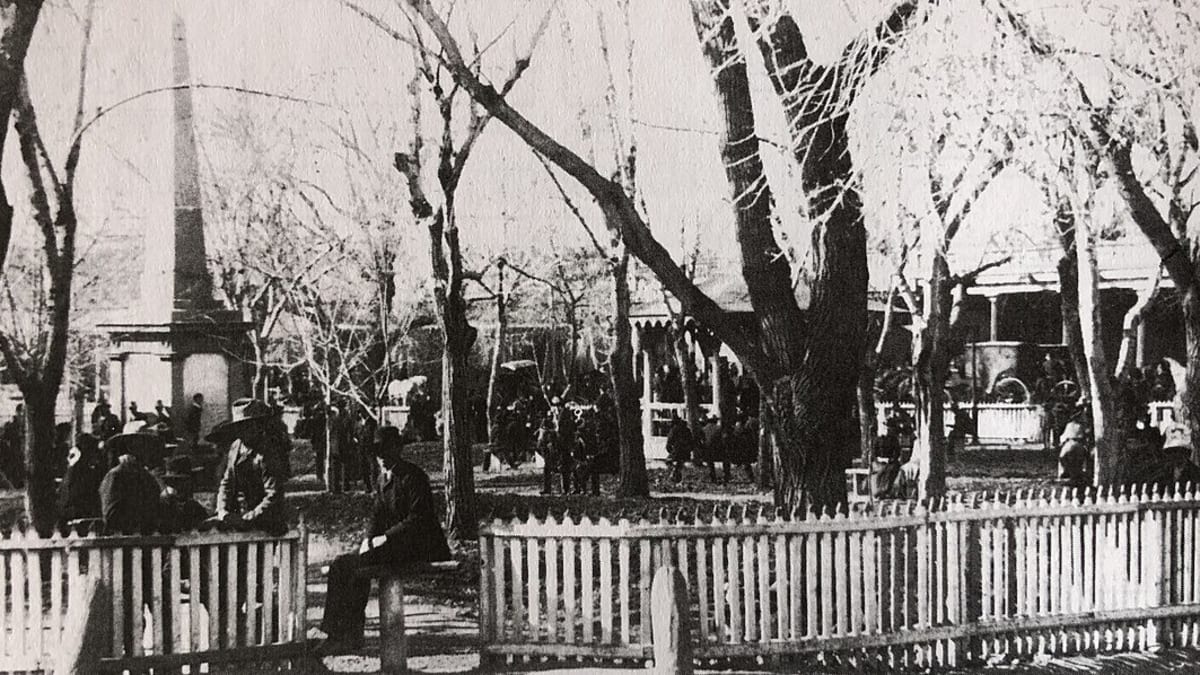
Santa Fe Plaza
63 Lincoln Ave
Santa Fe, NM
The oldest public square in the American Southwest, where the Santa Fe Trail ended and Native artists still sell their work under a 400-year-old portal.
Santa Fe Plaza is the beating heart of the oldest capital city in the United States, a tree-shaded square of packed earth and old adobe that has been the town's gathering place for more than four hundred years. Spanish colonial governor Don Pedro de Peralta laid it out around 1610 as the formal center of his new capital, following the Spanish rule that every colonial town be built around a plaza, and the square has never lost that role. It has been a parade ground, a marketplace, a battlefield, and a fiesta grounds, and on any given day it is still all of those things in miniature.
It is easy to walk across the plaza in a minute and miss what you are standing in, so it helps to slow down. This is a designated National Historic Landmark and one of the most storied public spaces in the country: the terminus of two great historic trade roads, the front porch of the oldest public building in America, and the place where, for nearly a century, Native artists from the surrounding pueblos have sold their work directly to travelers. The plaza is not a museum you enter, it is a living square you step into.
What Travelers Love
- Native American artists selling handmade jewelry and pottery under the Palace of the Governors portal, a tradition kept alive since 1936
- Standing on the spot where the 900-mile Santa Fe Trail finally ended, marked by a stone monument
- The oldest continuously used public building in the country facing the square, dating to 1610
- Free concerts, dances, and markets under the shady old trees through the warm months
Worth Knowing
- The plaza is free and open all the time; the museums that ring it charge separate admission
- The Native artisans under the portal are the real thing, each a member of a registered tribe who signs their own work, chosen by a daily lottery
- Santa Fe sits at about seven thousand feet, so the sun is strong and the air is thin, and evenings turn cool even in summer
- It is walkable from most downtown lodging, and metered street parking and paid lots sit within a block or two
Learn about Santa Fe Plaza
Where two great trails ended
The plaza was the finish line for two of the most important trade routes in North American history. El Camino Real de Tierra Adentro, the royal road of the interior, ran fifteen hundred miles up from Mexico City and ended here, carrying goods, settlers, and news north into the colony for two centuries. Then, after Mexico opened trade in 1821, the Santa Fe Trail brought wagons nine hundred miles across the plains from Independence, Missouri, and dumped their loads of American goods right onto this square.
A stone monument in the center of the plaza marks the end of the Santa Fe Trail, and the Daughters of the American Revolution placed a marker here as well. For decades this was the point where cultures met and traded: Spanish, Mexican, Pueblo, and American, all bargaining in the same dusty square. That long history of exchange is exactly why Santa Fe still feels like a crossroads of three cultures rather than a single one.
The Palace of the Governors and the portal
Facing the north side of the plaza is the Palace of the Governors, a long, low adobe building put up around 1610 that has been in continuous public use ever since, making it the oldest such building constructed by Europeans in the continental United States. It served as the seat of government under Spain, then Mexico, then the United States, from 1610 all the way until 1886, and it now anchors the New Mexico History Museum.
The plaza's most famous daily sight happens under the covered portal that runs along the front of the palace. There, Native American artists from the pueblos and tribes of New Mexico spread their handmade jewelry, pottery, and other work on blankets and sell directly to visitors. The program dates to 1936, and it is carefully run: every vendor must belong to a registered tribe and personally stamp or sign their work, and a daily lottery decides who gets a spot, so the selection changes and the work is genuinely handmade by the person selling it.
Four hundred years of history in one square
Not everything that happened here was gentle. During the Pueblo Revolt of 1680, when the pueblos rose up and drove the Spanish out of New Mexico for a dozen years, the colonists took refuge in the government buildings on this very plaza before fleeing south. The victorious Pueblo people then reshaped the square itself, building it up into a multistory pueblo arranged around two courtyards, each with its own kiva, before the Spanish returned in 1692.
In the centuries since, the plaza has hosted troops, traders, and travelers, and today it hosts the city's great gatherings. In the warm months a bandstand and gazebo host free concerts and folk dances, and the square fills for the Spanish Market, the Indian Market, and the long-running Fiesta de Santa Fe. Ring the plaza with the Cathedral Basilica of St. Francis a block east and the tiny old San Miguel Chapel a short walk south, and you have four centuries of history packed into a few walkable blocks.
Visiting the plaza
The plaza is free and open at all hours, and it is the natural place to start any visit to Santa Fe. It is walkable from nearly all of the downtown lodging, and metered street parking and paid lots sit within a block or two, though the surrounding one-way adobe streets reward patience. Give yourself time to sit under the trees, browse the portal, read the trail monument, and simply watch the square go about its day.
Remember that Santa Fe sits high, around seven thousand feet, so the sun is fierce, the air is dry and thin, and even summer evenings cool off quickly, all of which the plaza's big shade trees help with. From here the cathedral, the history and art museums, and dozens of galleries are all an easy stroll. Come early for the quiet and the light, or come in the evening when the plaza fills with music, and let the oldest square in the Southwest be your anchor for the rest of the city.
Closest Boutels
The closest Boutel™ stays, so you can turn this stop into an overnight. Each is a place we chose through independent editorial review, never a paid placement.
Details
Santa Fe, NM
Frequently asked questions
What is the Santa Fe Plaza?
The Santa Fe Plaza is the historic heart of Santa Fe, New Mexico, a charming central square that has been the social, cultural, and commercial center of the city for over four hundred years, dating to the early Spanish colonial era. Surrounded by adobe architecture, historic buildings including the Palace of the Governors, museums, shops, galleries, and restaurants, the plaza is a beautiful and lively gathering place. Beneath the portal of the Palace of the Governors, Native American artisans sell handmade jewelry and crafts. Rich in history, art, and culture, the Santa Fe Plaza is the beloved and picturesque centerpiece of one of America's oldest and most distinctive cities.
What can you do at the Santa Fe Plaza?
You can stroll the historic square and admire the adobe architecture, browse and buy authentic handmade jewelry and crafts from Native American artisans beneath the portal of the Palace of the Governors, visit the New Mexico History Museum and other nearby museums, explore art galleries, shops, and boutiques, dine at excellent restaurants, and enjoy frequent festivals, markets, and events held on the plaza. It is a wonderful place to soak up Santa Fe's history, art, and culture. With its history, shopping, art, dining, and vibrant atmosphere, the Santa Fe Plaza offers a rich and delightful experience at the heart of the city.
What is special about buying crafts at the Santa Fe Plaza?
A cherished tradition at the Santa Fe Plaza is the Native American artisan market beneath the portal, or covered walkway, of the historic Palace of the Governors, where Native artists from the region's pueblos and tribes sell their handmade jewelry, pottery, and crafts directly to visitors. This long-running program ensures the work is authentic and made by the artisans themselves, offering a special opportunity to buy genuine Native American art while supporting the artists. Shopping here is a highlight of the plaza, giving visitors a meaningful and authentic connection to the region's living Native cultures and craftsmanship.
When is the best time to visit the Santa Fe Plaza?
The plaza is enjoyable year-round, with spring through fall offering pleasant weather for strolling and outdoor events, summer bringing lively festivals and markets, and fall pleasant with beautiful light, while winter is cooler but often magical, especially when adobe buildings are lined with traditional farolito lights during the holidays. Santa Fe's many festivals, including art markets and cultural events, add appeal throughout the year. For pleasant weather and festivals, aim for spring through fall, while the winter holidays offer a particularly enchanting atmosphere at the historic Santa Fe Plaza.
What is near the Santa Fe Plaza?
The Santa Fe Plaza is at the heart of Santa Fe, New Mexico, near the historic Loretto Chapel with its mysterious staircase, the Cathedral Basilica, Canyon Road's art galleries, the many museums of the city, and the immersive Meow Wolf art experience, with Taos, Bandelier National Monument, and the surrounding mountains within reach. That makes the Santa Fe Plaza the perfect base to combine with the Loretto Chapel, Canyon Road, Meow Wolf, and the many other attractions of Santa Fe and northern New Mexico on a visit to the state.
Nearby

Loretto Chapel and the Miraculous Staircase
0.1 miles away
A little Gothic chapel off the Santa Fe plaza holds one of the world's most famous staircases: an elegant wooden spiral that makes two full turns with no center support, built, the legend says, by a m...
Meow Wolf
2.1 miles away
Meow Wolf: 1352 Rufina Circle, Santa Fe. Open daily, admission charged, children under 3 free. Book tickets online - often sells out on weekends. Allow 2-3 hours minimum.

El Santuario de Chimayo
21 miles away
Chimayo is genuinely unlike any church experience you can have in the United States.