
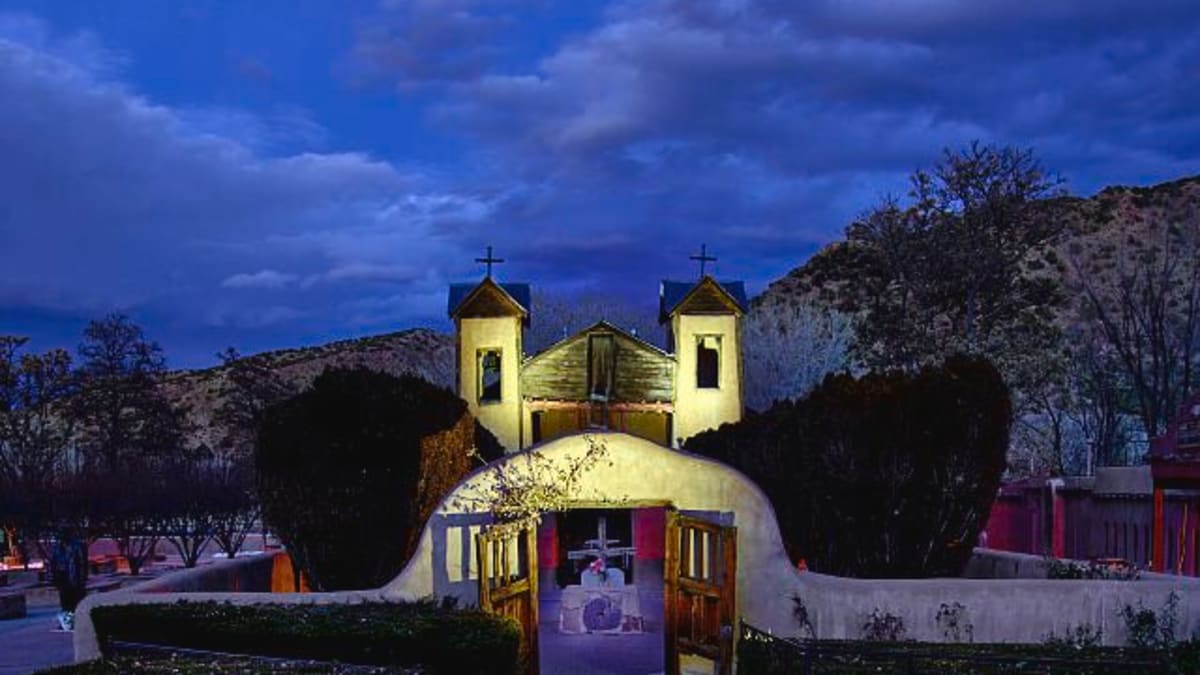
El Santuario de Chimayo
46 El Potrero Rd, Chimayo, NM
Chimayo, NM
A small adobe church in the Sangre de Cristo foothills, revered for its holy dirt and one of the great pilgrimage sites of the Americas.
El Santuario de Chimayo is a small adobe church in the foothills of the Sangre de Cristo Mountains, and one of the most visited pilgrimage sites in the United States. Built in the early 1800s in the Hispano village of Chimayo, it is famous for a small back room holding a shallow pit of earth known as the holy dirt, which generations of the faithful have believed carries the power to heal.
Each year, and especially during Holy Week leading up to Easter, thousands of pilgrims walk to the santuario, some traveling great distances on foot along the roads of northern New Mexico. They come to pray, to gather a bit of the holy dirt, and to leave behind crutches, photographs, and written testimonies of prayers answered. The church, its art, and the devotion that fills it make Chimayo a place unlike any other in the state.
What Travelers Love
- The beautiful old adobe church with its twin bell towers and painted interior
- The small room of holy dirt, where pilgrims gather earth said to bring healing
- The wall of crutches and testimonies left by those who came seeking a cure
- The setting on the High Road, amid a village famed for weaving and chile
Worth Knowing
- This is an active place of worship and pilgrimage, so dress and behave respectfully, especially during services
- Photography may be limited inside the church and the prayer rooms, so look for posted guidance
- Holy Week draws enormous crowds of walking pilgrims, so expect closures and heavy traffic then
- The village sits at high elevation in mountain foothills, so dress for cool air and changeable weather
Learn about El Santuario de Chimayo
The story of the holy dirt
The traditions around Chimayo tell of a crucifix discovered on this spot in the early 1800s, tied to a local man who, drawn by a light or a vision, unearthed it in the ground. According to the stories, the crucifix would not stay anywhere else, returning again and again to the place where it was found, so a chapel was built over the spot. That spot is now the small room where pilgrims gather the holy dirt.
The ground here was already regarded as sacred and healing in the region's earlier Native traditions, and the church's story wove that older reverence into Catholic devotion. Today pilgrims take small amounts of the earth, and the church replenishes the pit with clean soil. The nearby room is lined with the crutches, braces, and heartfelt notes of those who believe they were healed, a moving record of faith spanning generations.
The adobe church and its art
The santuario is a classic example of the adobe mission architecture of northern New Mexico, its thick earthen walls, twin bell towers, and simple lines rooted in the building traditions the Hispano settlers developed over centuries. Inside, the church glows with folk-art religious paintings and carvings, including hand-painted altar screens known as reredos, made in the santero tradition of the region.
These works, created by local devotional artists, give the interior its distinctive warmth and character. The church has been carefully preserved as a National Historic Landmark, protecting both its architecture and its living role as a place of worship. It remains an active church, so visitors move among people at prayer, and the atmosphere is one of quiet devotion rather than mere sightseeing.
The pilgrimage and Holy Week
The great pilgrimage to Chimayo unfolds during Holy Week, when many thousands of people walk to the santuario, some setting out from Santa Fe and even farther, others carrying crosses or walking through the night. It is one of the largest Holy Week pilgrimages in the country, an outpouring of faith that draws people of many backgrounds along the roads of northern New Mexico.
The pilgrimage reflects the deep Hispano Catholic heritage of the region, kept alive in villages like Chimayo for generations. Walkers come in penance, in gratitude, or in hope, and the roadsides fill with the faithful making their way on foot. For those who visit at other times of year, the church is quieter but no less powerful, and the sense of accumulated devotion in its walls is unmistakable.
Chimayo, the High Road, and the seasons
The village of Chimayo is a treasure in its own right, an old Hispano community famed for its weaving, with families who have woven distinctive Chimayo textiles for generations, and for its prized native chile. The santuario sits along the High Road to Taos, a scenic mountain route that links a string of historic villages, adobe churches, and artist studios between Santa Fe and Taos.
Spring, especially Holy Week, is the season of the great pilgrimage, while summer brings warm days and the green of the mountain foothills. Fall turns the surrounding cottonwoods and aspen gold and is a lovely time to drive the High Road. Winter is cold and can bring snow to the village and the surrounding peaks, wrapping the adobe church in a hushed, wintry stillness.
Closest Boutels
The closest Boutel™ stays, so you can turn this stop into an overnight. Each is a place we chose through independent editorial review, never a paid placement.
Pinon Court by La Fonda
Honorable Mention201 Montezuma Avenue, Santa Fe, NM
21 miles away|Learn More ›
Details
Chimayo, NM
Frequently asked questions
What is El Santuario de Chimayo?
El Santuario de Chimayo is a historic and beloved adobe church in the village of Chimayo in northern New Mexico, one of the most important Catholic pilgrimage sites in the United States. Built in the early nineteenth century, this beautiful and atmospheric sanctuary is famous for its holy dirt, believed by many to have healing powers, drawing pilgrims and visitors from around the world, especially during Holy Week when thousands walk to Chimayo. With its stunning traditional New Mexican architecture, rich folk art, deep spiritual significance, and serene setting, El Santuario de Chimayo is a moving and culturally profound destination that reflects the enduring faith and heritage of the region.
What is the holy dirt at El Santuario de Chimayo?
The holy dirt, known as tierra bendita, is soil from a small pit inside a room at El Santuario de Chimayo that pilgrims and visitors believe holds healing and blessing powers, and many take small amounts of the dirt, which the church replenishes. A nearby room is filled with crutches, photos, and notes left by those who believe they were healed, testifying to the deep faith surrounding the site. Whether visited for religious devotion or cultural interest, the holy dirt and the stories connected to it are central to the sanctuary's significance and its status as a cherished place of pilgrimage and healing.
Can anyone visit El Santuario de Chimayo?
Yes, El Santuario de Chimayo welcomes visitors of all backgrounds, whether they come as pilgrims for religious reasons or as travelers interested in the history, architecture, and culture, and it is a working church, so admission is generally free though donations are appreciated. As a sacred place of worship and pilgrimage, visitors are asked to be respectful, keep quiet, and mind any guidelines, especially during services or busy pilgrimage times. Photography may be restricted inside. Approaching the visit with respect for its spiritual significance allows everyone to appreciate this beautiful and moving sanctuary and its meaning to the faithful.
When is the best time to visit El Santuario de Chimayo?
El Santuario de Chimayo can be visited year-round, with spring through fall offering pleasant weather for the scenic drive to Chimayo, though the most significant time is Holy Week, especially Good Friday, when tens of thousands of pilgrims walk to the sanctuary in a remarkable annual tradition, making it deeply moving but very crowded. For a quieter, more contemplative visit, avoid the Holy Week crowds. Checking current hours and any event information before you go is wise. For pleasant weather and fewer crowds, the milder months outside Holy Week are ideal for visiting this beloved sanctuary.
What is near El Santuario de Chimayo?
El Santuario de Chimayo is in the village of Chimayo in northern New Mexico, along the scenic High Road to Taos, near the traditional weaving shops of Chimayo, and within reach of Santa Fe with its plaza and museums to the south and Taos with its pueblo to the north. That makes El Santuario de Chimayo a moving cultural and spiritual stop to combine with the High Road to Taos, Santa Fe, Taos, and the many attractions of northern New Mexico on a visit to the state.
Nearby

Santa Fe Plaza
21 miles away
The 400-year-old Spanish colonial square at the heart of Santa Fe, laid out around 1610 and now a National Historic Landmark.

Loretto Chapel and the Miraculous Staircase
21 miles away
A little Gothic chapel off the Santa Fe plaza holds one of the world's most famous staircases: an elegant wooden spiral that makes two full turns with no center support, built, the legend says, by a m...
Meow Wolf
22 miles away
Meow Wolf: 1352 Rufina Circle, Santa Fe. Open daily, admission charged, children under 3 free. Book tickets online - often sells out on weekends. Allow 2-3 hours minimum.