
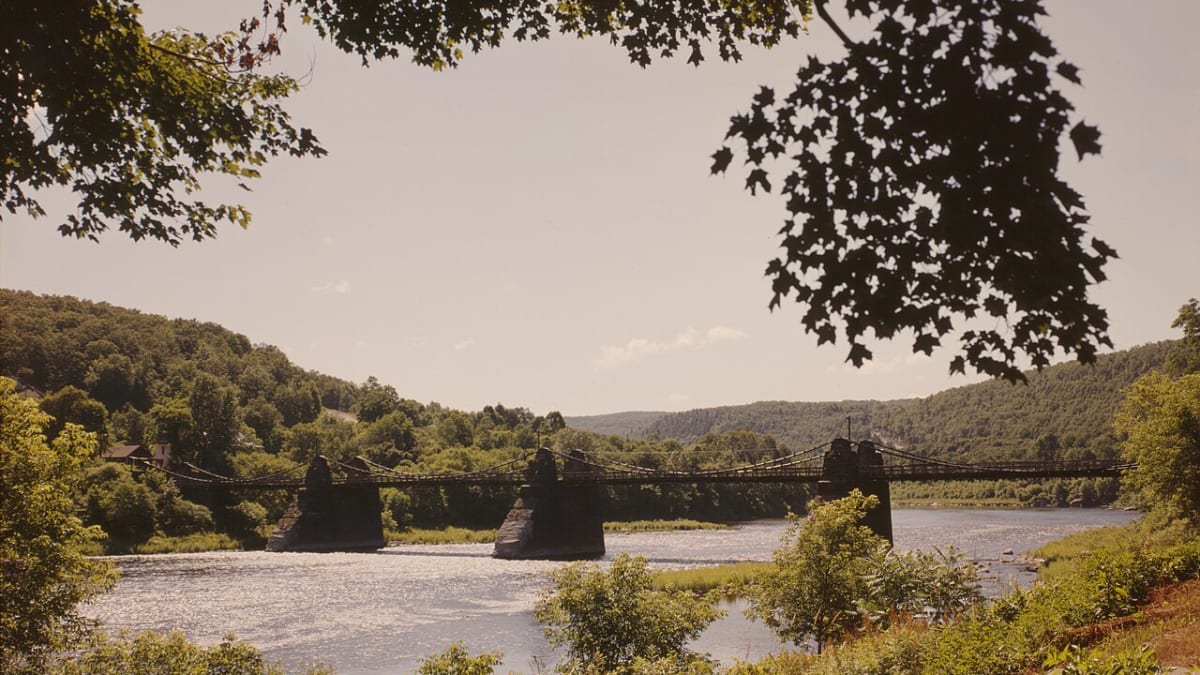
Roebling Delaware Aqueduct Bridge
182 Lcpl Jacob Beisel Rd, Lackawaxen, PA
Lackawaxen, PA
The oldest wire suspension bridge in America, built by the engineer who would go on to design the Brooklyn Bridge, still carrying travelers across the Delaware.
The Roebling Delaware Aqueduct Bridge is a quiet marvel, the oldest surviving wire suspension bridge in the United States and a direct ancestor of the Brooklyn Bridge. It was built between 1847 and 1849 by John A. Roebling, the German-born engineer whose masterwork in New York City lay decades in the future, and it stands today as a working crossing of the Delaware River on the line between New York and Pennsylvania.
Its original purpose was unusual: it was not a road bridge but an aqueduct, a trough that carried the water and boats of the Delaware and Hudson Canal high over the river, so that canal traffic and the river below no longer had to interfere with one another. The canal is long gone, but Roebling's stone piers and suspension cables endure, now carrying cars and pedestrians across the same span, a living piece of American engineering history.
What Travelers Love
- Crossing the oldest surviving wire suspension bridge in the country
- The direct link to John Roebling, engineer of the Brooklyn Bridge
- The clear, quiet Delaware River flowing beneath, popular with paddlers and eagles
- Standing at the meeting point of New York and Pennsylvania over the water
Worth Knowing
- The bridge still carries light vehicle traffic on a narrow single lane, so drive slowly and yield
- It is a good spot to pull over and walk out onto the span for the river views
- Bald eagles are often seen along this stretch of the Delaware, so bring binoculars
- The address sits on the Pennsylvania bank, but the crossing links directly to New York
Learn about Roebling Delaware Aqueduct Bridge
John Roebling and the road to the Brooklyn Bridge
John A. Roebling emigrated from Germany and became one of the great engineers of nineteenth-century America, a pioneer of the wire-cable suspension bridge. The Delaware Aqueduct, completed in 1849, was one of his early major works, and in it he worked out the principles of spinning and anchoring the wire cables that would later hold up his most famous creation.
That creation was the Brooklyn Bridge, whose towers and cables Roebling designed and which opened in 1883. He did not live to see it finished. An accident at the site cost him his life early in construction, and his son Washington Roebling carried the great bridge to completion, aided by his wife Emily. The modest Delaware crossing is thus a first draft, in a sense, of one of the most celebrated bridges in the world, and it remains standing while so many later structures have come and gone.
An aqueduct that carried a canal over a river
In the mid-1800s, the Delaware and Hudson Canal carried coal from Pennsylvania's mines toward the markets of New York, and its route had to cross the Delaware River. Where the canal met the river, canal boats had once been floated across the open water on a slackwater pool, a slow and dangerous arrangement that clashed with the river's own traffic of log rafts.
Roebling's solution was to lift the canal clear over the river in a suspended trough, a water bridge or aqueduct. Canal boats floated across inside the trough, high and dry above the Delaware, while the river and its rafts passed freely beneath. It was an elegant fix, and it worked for decades until railroads made the canal obsolete around 1900. The aqueduct was then converted to a toll road bridge, its wooden trough replaced by a roadway, and in that form it survived to become a national historic landmark.
The bridge today and the river below
Now part of the Upper Delaware Scenic and Recreational River, administered by the National Park Service, the bridge carries a single narrow lane of traffic and a walkway across the Delaware. The stone piers and the wire suspension cables are Roebling's originals, and walking out onto the span you can look down the spinning cables and out over the wide, clear river, understanding at a glance how the later Brooklyn Bridge grew from this idea.
The Delaware here is a protected wild river, clean and quiet, popular with canoeists and anglers and watched over by bald eagles that nest and hunt along the corridor. In winter especially, eagles gather in numbers along this stretch. Standing on the bridge, with the river sliding beneath and forested hills on either bank, it is easy to forget how close this peaceful spot is to the busy Northeast.
Season by season
Spring brings high, fast water and returning migratory birds, a lively time along the river as the forests leaf out. Summer is the paddling season, when canoes and kayaks fill the Delaware and the bridge makes a scenic landmark on a lazy river day.
Autumn sets the wooded hills of the Upper Delaware ablaze with color, framing the bridge and its stone piers beautifully. Winter is the eagle season, when bald eagles gather along the open water to fish, and the bare trees and quiet make them easier to spot from the bridge and riverbanks.
Closest Boutels
The closest Boutel™ stays, so you can turn this stop into an overnight. Each is a place we chose through independent editorial review, never a paid placement.
Details
Lackawaxen, PA
Frequently asked questions
What is the Roebling Delaware Aqueduct Bridge?
It is the oldest existing wire-cable suspension bridge in the United States, built in 1848 and spanning the Delaware River between Minisink Ford, New York, and Lackawaxen, Pennsylvania. It was designed by John A. Roebling, the engineer who later created the famous Brooklyn Bridge, making it a landmark of American engineering history. Now a National Historic Landmark, it offers a tangible connection to both the canal era and the origins of suspension-bridge design.
Why was the Roebling bridge originally built?
It began life not as a road bridge but as an aqueduct carrying the Delaware and Hudson Canal across the river. Canal boats floated through a water-filled trough suspended above the Delaware, allowing them to cross the river without interfering with the log rafts and river traffic below. After the canal era ended, it was converted to carry vehicles, and today it serves as a narrow one-lane road and pedestrian bridge.
Can you walk or drive across the Roebling bridge?
Yes, it functions as a working one-lane bridge open to both cars and pedestrians, so you can drive or walk across and take in the Delaware River scenery. Because it is narrow and shared, cross with care, watch for oncoming traffic, and mind pedestrians and vehicles alike. Interpretive information from the National Park Service, which oversees it as part of the Upper Delaware, helps explain its remarkable history.
When is the best time to visit the Roebling bridge?
Spring through fall is ideal for enjoying the bridge and the surrounding Upper Delaware river scenery, with autumn foliage making the setting especially beautiful. It is a quick but historically rich stop, easily combined with other area sites. Checking seasonal access and any interpretive-center hours before you go helps, particularly in the colder months.
What is near the Roebling Delaware Aqueduct Bridge?
The bridge sits in the scenic Upper Delaware region, near the Zane Grey Museum, honoring the famous western novelist who lived nearby, and the Minisink Battleground, a Revolutionary War site. The Delaware River itself offers paddling, fishing, and eagle watching in season. Together they make the area a rewarding stop for history, engineering, and outdoor recreation along the New York and Pennsylvania border.
Nearby
Lake Wallenpaupack Shoreline Trail and Beach
9.9 miles away
The recreational heart of the northern Poconos, this big man-made lake near Hawley offers an easy three-mile packed-gravel shoreline trail and the area's only public sand swimming beach with summer li...

Grey Towers National Historic Site
14 miles away
This is where American conservation grew up, and hardly anyone outside forestry knows it. Grey Towers above Milford was the summer home of Gifford Pinchot, the first chief of the U.S.

Promised Land State Park
17 miles away
Promised Land State Park spreads across 3,000 wooded acres on the Pocono Plateau, with two mountain lakes for paddling and swimming, deep hemlock and laurel trails, and rustic stone-and-log buildings...