
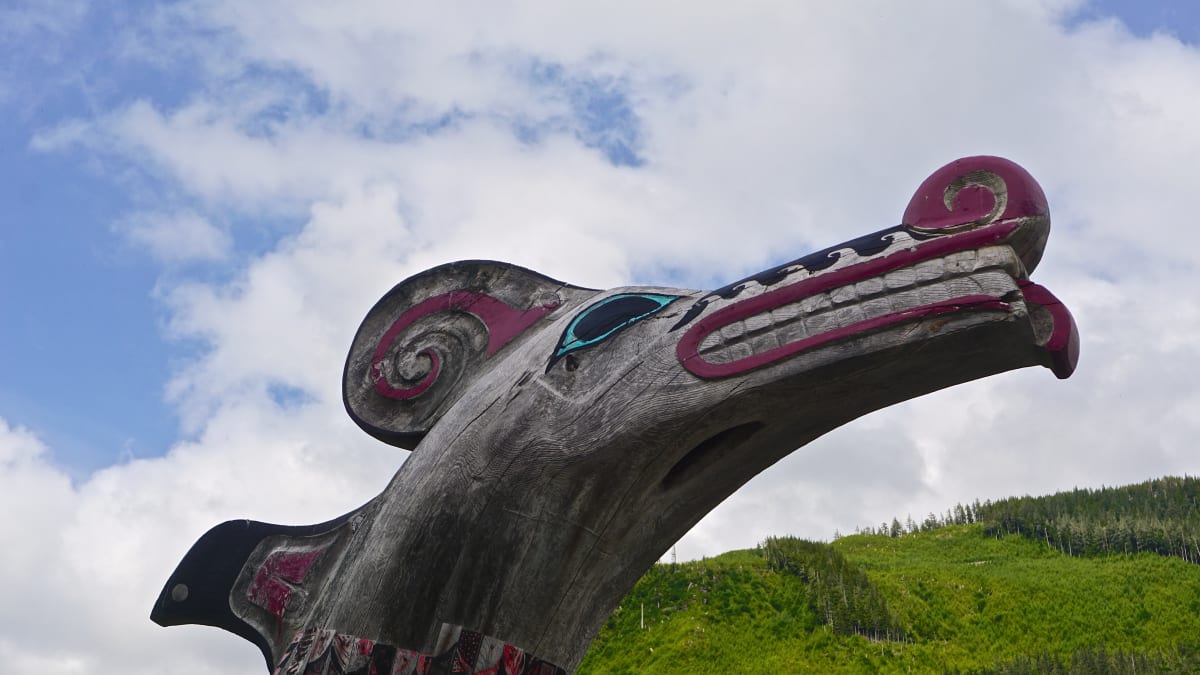
Potlatch Totem Park and Museum
9809 Totem Bight Rd
Ketchikan, AK
A family-built Tlingit village next door to the state's historic totem park, where the poles are still being carved and a surprise antique car museum hides out back.
Potlatch Totem Park and Museum is a re-created Tlingit village on the water about ten miles north of Ketchikan, built on ground that Native families once used as a fishing camp. A cluster of cedar clan houses stands around a working carving shed, and a tall pole raised to Raven watches over the whole site. It opened in 2006 as the private, family-run neighbor to the state's historic Totem Bight park right next door.
What makes it worth the drive is that the tradition here is still in motion. The poles are not weathered originals pulled from an abandoned village; they are new, carved by living hands, sometimes right in front of you. Step inside a clan house, read the raven, eagle, and killer whale crests on the poles outside, then wander out back and find a small museum of antique cars and old firearms that has nothing to do with totems and everything to do with the family that built the place.
What Travelers Love
- Watching a totem pole take shape by hand in the open carving shed
- Cedar clan houses you can step inside, with carved house posts and scenes of village life in the 1800s
- Reading the crests on a tall pole raised to Raven and learning what each figure means
- The unexpected antique car and firearm museum tucked in behind the village
Worth Knowing
- The poles here are contemporary carvings on a re-created village site, not salvaged historic originals; for weathered 19th-century poles, pair this with the Totem Heritage Center in town
- It is an outdoor walk in a rainforest, so bring a rain layer in any season
- It sits about ten miles north of downtown, so plan a car, tour, or taxi to get out here
- A guide brings the poles and clan houses to life, though the park welcomes self-guided visits too
Learn about Potlatch Totem Park and Museum
The story of Potlatch Totem Park
For generations the Tlingit kept seasonal fishing camps along this coast, including the creek mouth that gave Ketchikan its name. As Native families moved into town for cannery work in the early 1900s, many old villages and their totem poles were left to the forest, where the cedar slowly returned to the ground.
In the late 1930s the U.S. Forest Service and the Civilian Conservation Corps hired skilled older Native carvers to rescue and duplicate those weathering poles and to train a younger generation. That Depression-era program built the totem park at Totem Bight, right beside where Potlatch stands today, along with the great pole collection at Saxman south of town.
Potlatch Totem Park opened in 2006 as a private, family-run continuation of that same idea: not a museum of salvaged relics, but a living village where poles are carved, clan houses are raised, and the stories behind them are told out loud. Building it on old Tlingit fishing ground, next door to the state's historic park, was a deliberate way to carry a working tradition forward rather than freeze it behind glass.
How to read a totem pole
A totem pole is not an idol and was never worshipped. It is closer to a public record carved in cedar: a family's history, its rank, its rights, and the crests it is entitled to display, all stacked into a single tall column that anyone in the community could read at a glance.
The figures are crests, animals and beings that belong to a particular clan. Along the Northwest Coast you see Raven, Eagle, Wolf, Killer Whale, Bear, and Frog again and again, and at Potlatch the poles carry Raven, Eagle, Thunderbird, Killer Whale, Wolf, and a mother bear with her cub. The tall pole raised to Raven honors the trickster who, in the old stories, freed the sun and brought light into the world.
Tlingit and Haida society is matrilineal, traced through the mother, and divided into two halves, Raven and Eagle, so that a person marries someone from the opposite side. The crests on a pole tell you which family raised it and which half they belong to, which is why the same handful of animals can carry a different meaning on every pole.
What a potlatch is
The park takes its name from the potlatch, the ceremony at the center of Northwest Coast life. The word comes from an old coastal trade language and simply means to give. A potlatch is a great gathering of speeches, dancing, feasting, and the formal giving of gifts, hosted by a high-ranking family to mark a moment the whole community needs to witness.
A potlatch is how a new totem pole is raised, a clan house is dedicated, a name is passed down, or a lost family member is honored and mourned. The guests are not just onlookers; by accepting the host's food and gifts, they agree to remember and validate what took place. It was the region's way of recording law, history, and status, a social and legal event rather than a religious one.
The museum out back
Behind the village is the surprise that visitors talk about most: a small, personal museum that has nothing to do with totems. It holds a collection of antique automobiles, including an early Ford coupe and a steam-powered Stanley from the 1920s, along with a set of rare old firearms and displays of Native art.
It is an unabashedly quirky mix, the kind of thing that happens when a family with wide-ranging passions builds an attraction on its own terms. Together with the gift shop's locally made work, it gives Potlatch a homespun, one-of-a-kind character that the bigger, more official totem sites do not have.
Ketchikan and the Tongass
Potlatch sits inside the Tongass National Forest, the largest national forest in the country and the largest temperate rainforest on earth, a green wall of spruce, hemlock, and cedar that climbs straight up from the water. All that forest is fed by the rain Ketchikan is famous for, well over a hundred inches a year, which also feeds the salmon runs that earned the town its title as the salmon capital of the world.
The town grew up around fish. The Tlingit fished the creek here for generations, canneries arrived in the 1880s, and by the 1930s Ketchikan was packing salmon by the millions of cases and calling itself Alaska's First City. Down on Creek Street, the old boardwalk on pilings over the water tells a rowdier chapter of that history.
On the drive out to the park, watch the water and the treetops for bald eagles, ravens, seals, and the occasional whale, and pull off at Ward Lake for an easy loop through the rainforest. Summer, roughly May through September, is the green and lively season, though the rain can arrive in any month, so the smart move is to expect it and dress for it.
Closest Boutels
The closest Boutel™ stays, so you can turn this stop into an overnight. Each is a place we chose through independent editorial review, never a paid placement.
Details
Ketchikan, AK
Frequently asked questions
What is Potlatch Totem Park?
Potlatch Totem Park, near Ketchikan in southeastern Alaska, is a cultural park showcasing beautiful totem poles and traditional clan houses, celebrating the heritage of the Tlingit and other Native peoples of the region. The park features a striking collection of totem poles, both replicas and carvings representing the region's totem traditions, along with recreated clan houses and, often, a carving shed and displays that share the art, stories, and culture behind the poles. Set in a lovely wooded setting, it offers a meaningful introduction to the totem heritage of southeastern Alaska. A beautiful and cultural site, it educates and delights visitors. With its totem poles and clan houses, Potlatch Totem Park offers a compelling destination in Alaska.
What can you see at Potlatch Totem Park?
You can see a collection of totem poles and recreated traditional clan houses, learn about the totem traditions and culture of the Tlingit and other Native peoples of the region, and often see a carving shed and displays that explain the art and stories behind the poles. The totem poles, the clan houses, the cultural displays, and the wooded setting are the draws, offering a meaningful look at the region's totem heritage. The recreated clan houses are especially evocative. With its totems and culture, Potlatch Totem Park offers a rewarding visit near Ketchikan, Alaska.
What do totem poles mean in Native culture?
Totem poles are a rich art form of the Tlingit, Haida, and other Native peoples of the Northwest Coast, carved to tell stories, honor clans and ancestors, record histories and legends, mark important events, and express identity through their carved figures and symbols. Each pole carries meaning within its culture, and the tradition is a living one, still practiced by carvers today. Approaching the poles with respect for their cultural significance honors the peoples who create them. Understanding this meaning enriches a visit to Potlatch Totem Park in Alaska.
When is the best time to visit Potlatch Totem Park?
The summer months are the prime time to visit, when Ketchikan is lively with the visitor season, tours and programs are most available, and the weather is mildest for enjoying the outdoor totem poles and clan houses, while the park can be seen in other seasons with more limited programs. Because programs are seasonal, checking current information before you go is wise. For the fullest experience, aim for summer at Potlatch Totem Park in Alaska.
What is near Potlatch Totem Park?
Potlatch Totem Park is near Ketchikan in southeastern Alaska, within reach of the Saxman Totem Park, Creek Street and downtown Ketchikan, and the Inside Passage waters. That makes Potlatch Totem Park a compelling stop to combine with the Saxman Totem Park and the other attractions of Ketchikan on a visit to Alaska.
Nearby
Creek Street
7.4 miles away
People photograph Creek Street for the pretty stilt houses without knowing the story under their feet.

Saxman Totem Park
9.7 miles away
Kids get totem poles fast when they learn each figure is a character in a story, and Saxman is a great place for that.