
Palace of Fine Arts
3601 Lyon St, San Francisco, CA
San Francisco, CA
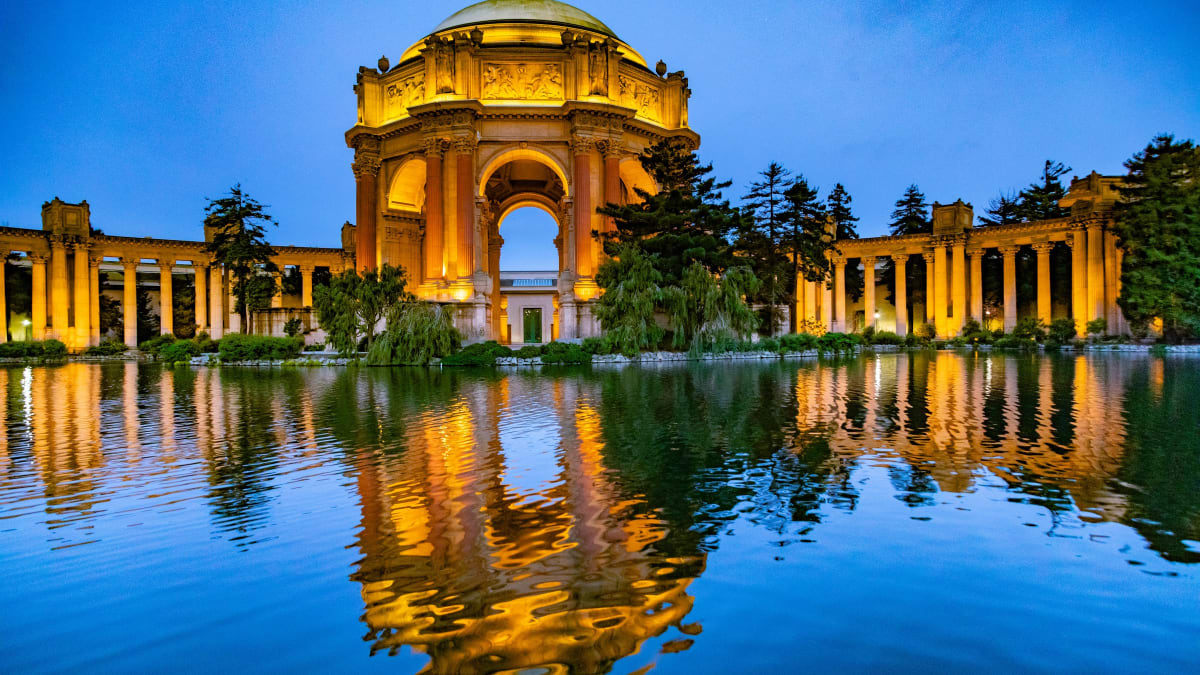
A romantic domed rotunda and colonnade reflected in a lagoon, the beloved survivor of a 1915 world's fair.
The Palace of Fine Arts is one of the most beautiful and beloved landmarks in San Francisco, a great domed rotunda and curving colonnade of golden classical architecture, reflected in a still lagoon and framed by trees in the Marina District. It was built for the Panama-Pacific International Exposition, the world's fair held in the city in 1915, and designed to evoke a romantic, melancholy grandeur, like a beautiful ruin of some ancient civilization, a mood that still lingers over the place today.
The Palace was never meant to last, built like the rest of the fair from temporary materials, but San Franciscans loved it too much to let it go. Decades later the city rebuilt it in permanent form so that it would endure, and today it stands as a free public park, its rotunda mirrored in the lagoon where swans and ducks glide. A short walk from the bay and within sight of the Golden Gate Bridge, it is a place of rare beauty and one of the city's favorite spots to wander, photograph, and dream.
What Travelers Love
- A magnificent domed rotunda and colonnade reflected in a peaceful lagoon
- Romantic classical architecture that feels like a beautiful ruin from another age
- A free, tranquil park for strolling, photography, and watching swans and ducks
- A short walk from the Marina, the bay, and views of the Golden Gate Bridge
Worth Knowing
- The grounds and lagoon are a free public park, open and lovely to stroll any time
- It is a favorite for photography and weddings, especially in the golden light of early morning and evening
- It pairs naturally with a walk along the Marina and the bayfront toward the Golden Gate Bridge
- An adjacent hall hosts events and exhibitions, so its schedule can vary
Learn about Palace of Fine Arts
A monument from a world's fair
The Palace of Fine Arts was created for the Panama-Pacific International Exposition of 1915, the great world's fair that San Francisco held to celebrate the opening of the Panama Canal and, just as importantly, the city's triumphant recovery from the earthquake and fire of a few years before. Amid the exposition's many grand but temporary palaces, the Palace of Fine Arts, designed by the architect Bernard Maybeck, stood out for its dreamlike, romantic beauty.
Maybeck designed the Palace to evoke the mood of a beautiful, half-forgotten ruin, a monument to art and to the passage of time, with its great rotunda, its colonnade, and its reflecting lagoon composed to stir a gentle melancholy in visitors. It was among the most admired sights of the fair, and when the exposition ended and its other palaces came down, the Palace of Fine Arts was the one the city could not bear to lose.
Saved by the people
Like the rest of the exposition, the Palace of Fine Arts was built to be temporary, its grand forms made of plaster and other impermanent materials that would not survive for long. As the years passed and the structure slowly decayed, it might easily have been demolished and forgotten. Instead, the people of San Francisco held it in such affection that they would not let it fall, and a determined effort arose to save it.
In time the Palace was completely rebuilt in permanent, durable materials, recreating Maybeck's romantic design to stand for generations to come, and the lagoon and grounds were preserved as a public park. That story of a beloved building saved by public devotion is part of what makes the Palace so cherished today, a monument not only to a world's fair but to a city's love for beauty.
The rotunda and the lagoon
At the heart of the Palace stands its rotunda, a great open dome carried on classical columns and richly ornamented, rising above the surrounding colonnade that sweeps in a long curve around the lagoon. Reflected in the still water, doubled and shimmering, the golden architecture is extraordinarily beautiful, especially in the warm light of early morning and evening, and the ensemble is one of the most photographed scenes in San Francisco.
The lagoon and its grounds make the Palace a living park as well as a monument. Swans, ducks, and other water birds glide across the water, willows and other trees shade the paths, and benches invite visitors to sit and take in the scene. It is a favorite place for a peaceful stroll, for photography, and for weddings and celebrations, drawn by beauty that feels both grand and gentle, romantic and serene.
By the bay and the bridge
The Palace of Fine Arts sits in the Marina District, just inland from San Francisco Bay, and its setting is part of its appeal. A short walk brings visitors to the bayfront and the green expanse of the Marina and Crissy Field, from where the Golden Gate Bridge sweeps across the mouth of the bay in full view, making the Palace an easy and lovely stop on a day exploring the city's northern waterfront.
Between the beauty of the Palace itself, the tranquility of its lagoon, and the sweep of the bay and bridge nearby, this corner of San Francisco offers some of the finest scenery in the city. The Palace of Fine Arts rewards both a quick photo stop and a long, unhurried wander, a place where a century of history, a city's affection, and the natural beauty of the bay come together in one unforgettable scene.
Closest Boutels
The closest Boutel™ stays, so you can turn this stop into an overnight. Each is a place we chose through independent editorial review, never a paid placement.
Details
San Francisco, CA
Frequently asked questions
What is the Palace of Fine Arts?
The Palace of Fine Arts is a grand and romantic monument in the Marina District of San Francisco, a great domed rotunda and sweeping colonnade of golden classical architecture set beside a tranquil lagoon. It was built for the Panama-Pacific International Exposition, the world's fair held in the city in 1915, and designed by the architect Bernard Maybeck to evoke the beauty of an ancient ruin. So beloved that the city later rebuilt it to last, it is now a free public park, its rotunda mirrored in the lagoon where swans and ducks glide, a short walk from the bay and the Golden Gate Bridge. Its beauty and history make it a delightful destination. A romantic and beloved landmark, it enchants visitors. With its rotunda and lagoon, the Palace of Fine Arts offers a compelling destination in California.
Why was the Palace of Fine Arts saved and rebuilt?
The Palace of Fine Arts was built for the 1915 world's fair from temporary materials that were never meant to last, and as the structure slowly decayed over the decades it might easily have been demolished. Instead, the people of San Francisco held it in such affection that they would not let it fall, and a determined effort arose to save it, leading to a complete rebuilding of the Palace in permanent, durable materials that recreated its romantic design to endure for generations. That story of a beloved building saved by public devotion is part of what makes it so cherished. Appreciating this history enriches a visit to the Palace of Fine Arts in California.
Is the Palace of Fine Arts free to visit?
Yes, the grounds, rotunda, and lagoon of the Palace of Fine Arts are a free public park, open and lovely to stroll at any time, and there is no charge to admire the architecture, walk the paths, or photograph the scene reflected in the water. It is a favorite spot for photography and weddings, especially in the golden light of early morning and evening, and it pairs naturally with a walk along the Marina toward the Golden Gate Bridge. An adjacent hall hosts events and exhibitions with their own schedules. Enjoying this free and beautiful park is the pleasure of a visit to the Palace of Fine Arts in California.
When is the best time to visit the Palace of Fine Arts?
The Palace of Fine Arts is beautiful year-round, but the golden light of early morning and of the hour before sunset is especially magical on the rotunda and its reflection in the lagoon, and those quieter times also avoid the busiest midday crowds. The park is lovely in any weather, whether under clear blue skies or the drifting fog for which San Francisco is famous. For the finest light and a peaceful visit, aim for early morning or evening at the Palace of Fine Arts in California.
What is near the Palace of Fine Arts?
The Palace of Fine Arts is in the Marina District of San Francisco, California, a short walk from the bayfront green of the Marina and Crissy Field with their sweeping views, within reach of the Golden Gate Bridge across the mouth of the bay, the vast forested parkland of the Presidio next door, and Fisherman's Wharf along the waterfront to the east. That makes the Palace of Fine Arts a compelling stop to combine with the Golden Gate Bridge and the bayfront sights of San Francisco on a visit to California.
Nearby

Alcatraz Island
2.2 miles away
The Rock, a rocky island in San Francisco Bay that held the most notorious federal prison in America from the 1930s to the 1960s, locking away dangerous inmates like Al Capone behind cold water famed...

Vista Point
2.7 miles away
Vista Point on the Marin side of the Golden Gate Bridge is the most reliable quick stop for a full-span view of the bridge and the bay.
Harvey Milk Plaza
2.9 miles away
A small public plaza at the gateway to San Francisco's Castro, at Castro and Market, named for Harvey Milk, one of the country's first openly gay elected officials.

Dolores Park
3.2 miles away
A sunny fourteen-acre hillside lawn at the western edge of San Francisco's Mission District, where the whole city seems to gather on a warm day beneath a palm-lined view of the downtown skyline.

Twin Peaks
3.4 miles away
San Francisco's great free overlook, a pair of grassy hills over 900 feet high near the city's center.

Bay Model Visitor Center
6.1 miles away
The Bay Model in Sausalito is a 1.5-acre working hydraulic model of the San Francisco Bay and Sacramento-San Joaquin Delta, built by the Army Corps of Engineers between 1957 and 1963 to test how engin...

Muir Woods National Monument
9.7 miles away
Muir Woods is a valley of old-growth coastal redwood (Sequoia sempervirens) just north of the Golden Gate, accessible via US-101 to the Stinson Beach/Muir Woods exit.

San Francisco Bay
11 miles away
San Francisco Bay is a drowned river valley that formed when rising sea levels after the last glaciation flooded the interior valleys of central California.