

Opal Creek Wilderness
NF-2209, Lyons, OR
Lyons, OR
Oregon's most storied stand of ancient forest, jade-green pools under thousand-year-old trees and the mining camp that was saved from the saw, now living through the long, honest aftermath of the 2020 wildfire.
Opal Creek is, or was, the crown of Oregon's ancient forests: the largest intact stand of old-growth in the western Cascades, a valley where Douglas firs and western red cedars five hundred to a thousand years old towered over a creek so clear its pools glow jade-green over the bedrock. Tucked within it sits Jawbone Flats, a preserved early-1900s mining camp turned forest study center, reached by a walk up an old mining road beneath the giants.
It is also a place you cannot visit right now, and this page tells that story honestly. In 2020 the Beachie Creek Fire swept through and burned much of the forest and most of the camp. Opal Creek has been closed ever since and, as of 2026, is not expected to reopen until 2027 at the soonest. What follows is the full arc: the ancient forest, the mining camp, the long fight to protect it, and the fire and slow recovery that are now part of its story.
What Travelers Love
- The ancient old-growth forest, home to Douglas firs and cedars centuries and even a thousand years old
- Opal Pool and the creek's astonishing clear, jade-green water over polished bedrock
- Jawbone Flats, the preserved historic mining camp tucked deep in the woods
- The larger story: this is the forest a community fought for decades to save from logging
Worth Knowing
- The 2020 Beachie Creek Fire burned much of the forest and most of Jawbone Flats, and the area has been closed to the public ever since
- As of 2026 it remains closed for repairs and hazard removal, with reopening not expected until 2027 at the earliest; do not enter a closed area
- The forest you may have seen in older photos is changed; expect a burned, recovering landscape when it reopens, not the untouched grove of before
- When access returns, check current conditions closely, as burned forests carry ongoing hazards from falling trees and unstable ground
Learn about Opal Creek Wilderness
The largest ancient forest in the western Cascades
Before the 2020 fire, Opal Creek held the largest intact stand of old-growth forest in the western Cascades and one of the last uncut watersheds of its size in Oregon. Trees five hundred to a thousand years old were not rare here, they were common, a cathedral of Douglas fir, western red cedar, western hemlock, and Pacific silver fir rising over a deep, mossy understory.
This is what old-growth means: a forest complex enough to have grown its own architecture, standing giants, massive fallen logs slowly returning to soil, and a canopy layered from the ground to hundreds of feet up, each level home to different life. Forests like this take centuries to build and cannot be quickly replaced, which is exactly what made Opal Creek so precious and so fiercely defended.
Running through it all is the creek itself, and the nearby Little North Santiam, water so clear it seems to vanish, pooling into deep green basins over smooth bedrock. Opal Pool, a jewel of jade-colored water in a rock gorge, became the emblem of the whole place.
Jawbone Flats and the mining days
Deep in the forest sits Jawbone Flats, a cluster of rustic cabins that began as a mining camp in the early twentieth century, when prospectors chased copper, gold, and silver claims through the Santiam country. The ore never made anyone rich, but the little settlement hung on far longer than most, and its weathered wooden buildings survived into modern times.
In its later life the camp took on a second purpose. The Shiny Rock Mining Company, established at Jawbone Flats in the 1970s, kept a foothold on the land, and in time the camp was given over to conservation, becoming home to the Opal Creek Ancient Forest Center, which ran it as a place to study and teach about the old-growth forest all around it.
For decades, reaching Jawbone Flats meant walking a few miles up an old mining road under the ancient trees, past the clear pools, an approach that was itself part of the experience. The camp gave Opal Creek a human heart: a lived-in, hand-built place set down in the middle of one of the wildest forests left in Oregon.
The fight to save it
In the 1980s and 1990s, Opal Creek became one of the fiercest battlegrounds of the Pacific Northwest's forest wars. The old-growth here was slated to be logged, and a determined campaign rose to stop it, led in no small part by George Atiyeh, a man who had grown up in these woods on his family's mining ground and knew the forest as home.
Atiyeh fought with everything he had. He flew politicians, reporters, and anyone he could persuade over the Cascades so they could see for themselves the clear-cuts closing in on the last great groves, and he used his family's old mining claims and the Shiny Rock Mining Company to hold the ground and block the saws, turning the very laws once written for extraction into a shield for the trees. Those flights and that stubbornness helped turn public opinion.
The long fight succeeded. In 1996, with the support of Oregon Senator Mark Hatfield, Congress protected Opal Creek as designated wilderness and a surrounding scenic recreation area, permanently sparing the ancient forest from logging. It was one of the signature conservation victories of its era, a forest saved because people refused to let it go.
Fire, loss, and a long recovery
Over Labor Day weekend in 2020, driven by extreme winds, the Beachie Creek Fire exploded out of the Opal Creek country into a catastrophic conflagration, forcing the evacuation of towns down the Santiam Canyon and killing people in the communities below. It burned much of Opal Creek's ancient forest and destroyed most of the historic buildings at Jawbone Flats.
The fire also took George Atiyeh himself. The man who had spent his life saving this forest died in the fire on his own land here, a loss that struck the conservation community hard and bound his story forever to the place he protected. It is a painful, true part of Opal Creek's history, not a legend but a matter of record.
Opal Creek has been closed to the public since that fire, and as of 2026 it remains closed while crews clear hazard trees, repair roads and campsites, and make the ground safe. Reopening is not expected before 2027. In the meantime, the forest is doing what forests do: wildlife has been documented moving back through the burn, and green is returning to the blackened slopes. When Opal Creek reopens, visitors should come understanding that they will meet a recovering landscape, scarred and changed, with its old giants standing dead among the new growth, a place still worth deep respect, and still finding its way back.
Season by season
In the years it was open, summer was the prime season, when the forest road was clear, the days were warm, and the cold green pools were at their most inviting after the long hike in.
Fall brought cooler air, quieter trails, and the turning of the bigleaf maples against the dark evergreens, a favorite time for those who wanted the forest more to themselves.
Spring and winter meant high, cold water and snow lingering on the higher ground, with the road sometimes rough or closed. For now, while the closure holds, the seasons simply mark the slow work of a burned forest healing, and the wait for the day it can welcome people back.
Closest Boutels
The closest Boutel™ stays, so you can turn this stop into an overnight. Each is a place we chose through independent editorial review, never a paid placement.
Details
Lyons, OR
Frequently asked questions
Is Opal Creek open to visitors?
For several years the area has been closed to the public following a major wildfire, and all the trailheads and forest roads leading in have remained closed while crews deal with hazard trees, damaged roads, and unsafe ground. Reopening timelines have repeatedly shifted and remain uncertain, so it is essential to check the current official status with the Willamette National Forest before planning a trip, and never to enter a posted closure.
What happened to Opal Creek?
In 2020 the Beachie Creek Fire swept through the canyon, burning much of its famous ancient forest and destroying most of the historic buildings at the old mining camp of Jawbone Flats. The recovery has been slow and complex, with damaged bridges and roads and vast numbers of standing dead hazard trees that must be dealt with before the public can safely return. It is a landscape in the long process of healing.
What was Opal Creek known for?
It protected one of the largest intact stands of ancient low-elevation old-growth forest in Oregon, a place of towering trees, emerald-green pools, and clear rushing water, reached through the rustic historic camp of Jawbone Flats. Its preservation was a hard-won conservation victory decades ago. Even as it recovers from fire, that legacy is why the name means so much to so many Oregonians.
Are there open alternatives while Opal Creek recovers?
Yes. While this area heals and stays closed, the surrounding Willamette National Forest and the wider Cascades offer many open old-growth trails, clear rivers, and swimming holes to explore instead. Because conditions and closures in fire-affected regions change, the best approach is to check current Forest Service alerts for whatever nearby destination you choose, and to respect all posted closures for your own safety.
When will Opal Creek reopen?
There is no firm date. Officials have pushed back reopening more than once as the scale of the recovery work has become clear, and any return of public access is expected to come in stages rather than all at once. Rather than rely on a rumored year, check the Willamette National Forest's official updates for the latest, and understand that when it does reopen, visitors will find a changed, recovering landscape.
Nearby

Silver Falls State Park, Trail of Ten Falls
24 miles away
Silver Creek carved this canyon through horizontal Columbia River flood basalts deposited roughly 15 million years ago.

Sahalie and Koosah Falls
27 miles away
Sahalie Falls drops 100 feet and Koosah Falls drops 70 feet on the upper McKenzie River within half a mile of each other, both fed by water that surfaces from Clear Lake above.
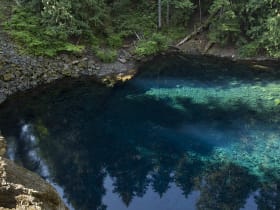
Tamolitch Falls (Blue Pool)
34 miles away
The McKenzie River disappears entirely into a porous lava field 1.5 miles upstream from Tamolitch and travels underground the whole way.