
Old Cahawba Archaeological Park
164 1st St N, Orrville, AL
Orrville, AL
Empty streets, standing chimneys, and old cemeteries remain where Alabama's first capital rose and vanished at the meeting of two rivers.
Old Cahawba was Alabama's first permanent state capital, a river town that rose quickly in the early 1800s and then, just as quickly, faded away. Today it is one of the South's most evocative ghost towns, a quiet archaeological park where empty streets, standing chimneys, old wells, and overgrown cemeteries mark where a whole city once stood at the meeting of the Alabama and Cahaba rivers.
Chosen as the capital in 1820, Cahawba grew into a thriving center of government and cotton commerce, only to lose the capital to Tuscaloosa a few years later after repeated flooding. It rallied as a river port before the Civil War, then declined for good afterward, and its people drifted away until the streets returned to field and forest. Walking those streets now, among ruins and markers, is a haunting way to touch Alabama's early history.
What Travelers Love
- Wandering the empty streets and ruins of a genuine ghost town
- The peaceful setting where the Alabama and Cahaba rivers meet
- Standing chimneys, old cemeteries, and interpretive markers that tell the story
- The haunting sense of a whole city that came and went
Worth Knowing
- This is an open archaeological site; treat ruins, graves, and artifacts with respect and leave everything in place
- The grounds are open and rural, so bring water, sun protection, and insect repellent
- Roads and paths are gravel and grass, best explored slowly by car and on foot
- It pairs naturally with Selma's civil rights history a short drive away
Learn about Old Cahawba Archaeological Park
Alabama's first capital
When Alabama became a state, its leaders chose a new site at the junction of the Alabama and Cahaba rivers for the capital, laying out the town of Cahawba in a grid and making it the seat of government in 1820. For a few years it was the young state's political heart, with a statehouse, offices, and the bustle of a new capital.
The location proved a problem. The low ground between the rivers was prone to flooding, and after repeated inundations the legislature moved the capital to Tuscaloosa in 1826. Cahawba might have withered then, but its position on the river gave it a second life.
Boom, war, and abandonment
Even after losing the capital, Cahawba grew into a prosperous river port and cotton-shipping town in the decades before the Civil War, one of the busier places in the Black Belt. That prosperity rested on the labor of enslaved people who worked the surrounding cotton plantations, a history the park works to tell honestly.
During the war, a warehouse in the town was used as a Confederate prison for captured Union soldiers. Afterward, with the plantation economy shattered and floods and hard times pressing, the town declined steadily. Residents moved away, buildings were dismantled or fell in, and by the late nineteenth century Cahawba had emptied out. For a time it was home to a community of formerly enslaved people who farmed the land before they, too, moved on.
A ghost town today
What remains is a landscape of absence and traces. The old street grid can still be followed, lined now with trees and open ground rather than buildings, and here and there stand ruins, standing chimneys, brick columns, foundations, and old wells, along with cemeteries where the town's residents were laid to rest.
Interpretive markers throughout the park explain what once stood on each spot, letting visitors reconstruct the vanished city in their imagination. The quiet, the ruins, and the rivers give the place a powerful, elegiac atmosphere, and archaeologists continue to study the site, so it remains a place of discovery as well as reflection.
The rivers and the Black Belt
The setting is a large part of Cahawba's appeal. The town sits where the clear Cahaba River joins the larger Alabama River, in the rich, dark soil of the Black Belt that made this cotton country in the first place. The rivers that both built and doomed the town still meet quietly at its edge.
The park lies a short drive from Selma, whose own history, especially the events of the civil rights movement at the Edmund Pettus Bridge, makes for a natural pairing. Together they offer a deep, sobering look at central Alabama's layered past, from its founding through its most consequential struggles.
Closest Boutels
The closest Boutel™ stays, so you can turn this stop into an overnight. Each is a place we chose through independent editorial review, never a paid placement.
Details
Orrville, AL
Frequently asked questions
What is Old Cahawba Archaeological Park?
Old Cahawba Archaeological Park, near Selma, Alabama, is a fascinating ghost town and archaeological site preserving the remains of Cahawba, Alabama's first state capital, now largely vanished. Once a thriving town and the seat of state government in the early nineteenth century, Cahawba later declined and was abandoned, and today its site is a quiet, atmospheric park of old streets, ruins, cemeteries, and interpretive markers amid the trees and fields where a town once stood. The site's layered history includes its era as capital, a Civil War prison, and the lives of the enslaved and later freed African Americans who lived here. A haunting, historic landscape, Old Cahawba offers a fascinating destination in Alabama.
What can you do at Old Cahawba Archaeological Park?
You can explore the atmospheric ghost-town site on foot or by car, following the old street grid past ruins, standing chimneys, cemeteries, and interpretive markers that tell the story of the vanished town, visit the welcome center, and imagine the once-thriving capital amid the quiet fields and trees. The evocative ruins, the historic cemeteries, the interpretive story, and the peaceful, haunting atmosphere are the draws, offering a unique blend of history and archaeology. It rewards curious and reflective visitors. With its ruins and history, Old Cahawba Archaeological Park offers an engaging experience near Selma, Alabama.
Why did Cahawba become a ghost town?
Cahawba became a ghost town after a series of setbacks following its brief time as Alabama's first state capital in the early nineteenth century. Prone to flooding at the meeting of two rivers, the town lost the capital to another city, and later economic decline, the disruptions of the Civil War era, and continued flooding led residents to leave until the town was largely abandoned. The site's history also includes a Civil War prison and the lives of enslaved and later freed African Americans. This rise and fall is the story the park preserves, making Old Cahawba a fascinating and reflective site in Alabama.
When is the best time to visit Old Cahawba Archaeological Park?
The cooler, milder months of fall through spring offer the most comfortable weather for exploring the outdoor site, whereas summer can be hot and humid, so mornings are best then, and insect repellent is helpful in the warm months near the rivers. The atmospheric ruins and cemeteries are evocative in any season. Checking current hours and the welcome center schedule before you go is wise. For the most comfortable weather to explore the ghost town, aim for fall through spring at Old Cahawba Archaeological Park near Selma, Alabama.
What is near Old Cahawba Archaeological Park?
Old Cahawba Archaeological Park is near Selma, Alabama, within reach of Selma's Civil Rights landmarks including the Edmund Pettus Bridge, the Selma to Montgomery National Historic Trail, the Black Belt countryside with the Safe House Black History Museum in Greensboro, and Montgomery to the east. That makes Old Cahawba Archaeological Park a fascinating stop to combine with the Selma landmarks, the Edmund Pettus Bridge, and the other historic sites of central Alabama on a visit to the state.
Nearby

Edmund Pettus Bridge Walk
7.6 miles away
To stand where history turned, walk out onto the Edmund Pettus Bridge in Selma.
Safe House Black History Museum
39 miles away
This is the kind of place you would never find on your own. In Greensboro stands a small shotgun house where Martin Luther King Jr.
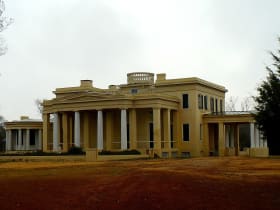
Gaineswood National Historic Landmark
45 miles away
Demopolis hides one of the strangest and finest antebellum houses in America, and few people outside Alabama have heard of it.